

Vietnam’s New Rules Target How Kids Use Social Media, Not Just Whether They Can
Vietnam is preparing to become the latest country to crack down on how children use social media — and its approach is unlike anything tried elsewhere.
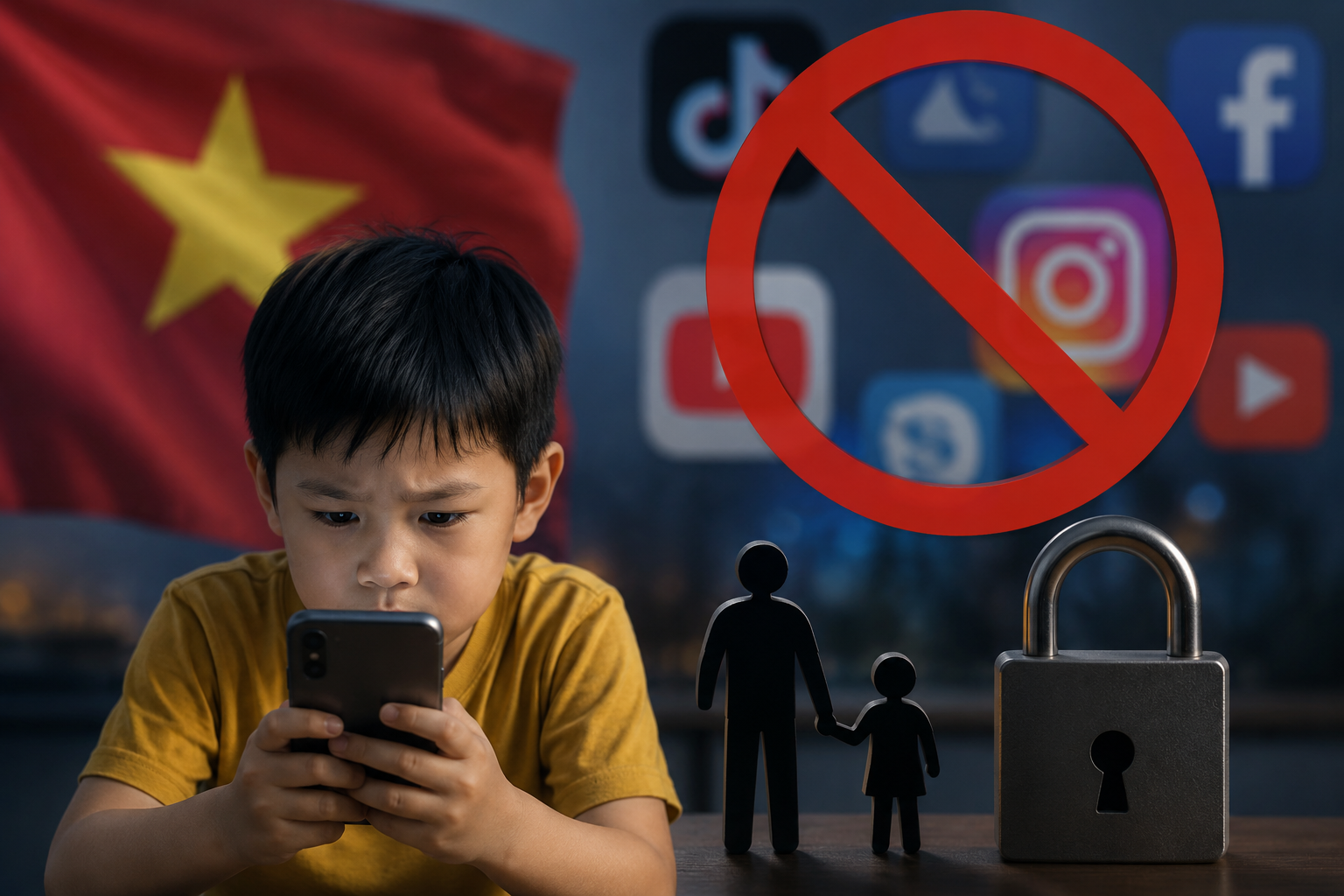
A draft decree from Vietnam’s Ministry of Culture, Sports and Tourism, currently open for public comment, would force social media platforms to ban users under 16 from posting content, commenting, or reacting to posts. The rules would also prohibit children from sharing other users’ posts and participating in live streams.
Rather than kicking kids off platforms entirely, Vietnam wants to turn them into spectators. Under the proposal, users under 16 could keep their accounts but would be barred from posting, commenting, or reacting to content — leaving them in a view-only status.
The mechanics build on rules already in place. Social media accounts belonging to children under 16 in Vietnam must already be registered using their parents’ information, and the new proposal would expand on that foundation. Children under 16 would need accounts registered by a parent or legal guardian responsible for monitoring the content they view and their screen time. Platforms would also be ordered to identify child users and default them into the strictest privacy and content settings available, blocking material related to violence, pornography, drugs, gambling, and suicide.
The restrictions extend beyond social apps. Vietnam’s draft decree would also require online game operators to verify users’ ages and limit under-16 players to no more than 60 minutes a day on any single game.
Vietnam’s Deputy Minister of Culture, Phan Tam, has framed the goal as calibration, not exclusion. According to Vietnamese officials, the government does not intend to deny children access to social media entirely, and the objective is to create a safer digital environment for minors. Industry has pushed back on the sharper edges of the plan — representatives from Meta and TikTok have urged the government not to impose a complete ban on children publishing content and interacting on platforms. The decree hasn’t been finalized and could still change before adoption.
Vietnam Isn’t a Pioneer. It’s Joining a Movement.
What makes Vietnam’s proposal notable isn’t that it’s unprecedented — it’s that it’s one of more than a dozen governments now moving in the same direction. Here’s where the rest of the world stands.
Australia: The Country That Started It All
Australia was first. Its Online Safety Amendment (Social Media Minimum Age) Act passed with bipartisan support in 2024 and began enforcement on December 10, 2025, making it illegal for anyone under 16 to hold a social media account — with no exceptions, even with parental consent.
The law has teeth. By mid-December 2025, age-restricted platforms had removed access to 4.7 million under-16 accounts across the country. But enforcement has proven messier than the headline numbers suggest. A University of Newcastle study published in the medical journal The BMJ found that more than 85 percent of surveyed Australian participants under 16 were still using social media three months after the ban took effect, with researchers surveying 408 adolescents aged 12 to 17 before and after the restrictions began. About two-thirds of those teens said they had encountered age-verification checks, usually a self-declared birth date or a selfie-based estimate — measures easy enough for a determined teenager to route around.
Rather than backing off, Canberra is doubling down. In June 2026, the government introduced legislation to raise the maximum penalty for social media companies that fail to prevent under-16 account holders to A$99 million (about $68 million), up sharply from the original cap. Prime Minister Anthony Albanese didn’t mince words, saying big tech companies are not doing enough to comply with the law. Australia’s eSafety Commissioner is now investigating potential breaches at Facebook, Instagram, Snapchat, TikTok, and YouTube, and the law is simultaneously facing a High Court challenge brought by Reddit.
France: First in the European Union
France became the first EU member state to pass a blanket social media age limit when lawmakers approved a ban for children under 15 on July 21, 2026. President Emmanuel Macron called the vote “a major step forward” and pledged to enforce the law by September.
The French law will be enforced by Arcom, the country’s audiovisual and digital regulator, and is expected to apply to all the major platforms, which see French children aged 12 to 17 spending an average of 1 hour and 21 minutes a day on TikTok alone. The legislation pairs the social media restriction with a ban on cellphones in secondary schools; phones have already been banned in French primary and middle schools since 2018.
France’s public health watchdog helped build the case for the law, concluding that platforms including TikTok, Snapchat, and Instagram were detrimental to adolescents, particularly girls, even though social media wasn’t the sole driver of declining teen mental health. Not everyone in France is convinced the law will work as intended. Some lawmakers have raised doubts about enforceability, and a legal adviser for the child-protection group e-Enfance cautioned that the law won’t immediately translate into an outright ban in practice.
Malaysia and Indonesia: Southeast Asia Moves Fast
Vietnam’s neighbors got there first. Malaysia began enforcing its own under-16 social media ban in June 2026 under the country’s Online Safety Act 2025. The rules require platforms with at least 8 million Malaysian users — including Facebook, Instagram, TikTok, and YouTube — to implement age-verification systems and block new accounts for children under 16, with non-compliant companies facing fines of up to 10 million ringgit (about $2.5 million). Parents whose children slip past the restrictions face no penalty.
Indonesia opted for a more layered approach. Rather than a single age cutoff, the country’s communications ministry created a tiered system where children 13 and older can use platforms deemed “lower-risk,” while “higher-risk” platforms — including YouTube, TikTok, Facebook, Instagram, Threads, X, Bigo Live, and Roblox — are restricted to users 16 and older. Enforcement began in March 2026, with the government gradually deactivating existing under-16 accounts on major platforms until companies come into full compliance. Indonesia’s communications minister described the country’s digital environment for children as facing a genuine emergency, citing rising exposure to pornography, cyberbullying, online scams, and addiction among young users.
Spain: Executive Liability Enters the Picture
Spain has taken one of the most aggressive regulatory stances yet. Prime Minister Pedro Sánchez announced in February 2026 that Spain would ban social media for under-16s and require platforms to deploy strict age-verification tools, framing the decision in stark terms: children are being exposed to “a space of addiction, abuse, pornography, manipulation and violence.”
Spain’s approach goes further than most by attaching personal consequences to corporate non-compliance. The country’s 2026 regulatory package includes provisions that would introduce criminal liability for technology company executives whose platforms fail to remove illegal content after being notified. The move drew immediate pushback from the tech industry — Telegram CEO Pavel Durov criticized the plan, arguing it would expand state control over online information and create risks to user privacy and support large-scale surveillance.
United Kingdom: A Different Legal Model
Britain’s approach centers on age verification rather than an outright ban. The UK’s Social Media (Minimum Age) Act received royal assent in June 2026, banning under-16s from major platforms and mandating age verification for all users, with fines reaching 10 percent of a company’s global annual revenue for non-compliance. Because the law requires every user — not just minors — to prove their age to access platforms like Instagram, TikTok, and YouTube, it has drawn criticism from digital rights groups concerned about the broader privacy implications of nationwide identity verification.
The Rest of the World Is Watching Closely
The list of countries actively restricting or seriously weighing restrictions keeps growing:
- Kazakhstan is considering a proposed amendment that would ban under-16s from creating social media accounts, except for messenger apps, though it hasn’t yet become law.
- Brazil enacted its Digital Statute of the Child and Adolescent in September 2025, which requires social media companies to set up parental controls and age-verification techniques and blocks platforms from using minors’ data for targeted advertising, though it stops short of setting a hard age limit. The law took effect in March 2026.
- Denmark has proposed a ban for children under 15.
- Germany’s ruling coalition, including the CDU and SPD, is weighing a ban on minors’ social media use, though a decision has been postponed until mid-2026.
- Slovenia is drafting legislation that would bar children under 15 from social media.
- Poland is developing a technical tool it aims to launch by the end of 2026 to keep children off social media platforms.
- The Netherlands’ government has floated a ban for under-15s.
- New Zealand introduced a bill in 2025 that would restrict social media for users under 16 through stringent age verification.
Even Turkey and Azerbaijan have imposed restrictions in some form, according to regional reporting, and Thailand and South Korea are reportedly studying similar approaches.
Why Now? The Case Governments Are Making
The common thread across nearly every one of these laws is concern about adolescent mental health and exposure to harmful content — addiction to algorithmic feeds, cyberbullying, sexual content, and in some cases links to violence.
France’s push accelerated after a fatal school stabbing, with Macron citing social media as a contributing factor to youth violence. Indonesia’s minister described the situation facing the country’s children as a “digital emergency.” Spain’s prime minister used the language of exposure and abuse. Malaysia cited cyberbullying, financial scams, and child sexual abuse material as key drivers.
The regulatory wave is also self-reinforcing. Several governments — including Malaysia, Spain, and the UK — have explicitly cited Australia’s law as their reference model, and Australia’s implementation is, in turn, being closely watched by dozens of countries that have either created or committed to creating their own versions.
Does It Actually Work?
Australia is the only country with enough runtime to offer real evidence — and the early data is complicated.
On one hand, millions of accounts were removed from major platforms within weeks of enforcement. On the other, the BMJ-published Newcastle study suggests the vast majority of under-16 users found ways to stay active on the platforms anyway, often using age-verification methods — like self-reported birthdates or selfie estimates — that are trivial to falsify. Australia’s own eSafety Commissioner, Julie Inman Grant, has reframed the law’s goal in more modest terms, describing it not as an outright ban but as a delay mechanism rather than a hard barrier.
That tension — between the political appeal of a clean, enforceable age line and the practical difficulty of verifying anyone’s age online without invasive identity checks — is shaping up to be the central challenge for every country now following Australia’s lead, Vietnam included.
What Comes Next
Vietnam’s draft decree is still in public consultation and hasn’t been finalized. Given the pattern in other countries — France’s law faced a Constitutional Council review, Spain’s proposal moved through parliamentary revisions, and the UK’s bill evolved substantially before royal assent — Vietnam’s final rules could look different from the current draft.
What’s unlikely to change is the broader trajectory. With more than a dozen countries now enforcing, drafting, or actively considering restrictions on how children use social media, Vietnam’s move fits a pattern that shows no signs of slowing down. The unresolved question — for Vietnam and for every government pursuing similar rules — is whether any of these laws can be enforced reliably without either a workable, privacy-respecting way to verify a user’s age or a level of platform cooperation that, so far, hasn’t been the norm.








Leave a Reply