

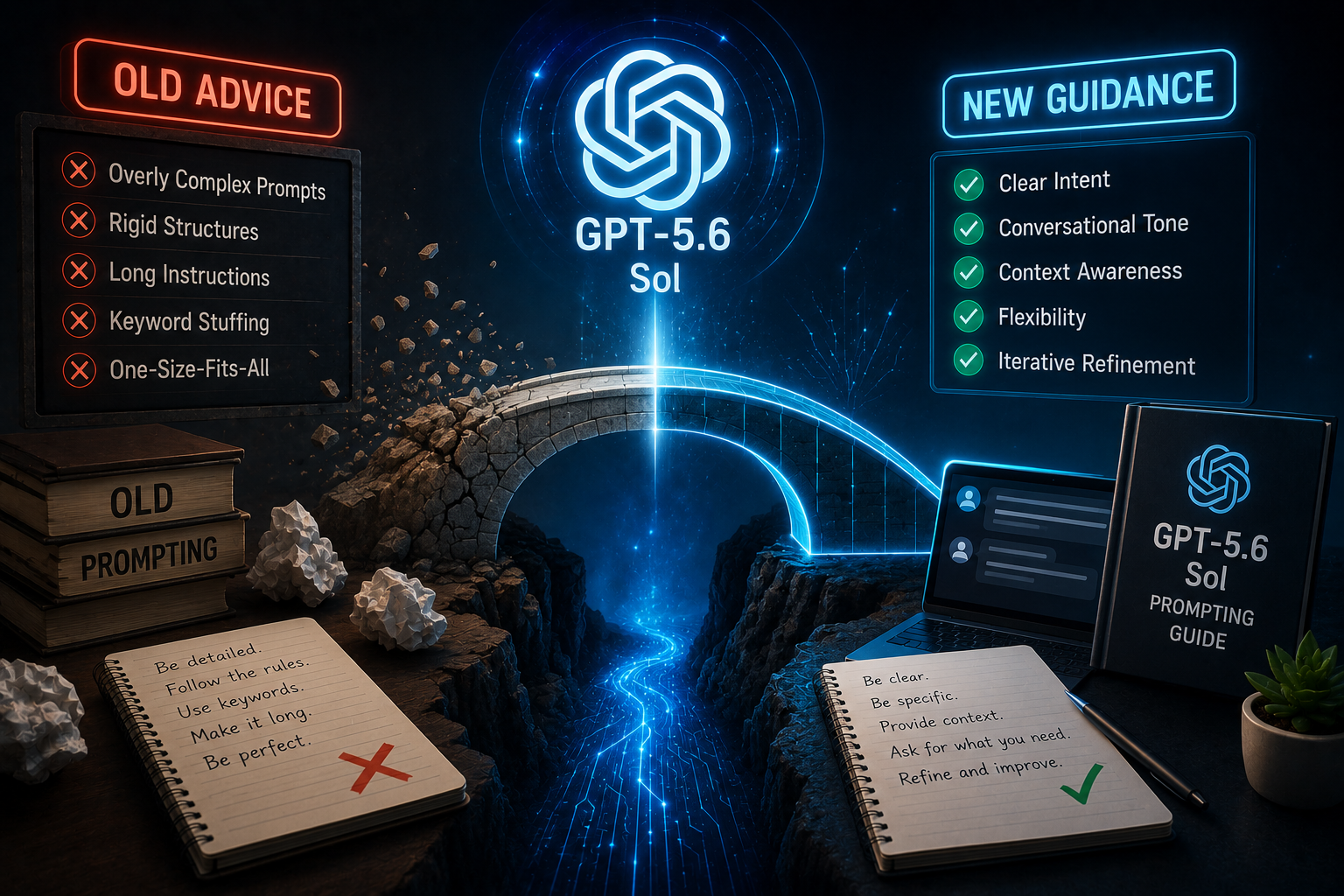
For the past year, the dominant advice for getting good results out of large language models was to write more: longer system prompts, structured XML blocks, explicit persistence instructions, and detailed scripts telling the model exactly how to behave at every step. OpenAI’s new prompting guide for GPT-5.6 Sol reverses that logic almost entirely. The advice now is to write less, define the outcome clearly, and let the model handle the path on its own.
This shift isn’t a stylistic preference — it’s backed by measurable performance differences, and it changes how anyone building prompts, agents, or AI-powered workflows should approach the task.
What Changed Between GPT-5 and GPT-5.6
The original GPT-5 prompting guide, released alongside the model, was built around the idea of scaffolding. It encouraged detailed context-gathering templates, instructions for parallelizing searches, explicit rules for when a model should escalate or stand down, and persistence blocks that told the model to keep working until a task was fully solved. The underlying philosophy was calibrating eagerness — giving the model explicit rails so it knew exactly how hard to push in any given situation.
GPT-5.6 Sol largely doesn’t need those rails. According to OpenAI’s updated guidance, much of that older scaffolding has become something the model now has to work around rather than benefit from. The new guide recommends trimming repeated rules, style instructions that don’t actually change output, examples that add nothing new, and process steps the model already handles reliably on its own.
The Core Idea: Outcome-First Prompting
The new approach centers on a simple shift in framing. Instead of describing how to complete a task step by step, a prompt should describe what the finished result looks like, what counts as done, and what to do when required information is missing.
A strong prompt under this model typically includes:
- The user-visible outcome — what the end result should actually look like from the user’s perspective.
- Success criteria — a clear definition of “done” rather than vague instructions like “be thorough.”
- Stopping conditions — explicit signals for when the model should conclude the task instead of continuing indefinitely.
- Hard constraints — non-negotiable rules the model must never violate, kept separate from softer guidance.
This is a meaningful departure from instructions like “keep going” or “be thorough,” which leave the model to guess at what sufficient effort actually looks like. Defining the destination clearly removes that ambiguity without needing to specify every step along the way.
Why Leaner Prompts Perform Better
OpenAI’s internal testing on coding agents found that leaner system prompts improved evaluation scores by roughly 10 to 15 percent, while cutting total token usage by 41 to 66 percent and reducing associated costs by 33 to 67 percent. In other words, less instruction produced better results at a fraction of the cost — a combination that runs counter to a year of prompting conventions built around adding more detail, not less.
The explanation comes down to how the model handles conflicting or redundant instructions. Older, less capable models often handled prompt conflicts by simply picking one instruction and ignoring the other. GPT-5.6 Sol takes conflicting rules more seriously, and reconciling them consumes reasoning effort that would otherwise go toward solving the actual task. A prompt with overlapping or contradictory rules doesn’t just risk unclear output — it actively slows the model down and increases the chance of an incorrect result.
This is why OpenAI’s new guidance treats prompt conflicts as a priority fix. Most production prompts, built up gradually over time, accumulate some degree of overlapping instruction, and that accumulated redundancy is now a bigger liability than it used to be.
Avoid Absolutes Like “Always” and “Never”
Another notable shift in the guidance is a move away from absolute framing. Instructions like “always do this” or “never do that” were a common way to steer model behavior firmly in one direction, but OpenAI now advises against relying on them. Absolute rules tend to over-constrain the model rather than guide it well, particularly in edge cases the prompt author didn’t anticipate. Framing expectations around outcomes and constraints, rather than blanket commands, tends to produce more reliable behavior across a wider range of situations.
Two New Additions Worth Knowing
The text.verbosity parameter. Because GPT-5.6 Sol is already more concise by default than its predecessor, older prompts that included “be brief” instructions can now over-correct, producing responses that are too short to be useful. The recommended approach is to set a global verbosity default through the parameter itself, then override it at the prompt level for specific tasks that need more or less detail.
Programmatic Tool Calling. This is a new section in the guide covering bounded workflows where code — not the model’s judgment — handles filtering, batching, or aggregating large intermediate outputs before returning a compact result. Offloading this kind of mechanical work to code rather than asking the model to reason through it directly reduces both cost and the chance of error in tasks that don’t actually require language understanding to complete correctly.
How This Plays Out in Practice
Applying outcome-first prompting to a real coding task produced a noticeably different process. Rather than jumping straight into writing code, the model spent more time mapping the full problem and planning each system before implementation began. The result was more coherent output — cleaner logic, more consistent visuals, and fewer inconsistencies — even though the process took longer up front.
That trade-off is the guide working as intended: a clearly defined destination lets the model choose an efficient route, even if that route involves more upfront planning than a heavily scripted, step-by-step prompt would have allowed.
A Practical Template for Outcome-First Prompts
A prompt built around this approach typically follows a simple structure:
Resolve the [task/issue] end to end.

Done means:
- [specific, observable outcome]
- [specific, observable outcome]

Before responding, you must:
- [required action]
- [required action]

If required evidence or information is missing:
- [exact fallback behavior]

Hard constraints:
- [non-negotiable rule]
- [non-negotiable rule]
This structure keeps the essentials — outcome, verification steps, fallback behavior, and constraints — without the narrative scaffolding that older prompting styles relied on.
Best Practices for Adapting Existing Prompts
- Audit for conflicting rules first. This is the highest-impact fix, since contradictions cost more with GPT-5.6 Sol than with earlier models.
- Remove instructions that don’t change behavior. If a rule has never visibly affected output, it’s likely just adding noise for the model to parse.
- Replace “be thorough” with a concrete definition of done. Vague effort instructions are less reliable than explicit success criteria.
- Use the verbosity parameter instead of prompt-level brevity instructions. This avoids the over-correction that comes from stacking both.
- Move mechanical data processing into code where possible, especially for tasks involving large outputs that need filtering or aggregation.
Common Mistakes to Avoid
- Carrying over GPT-5-era scaffolding unchanged. Persistence blocks and detailed context-gathering templates that once helped can now work against the model.
- Stacking “be brief” instructions on top of the verbosity parameter, which tends to produce responses that are too short.
- Using absolute language like “always” or “never” instead of framing expectations around outcomes and constraints.
- Leaving unresolved conflicts in long-standing prompts, which accumulate silently as prompts are edited over time.
- Assuming more detail is always safer. Under this model, unnecessary detail is a measurable cost, not a neutral addition.
Key Takeaways
- GPT-5.6 Sol performs better with prompts that define outcomes and constraints rather than detailed step-by-step instructions.
- Leaner system prompts improved evaluation scores while significantly reducing token usage and cost in internal testing.
- Conflicting or redundant rules are now a bigger liability than missing detail, since the model spends effort trying to reconcile them.
- The
text.verbosityparameter should handle response length, not prompt-level “be brief” instructions. - Programmatic Tool Calling offloads bounded, mechanical data processing to code, freeing the model to focus on judgment-based work.
Frequently Asked Questions
What is outcome-first prompting? It’s an approach to prompt design that focuses on clearly defining the desired result, success criteria, and stopping conditions, rather than scripting every step the model should take to get there.
Why do leaner prompts perform better on GPT-5.6 Sol? Because the model engages more seriously with every instruction it’s given, including conflicting or redundant ones. Reconciling unnecessary complexity consumes reasoning effort that would otherwise go toward the actual task, so trimming a prompt down tends to improve both speed and accuracy.
Should I stop using “be brief” in my prompts? It’s worth reconsidering. Since GPT-5.6 Sol is more concise by default, prompt-level brevity instructions can stack with that default behavior and produce overly short responses. Using the text.verbosity parameter is the more reliable way to control response length.
What is Programmatic Tool Calling used for? It’s designed for bounded workflows where filtering, batching, or aggregating large outputs is better handled by code than by the model’s judgment, reducing both cost and the risk of error in tasks that don’t require language reasoning to complete correctly.
Do I need to rewrite my existing prompts from scratch? Not necessarily. Start by auditing for conflicting or redundant instructions, since that tends to have the biggest impact, then trim instructions that don’t measurably affect output before making larger structural changes.
Conclusion
GPT-5.6 Sol’s prompting guide represents a real shift in how prompts should be written, not just a minor style update. The move away from heavy scaffolding toward outcome-first design reflects a model that handles ambiguity and conflict differently than its predecessors — and the performance numbers back up the change. For anyone building prompts or AI-powered workflows, the practical takeaway is straightforward: define the destination clearly, remove what doesn’t change behavior, and let the model handle the route.






Leave a Reply