


Disclaimer: This article is for informational purposes only and is not financial advice. Credit card rates, fees, and welcome offers change frequently and vary by creditworthiness — always verify current terms directly with the issuer and consult a licensed financial advisor before applying for credit.
Introduction
Credit card rewards have gotten noticeably more competitive heading into the second half of 2026. Issuers have been refreshing flagship travel cards with bigger welcome bonuses, pushing cashback rates higher on everyday spending categories, and — according to several industry trackers — leaning further into personalized, dynamic rewards rather than flat, one-size-fits-all cashback. That’s good news for consumers, but it also makes comparing cards more complicated than it used to be.
Rather than trying to crown one single “best” card, this guide breaks the field down by what actually matters for different types of spenders: flat-rate cashback for simplicity, category-based rewards for people willing to plan a little, and premium travel cards for those who fly or stay in hotels often enough to justify an annual fee. Here’s the real data behind each category.
How to Think About Rewards Categories
Credit card rewards generally fall into three structures, and understanding the difference matters more than any single card’s marketing:
- Flat-rate cashback — a consistent percentage (typically 1.5%–2%) on every purchase, with no categories to track.
- Bonus-category rewards — higher rates (often 3%–5%) on specific spending categories like dining, groceries, or gas, with a lower baseline rate elsewhere.
- Travel points and miles — rewards redeemable for flights, hotels, and travel-related expenses, often worth more per point when redeemed through the issuer’s own travel portal or transferred to airline and hotel partners.
None of these structures is universally “better” — the right one depends entirely on how consistently you spend in bonus categories and whether you’re disciplined enough to track rotating quarters or maximize point transfers.
Best No-Annual-Fee Cashback Cards
For straightforward, no-fuss rewards, flat-rate cashback cards remain the simplest option, and 2026’s top picks in this category are notably competitive:
- Wells Fargo Active Cash® Card — Unlimited 2% cash back on all purchases, no annual fee, plus a $200 cash rewards bonus after spending $1,000 in the first three months.
- Citi® Double Cash Card — Effectively 2% total cash back, split as 1% when you buy and 1% as you pay off the purchase, with no annual fee.
- Chase Freedom Unlimited® — 1.5% cash back on all purchases, boosted to 3% on dining and drugstores and 5% on travel booked through Chase Travel, with no annual fee.
The appeal of this category is consistency: no rotating categories to activate, no spending caps to hit, and no annual fee eating into what you earn.
Best Category-Bonus Rewards Cards
For spenders willing to track categories in exchange for a higher return, bonus-category cards can meaningfully outearn flat-rate options in the right circumstances:
- Chase Freedom Flex℠ — 5% cash back on up to $1,500 in rotating quarterly categories (activation required), plus 3% on dining and drugstores, with no annual fee.
- Discover it® Cash Back — 5% cash back on rotating quarterly categories (up to a quarterly cap), paired with a first-year cashback match that effectively doubles whatever you earn in your first 12 months.
- Capital One SavorOne — 3% cash back on dining, entertainment, streaming services, and grocery stores, with no annual fee.
The trade-off here is real: these cards require more attention than a flat-rate card, and rewards outside the bonus categories typically drop to a modest 1%.
Best Travel Rewards Cards
Travel cards trade an annual fee for stronger earning rates and points that can be worth significantly more than 1 cent each when redeemed strategically:
- Chase Sapphire Preferred® Card — $95 annual fee; earns 5x points on travel booked through Chase Travel, 3x on dining, and 2x on other travel. The card’s most recent refresh brought its highest-ever welcome bonus — 100,000 bonus points after spending $5,000 in the first three months — with an estimated redemption value that can exceed $1,000 when points are used for Chase’s Points Boost-eligible bookings or transferred to airline and hotel partners.
- Capital One Venture Rewards Credit Card — A simpler, flat 2x-miles-on-everything structure for travelers who don’t want to track bonus categories at all.
Best Premium Travel Card {#best-premium-travel-card}
At the higher end, premium travel cards carry significantly larger annual fees but pack in enough statement credits and perks that, for frequent travelers, the math can still work out in the cardholder’s favor:
- Chase Sapphire Reserve® — $395 annual fee; earns 5x on travel booked through Chase Travel, 3x on dining, and includes primary rental car insurance and multiple travel-related statement credits.
- Capital One Venture X Rewards Credit Card — $395 annual fee, largely offset by a $300 annual Capital One Travel credit and a 10,000-mile anniversary bonus (worth roughly $185 by some independent point valuations). Cardholders also get access to Capital One Lounges and Priority Pass lounges.
- American Express Platinum Card® — A premium option built around lounge access (over 1,550 airport lounges globally) and elevated travel earning rates, including 5x points on flights and prepaid hotels booked directly or through American Express Travel.
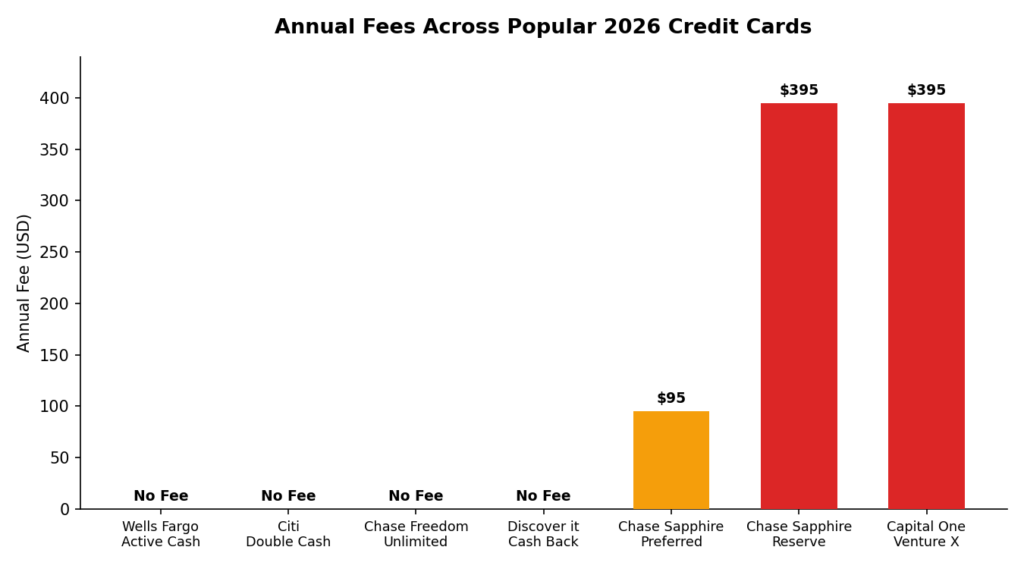
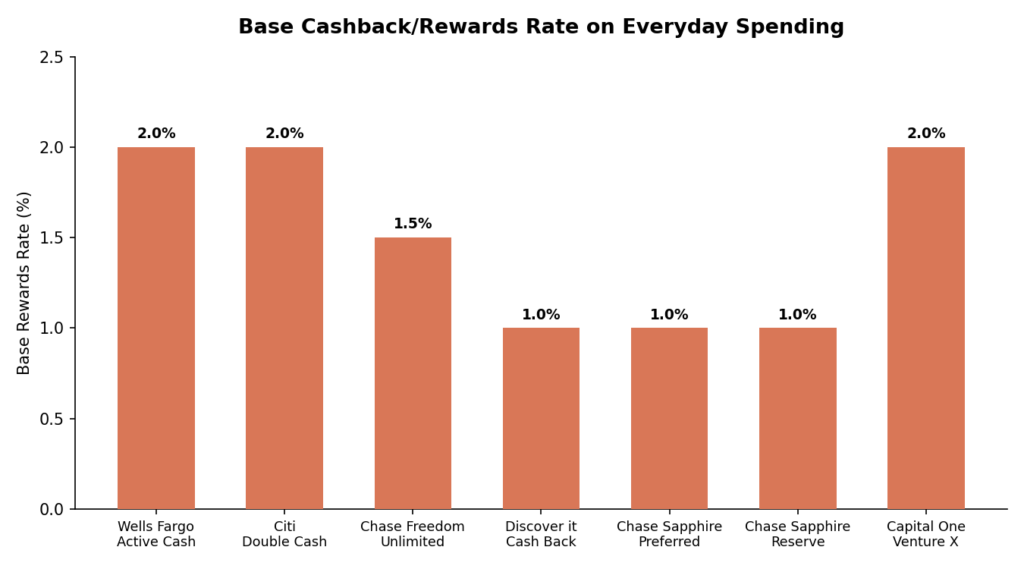
Annual Fees and Rewards Rates, Side by Side
Here’s how the base earning rate and annual fee compare across a representative set of cards from each category:
| Card | Annual Fee | Base Rewards Rate | Standout Category |
|---|---|---|---|
| Wells Fargo Active Cash | $0 | 2% flat cashback | None needed — flat rate |
| Citi Double Cash | $0 | 2% total (1% + 1%) | None needed — flat rate |
| Chase Freedom Unlimited | $0 | 1.5% flat | 5% travel via Chase Travel |
| Discover it Cash Back | $0 | 1% (5% rotating) | Rotating categories + 1st-year match |
| Chase Sapphire Preferred | $95 | 1x points | 5x travel via Chase Travel |
| Chase Sapphire Reserve | $395 | 1x points | 5x travel via Chase Travel |
| Capital One Venture X | $395 | 2x miles flat | 10x hotels via Capital One Travel |
| Amex Platinum | Higher premium tier* | 1x points | 5x flights/hotels via Amex Travel |
Amex Platinum’s exact annual fee should be confirmed directly with American Express, as premium travel card fees have been adjusted industry-wide in 2026.
Mistakes That Quietly Cancel Out Your Rewards
A card’s advertised rewards rate only tells part of the story. A few common habits erase most or all of the value these cards are designed to offer:
- Carrying a balance. With average credit card APRs running roughly 17%–21% for excellent credit and 28%+ for lower credit tiers in 2026, even one month of carried interest can wipe out an entire year’s worth of rewards on a typical balance.
- Overspending to chase a bonus category. Spending more than you normally would just to hit a 5% category rarely nets a real financial gain once you account for the extra spending itself.
- Letting statement credits and quarterly categories go unused. Many premium cards now bundle travel credits, dining credits, or streaming credits into their value proposition — credits that offset the annual fee only if you actually remember to use them.
- Ignoring the annual renewal math. A premium card’s perks can be worth well over the fee one year and barely break even the next, depending on how your travel habits shift — it’s worth re-evaluating annually rather than assuming the math stays the same.
How to Actually Choose
Rather than chasing the single “best” card on any list, it’s more useful to match the card structure to your actual spending pattern:
- If you want zero complexity: a flat 2% cashback card like Wells Fargo Active Cash or Citi Double Cash covers nearly all purchases with no categories to manage.
- If you’re willing to plan a little for a higher return: rotating or fixed bonus-category cards like Chase Freedom Flex or Capital One SavorOne can outearn flat-rate cards, provided your spending genuinely falls into those categories most months.
- If you travel occasionally and want flexible points: a mid-tier travel card like Chase Sapphire Preferred offers a strong balance of a manageable annual fee and points that can be worth significantly more than face value when transferred to travel partners.
- If you travel frequently enough to use lounge access and travel credits regularly: premium cards like Sapphire Reserve, Venture X, or Amex Platinum can pay for their fees several times over — but only for people who will actually use the specific perks bundled in.
For most people, industry analysts increasingly suggest pairing one strong no-annual-fee flat-rate card with one category-specific or travel card, rather than relying on a single card to cover every type of spending.
Conclusion
There’s no single “best” credit card in 2026 — there’s a best card for how you specifically spend and travel. Flat-rate cashback cards remain the simplest way to earn a solid, dependable return with zero management. Category-bonus cards can outearn them for disciplined spenders. And travel cards, particularly at the premium tier, offer real value for frequent travelers willing to actively use the credits and perks bundled into the annual fee. The math only works in your favor if you pick based on your actual habits — not the size of the welcome bonus alone.





Leave a Reply