

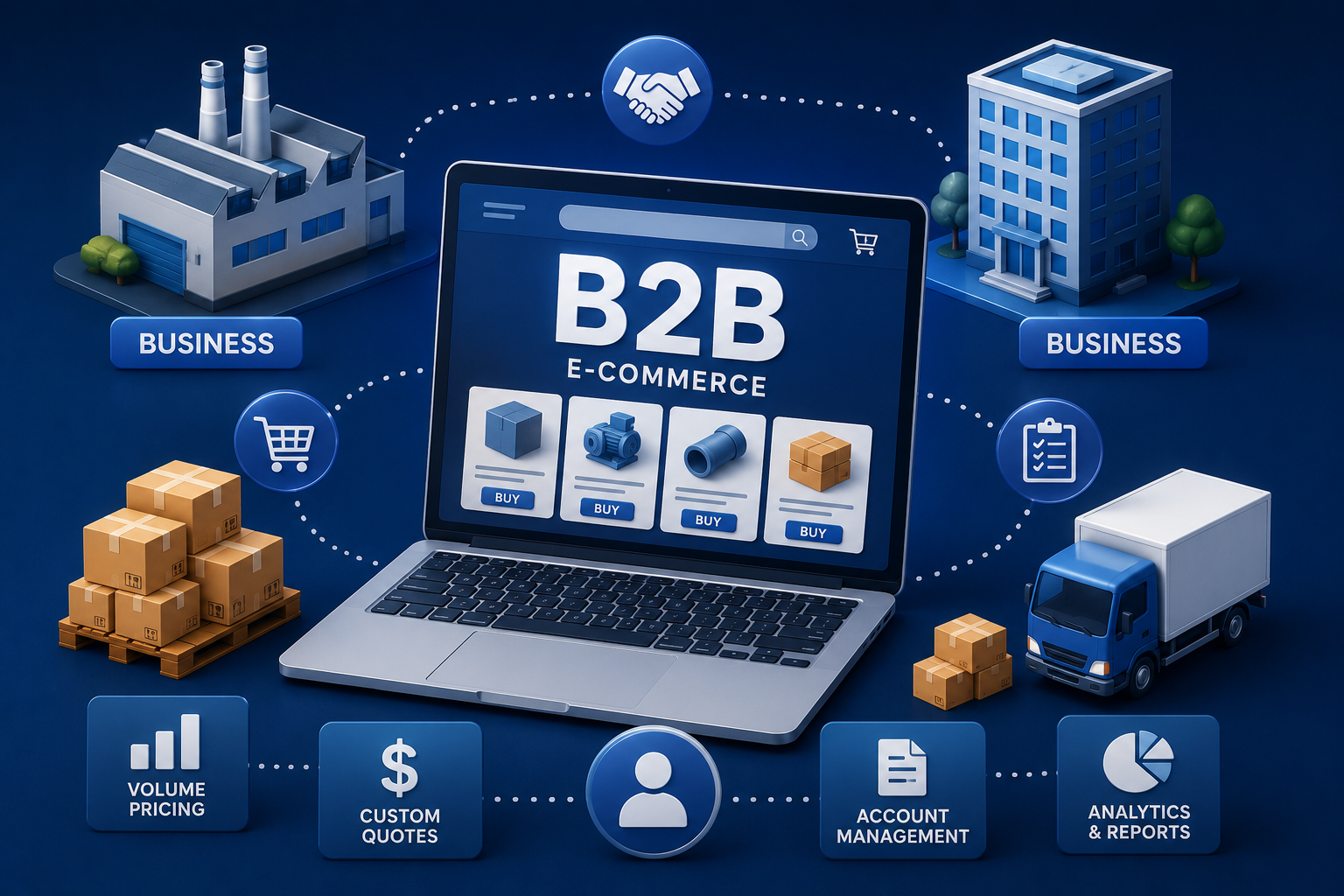
Selling to another business has never looked the same as selling to an individual shopper, but for decades, the tools used to do both looked remarkably similar: a phone call, a catalog, a handshake. That’s changed. Business buyers now expect the same speed and convenience they get as consumers, and the companies that sell to them have had to rebuild how transactions happen from the ground up. That shift has a name: B2B ecommerce.
This guide covers what B2B ecommerce actually is, how it differs from consumer ecommerce, the platforms and strategies that support it, and how to evaluate whether your business is ready to build or improve a digital B2B sales channel.
B2B ecommerce is the process of selling products or services between two businesses through a digital channel, rather than through in-person sales visits, phone orders, or paper catalogs. Instead of a sales representative manually taking an order, a business buyer can research products, request custom pricing, place an order, and reorder later — all through a self-service digital storefront built specifically for business purchasing.
A simple example makes the concept concrete: an auto parts manufacturer produces individual components — engines, fuel pumps, seat belts — and sells them not to individual drivers, but to auto manufacturers who assemble them into finished vehicles. Digitizing that relationship, rather than routing every order through a sales rep, is what B2B ecommerce does.
The goal isn’t just moving a paper process online. A well-built B2B ecommerce strategy creates a seamless, multichannel relationship between buyer and seller, giving sales and service teams a complete view of each account so every interaction feels personalized rather than transactional.
B2B vs. B2C Ecommerce: What’s Actually Different
B2B and B2C ecommerce share the same basic mechanics — a digital storefront, a checkout process, an order management system — but the underlying dynamics are fundamentally different. B2C purchases are typically driven by individual preference and emotion; B2B purchases are driven by organizational logic, efficiency, and often, multiple stakeholders who all need to sign off before a purchase happens.
| Feature | B2B Ecommerce | B2C Ecommerce |
|---|---|---|
| Target audience | Businesses — manufacturers, retailers, distributors | Individual consumers |
| Motivation | Logic, efficiency, organizational need | Emotion, personal desire, convenience |
| Sales cycle | Longer, multi-stakeholder approval | Shorter, typically one decision-maker |
| Order value | High, often bulk or recurring | Comparatively smaller cart sizes |
| Pricing | Negotiated, tiered, account-specific | Fixed, transparent, publicly promoted |
| Relationship | Long-term partnership, repeat business is central | Balance of acquisition and loyalty |
| Customer support | Detailed, technical, ongoing account management | Fast, self-service, FAQ-driven |
| Payment | Purchase orders, credit terms, invoicing | Credit cards, digital wallets, instant payment |
The pricing and order-quantity differences alone explain why B2B ecommerce requires more sophisticated infrastructure than a typical online store. A single account might have negotiated pricing, custom catalogs, multiple authorized buyers, and specific payment terms — none of which a standard consumer shopping cart is built to handle.
The Benefits of Moving B2B Sales Online
Digitizing B2B sales isn’t just about convenience — it changes the underlying economics of how a business serves its customers.
- Stronger customer relationships. Digital channels let you engage buyers at every stage of their journey, building a far more complete picture of what each account actually needs.
- Expanded market reach. A digital storefront removes geographic constraints, letting you serve new regions without the cost of building out a traditional sales team or physical presence in each one.
- Streamlined ordering. Automated, self-service ordering cuts down on manual paperwork and phone-based order-taking, giving buyers 24/7 access with real-time inventory visibility.
- Scalability without proportional cost. A digital platform can absorb significantly more transaction volume and new customers without requiring a matching increase in staff or physical infrastructure.
Together, these advantages explain why B2B ecommerce isn’t simply a nice-to-have digital channel — for many businesses, it’s become the most efficient way to grow without linearly scaling headcount alongside revenue.
Common Misconceptions That Hold Businesses Back
A surprising number of businesses delay investing in B2B ecommerce because of outdated assumptions. A few worth addressing directly:
“B2B buyers don’t want self-service.” In reality, a large share of business buyers actively prefer researching and purchasing independently online rather than working exclusively through a sales rep. The expectation of consumer-grade convenience hasn’t stayed confined to consumer purchases.
“B2B ecommerce is just B2C with bulk pricing.” This underestimates the complexity involved. B2B platforms need to support custom catalogs, multi-step approval workflows, varied payment terms, and integration with procurement systems — infrastructure a typical consumer storefront was never built to handle.
“Implementation is too expensive and complex.” While there’s real investment involved, modern B2B ecommerce platforms have significantly lowered the cost and technical barrier to entry compared to earlier generations of enterprise commerce software, and often deliver a faster return through efficiency gains and expanded reach than maintaining a purely traditional sales process.
“B2B customers don’t shop on mobile.” Business buyers increasingly research products, check inventory, and place reorders from a phone or tablet, not exclusively from a desktop. Treating mobile as an afterthought risks losing a meaningful share of buyer engagement.
Types of B2B Ecommerce
Not every B2B ecommerce business operates the same way. The model depends heavily on where a company sits in the supply chain.
- B2B2C (Business-to-Business-to-Consumer): A business sells to another business, which then sells to the end consumer — requiring seamless coordination between manufacturers, wholesalers, and retailers across the distribution chain.
- Wholesale: Selling products in bulk to retailers or other businesses, typically with volume-based or account-specific discounted pricing.
- Distributors: Businesses acting as intermediaries between manufacturers and retailers, relying heavily on unified systems for order management, shipment tracking, and inventory visibility to minimize costly supply-chain errors.
- Manufacturers: Companies selling components or materials directly to other businesses, often bypassing traditional intermediaries to simplify sales and strengthen direct customer relationships.
- Software-as-a-Service (SaaS): Cloud-based commerce platforms businesses subscribe to rather than purchase outright, offering scalable capability without the burden of maintaining internal infrastructure.
How B2B Ecommerce Supports Growth at Every Business Stage
B2B businesses typically move through a recognizable set of stages, and ecommerce plays a distinct role at each one.
Startup: A simple online storefront helps validate product-market fit, gather early feedback, and secure initial sales — all valuable evidence when seeking early-stage funding or proving demand before scaling.
Growth: As sales and competition increase, the priority shifts to scaling operations and simplifying processes to capture more market share. This is the stage where a platform’s ability to handle increasing traffic and more complex, recurring orders becomes critical.
Expansion: Businesses in this stage enter new markets, expand geographically, or diversify product lines, often through partnerships or acquisitions. Historical ecommerce data becomes a genuinely strategic asset here, informing decisions about where and how to expand.
Maturity: With an established market presence and steady revenue, the focus shifts toward optimizing operations and strengthening existing customer relationships rather than chasing rapid growth. A flexible platform matters most here, since continued adaptation to shifting market conditions is what sustains a competitive position long-term.
B2B Ecommerce Marketing Strategies That Actually Work
Because B2B purchases involve larger stakes and longer sales cycles, marketing has to build trust and provide substance, not just visibility.
Account-based marketing (ABM) tailors outreach to each specific customer based on real account data, treating each target account almost like its own market. Given how long B2B sales cycles run, personalized, relevant engagement consistently outperforms generic campaigns.
Customer reviews and testimonials carry significant weight in B2B purchasing decisions, since buyers trust the experiences of peers and other businesses more than a company’s own marketing claims. Actively encouraging satisfied customers to share their experience builds credibility that’s hard to manufacture any other way.
Data-driven marketing and analytics let you understand complex buyer behavior across a longer, multi-touch journey, helping you identify your most profitable segments and measure the real return on marketing spend across channels.
Content marketing builds authority and educates buyers navigating a complex, high-stakes decision. Detailed resources — case studies, guides, industry analysis — nurture prospects through extended sales cycles while also strengthening organic search visibility.
Email marketing supports personalized, ongoing communication with business buyers, especially useful for delivering account-specific offers and keeping multiple stakeholders within a single organization aligned throughout a long decision process.
Social media marketing, particularly on professional networks, builds credibility and visibility among decision-makers actively engaging with industry content, extending the reach of content marketing efforts into wider professional networks.
Paid advertising provides immediate, targeted visibility, letting you reach specific buyer profiles by company size, industry, and role — useful for competing against more established players without waiting for organic traction to build.
Emerging Trends Shaping B2B Ecommerce
A handful of shifts are steadily changing what buyers expect from a B2B digital experience:
- Data-informed personalization, where AI and machine learning help surface relevant product recommendations and tailored outreach, mirroring the personalization buyers already expect as consumers.
- Omni-channel consistency, where pricing, messaging, and experience stay uniform whether a buyer is on a website, speaking with a rep, or using a chatbot — with easy movement between channels.
- Mobile-first buying behavior, as more research, reordering, and purchasing activity shifts toward phones and tablets rather than staying confined to desktop.
- Subscription and recurring-revenue models, which build more predictable revenue and stronger customer loyalty than one-off transactional sales.
- Sustainable and ethical commerce, as buyers increasingly factor a supplier’s environmental and ethical practices into purchasing decisions, not just price and product fit.
How to Get Started With B2B Ecommerce
Step 1: Align your objectives with actual customer pain points. Start by identifying where your current sales process creates friction for buyers, then audit recent performance honestly — what’s working, where gaps exist between reps and customers, and where procedural inefficiencies are quietly costing you revenue.
Step 2: Start small and use incentives. Businesses generally see more sustainable success by rolling out a phased approach focused on one customer segment or business unit at a time, rather than attempting a full-scale launch immediately. This allows real testing and optimization before scaling company-wide.
Step 3: Track meaningful KPIs, not just vanity metrics. Beyond standard sales figures, track budget discipline, opportunity costs saved through automation, and shifts in customer service request volume — a decline often signals that self-service tools are genuinely working.
How to Choose the Right B2B Ecommerce Platform
A handful of questions should guide any platform evaluation:
Can it scale with you? B2B order volume can swing dramatically, from a handful of units to massive bulk purchases. Your platform needs to handle that range without requiring a costly rebuild every time order volume grows.
Does it support unified commerce? Many businesses run on a large number of disconnected applications, creating data silos that fragment the buyer experience. A platform that connects commerce with inventory, CRM, accounting, and marketing systems creates a single source of truth and far more informed decision-making.
Is it equipped with AI? AI-driven features — personalized recommendations, demand forecasting, dynamic pricing — increasingly separate competitive B2B platforms from basic digital storefronts, automating complexity that would otherwise require significant manual effort.
Does it have a strong partner ecosystem? Experienced implementation partners reduce long-term costs and help build a solution tailored to your specific business goals, rather than forcing your operations to conform to a rigid, one-size-fits-all platform.
Does it support headless architecture? Separating the front-end experience from back-end functionality gives you the flexibility to customize buyer experiences across channels without being boxed in by platform limitations, while generally improving load times and performance.
Best Practices for B2B Ecommerce Success
- Build self-service options as a default expectation, not an afterthought — most buyers actively prefer them.
- Invest in mobile optimization early rather than treating it as a lower priority than desktop.
- Use account-based personalization wherever your data supports it, since generic B2B marketing consistently underperforms tailored outreach.
- Choose a platform that can absorb significant order-volume swings without requiring frequent re-platforming.
- Track qualitative signals like reduced support requests alongside standard revenue KPIs.
Common Mistakes to Avoid
- Treating a B2B storefront as a scaled-up B2C site, underestimating the need for custom pricing, approval workflows, and procurement integrations.
- Ignoring mobile buyers based on the outdated assumption that B2B purchasing stays confined to desktop.
- Launching company-wide before piloting with a smaller customer segment, missing the chance to catch friction early.
- Focusing exclusively on standard sales KPIs while ignoring qualitative signals like support ticket volume or buyer feedback.
- Choosing a platform based on current needs only, without evaluating whether it can scale alongside future order volume and complexity.
Key Takeaways
- B2B ecommerce digitizes the sale of products and services between businesses, replacing manual, rep-driven processes with self-service digital storefronts.
- The core differences from B2C ecommerce come down to pricing complexity, sales-cycle length, and the number of stakeholders involved in a purchase decision.
- Common misconceptions — that B2B buyers avoid self-service or mobile purchasing — no longer hold up against actual buyer behavior.
- The right platform needs to support scalability, unified data across business systems, AI-driven personalization, and flexible headless architecture.
- Starting small with a focused customer segment, then scaling based on real feedback, consistently outperforms an immediate company-wide rollout.
Frequently Asked Questions
What is B2B ecommerce? B2B ecommerce is the online exchange of products, services, or information between two businesses, using digital platforms to manage the transaction, order fulfillment, and ongoing account relationship rather than relying on manual, in-person sales processes.
How is B2B ecommerce different from B2C ecommerce? B2B ecommerce involves longer sales cycles, negotiated account-specific pricing, multiple decision-makers, and larger or recurring order volumes. B2C ecommerce typically involves a single buyer, fixed pricing, and a shorter, more emotionally driven purchasing decision.
What are the biggest benefits of adopting B2B ecommerce? Key benefits include stronger customer relationships through consistent digital engagement, expanded market reach without proportional cost increases, streamlined self-service ordering, and the ability to scale transaction volume without a matching increase in staff.
Do B2B buyers actually want self-service purchasing options? Yes. A significant majority of B2B buyers prefer researching and purchasing independently online rather than working exclusively through a sales representative, reflecting the same convenience expectations they’ve developed as individual consumers.
What should a business look for in a B2B ecommerce platform? Look for a platform that scales with order-volume swings, supports unified commerce across your existing business systems, incorporates AI for personalization and demand forecasting, offers a strong implementation partner ecosystem, and supports headless architecture for flexible, multichannel experiences.
Conclusion
B2B ecommerce has moved well past being an optional digital add-on to a traditional sales process — for a growing number of businesses, it’s the primary way buyers expect to research, purchase, and reorder. Success depends less on simply having a digital storefront and more on building one sophisticated enough to handle the real complexity of B2B relationships: negotiated pricing, multi-stakeholder approval, and long-term account management. Businesses that treat their B2B ecommerce platform as core infrastructure — not a side project — consistently outpace those still relying on manual, rep-driven sales alone.






Leave a Reply