

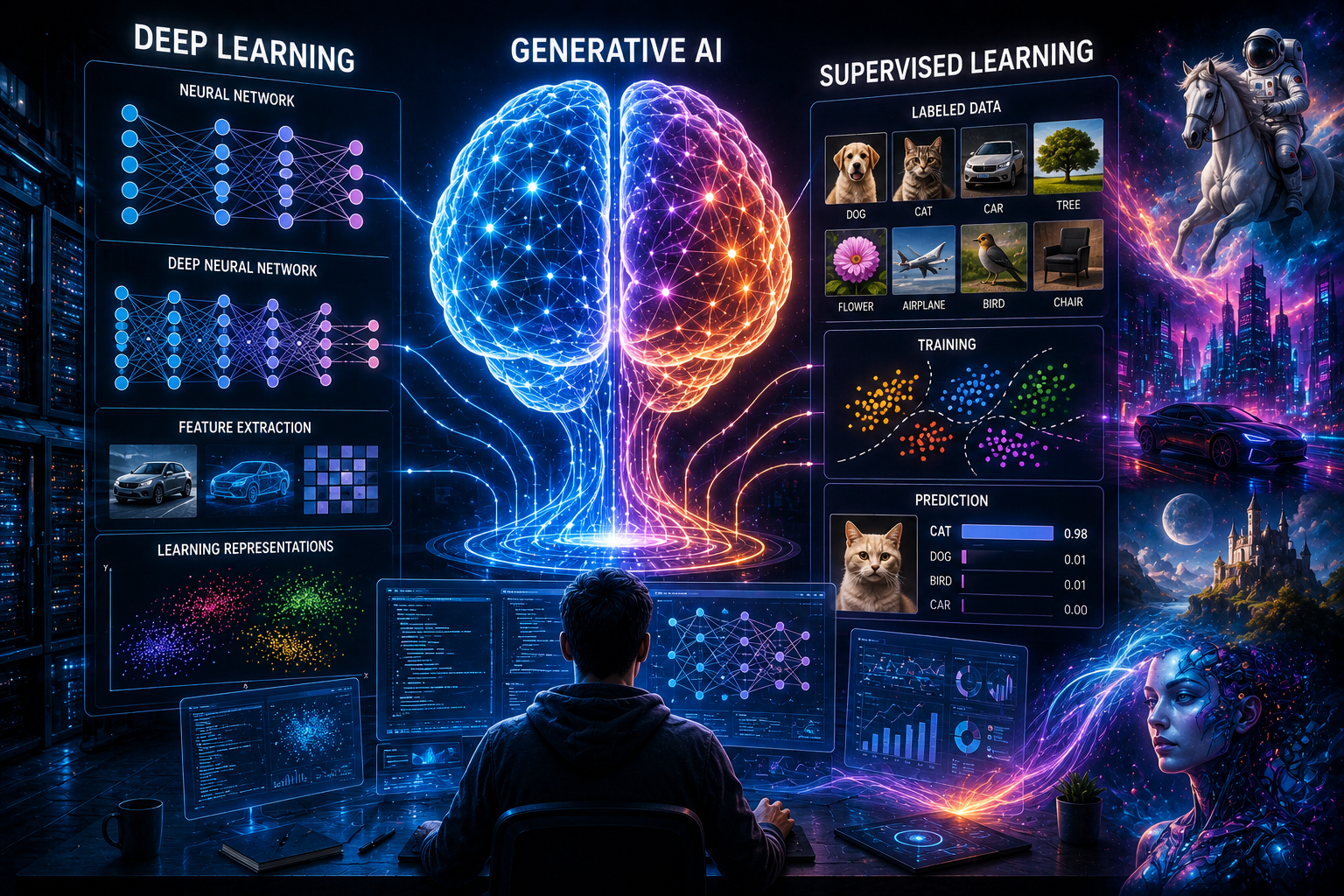
Generative AI tools that write essays, generate images, and hold conversations can feel almost magical from the outside — type a prompt, get a polished result. But nothing about that output is actually magic. Underneath every generative AI system sits a stack of older, more foundational technology: machine learning and deep learning, refined over decades before “generative AI” became a household term.
Understanding that stack — what machine learning actually does, how deep learning builds on it, and how the two combine to produce systems capable of generating entirely new content — makes it much easier to understand both what these tools are genuinely capable of and where their real limitations lie.
Where Generative AI Fits Within AI as a Whole
Artificial intelligence isn’t one single technology — it’s a broad umbrella covering many distinct approaches, each suited to different kinds of problems. Machine learning sits inside that umbrella as one major approach, deep learning sits inside machine learning as a more specialized technique, and generative AI is a more recent capability built primarily on top of deep learning’s foundations.
Thinking of it as a set of nested layers helps clarify the relationship: AI is the broadest category, machine learning is a subset focused on learning from data rather than explicit programming, deep learning is a subset of machine learning using layered neural networks, and generative AI is what emerges when deep learning techniques are applied specifically to creating new content rather than just classifying or predicting from existing data.
What Machine Learning Actually Does
Machine learning is the branch of AI that allows a system to identify patterns in data and improve its performance without being explicitly programmed for every possible scenario. Instead of a developer writing exact rules for every situation, a machine learning system builds its own internal model by learning from examples.
Machine learning approaches generally fall into three core categories, each suited to a different kind of learning problem.
Supervised learning trains a model using labeled data — every input in the training set comes paired with the correct output. The model’s job is to learn the relationship between inputs and outputs well enough to accurately handle new, unseen examples. This is the category most people encounter first, since it underlies many familiar applications like spam filtering and basic prediction tasks.
Unsupervised learning works without labeled outputs at all. Instead, the model analyzes raw, unlabeled data on its own, looking for structure, patterns, or groupings that weren’t explicitly defined beforehand. This approach is particularly useful for uncovering relationships in data that a human wouldn’t necessarily think to label in advance.
Reinforcement learning takes a fundamentally different approach, training a model — often called an “agent” — through interaction with an environment rather than through a fixed dataset. The agent takes actions, receives feedback in the form of rewards or penalties, and gradually refines its decision-making based on that feedback loop. This trial-and-reward structure is what makes reinforcement learning particularly well suited to problems involving sequential decisions, like game-playing systems or physical robots learning to navigate real-world environments — an approach increasingly visible in how humanoid robots are being trained to handle unpredictable, real-world physical tasks rather than tightly scripted demo routines.
How Machine Learning Supports Generative AI
Each of these learning categories contributes something distinct to how generative AI systems actually get built and refined.
Learning from labeled examples. Early-stage training for many generative models leans on supervised learning, teaching the system the relationship between a given input and a desired output before it’s asked to generate anything genuinely novel.
Finding structure in unlabeled data. Because so much of the content available to train large models — text, images, and beyond — isn’t neatly labeled, unsupervised learning plays a critical role in helping generative systems uncover meaningful patterns without needing every example manually categorized first.
Refining output through feedback. Adaptability matters enormously for generative systems that need to keep improving after their initial training. Reinforcement learning, particularly a variant called Reinforcement Learning with Human Feedback (RLHF), lets a model incorporate targeted human judgment into its ongoing refinement — a technique widely credited with helping conversational AI systems produce noticeably more useful, natural responses than earlier generations of chatbots.
Fine-tuning model parameters. Beyond the three core learning paradigms, generative AI systems rely heavily on broader machine learning optimization techniques to adjust internal parameters and improve output accuracy over time.
Building on prior training through transfer learning. Rather than training every new model completely from scratch, transfer learning lets a system start from a model already trained on a broad, general task and then adapt — or fine-tune — that foundation for a more specific content-generation purpose. This approach dramatically accelerates development, which is part of why new generative AI assistants and chatbots have been able to emerge and improve so rapidly, including competitors built entirely outside the usual Western AI ecosystem, like the Chinese-developed chatbot built to rival ChatGPT in a market where the original isn’t available.
What Deep Learning Adds to the Picture
Deep learning is a specialized subset of machine learning, structurally inspired by the way neurons connect and communicate in the human brain. Instead of relying on a single, relatively simple model, deep learning uses artificial neural networks with multiple layers — hence “deep” — to extract increasingly complex features from raw input data.
One practical advantage of deep learning is that, once properly configured, it typically requires less ongoing manual intervention than earlier machine learning approaches, and can often generate results considerably faster once trained. This efficiency is a major reason deep learning has become the dominant approach underlying most modern generative AI systems.
Hierarchical Representations
Generating genuinely diverse, realistic content requires a model to understand data at multiple levels of abstraction simultaneously — not just recognizing a shape, but understanding how that shape relates to texture, context, and meaning. Deep neural networks, with their multiple stacked layers, are specifically suited to building this kind of hierarchical understanding, which is foundational to nearly everything generative AI systems produce.
Convolutional Neural Networks (CNNs)
CNNs are a specialized type of neural network built primarily for analyzing visual data. They automatically learn spatial hierarchies of features directly from images, layer by layer, without needing those features manually defined in advance. Generative AI systems rely on CNNs heavily for visual understanding and cross-modal tasks like generating an image directly from a text description — the same underlying capability behind tools that let ordinary users insert themselves directly into AI-generated video content using personal avatars rather than relying on stock footage or actors.
Recurrent Neural Networks (RNNs)
RNNs are structured differently from standard feedforward networks, incorporating loops that let information persist and flow between connected nodes over time. Each node functions as both an input and an output within that loop. This structure makes RNNs particularly well suited to sequential data — text, speech, time-series information — where a generative model needs to understand and continue a coherent sequence rather than treating each data point in isolation.
Handling Large-Scale Data
Training a capable generative AI model requires enormous volumes of data, far beyond what earlier machine learning techniques were typically built to process efficiently. Deep learning architectures are specifically designed to scale to this kind of large-scale data handling, which is part of why deep learning became essential once generative AI moved from research curiosity to genuinely practical, large-scale application — a shift visible even in industries not traditionally associated with cutting-edge AI, like the energy sector, where deep learning models are now being applied to make sense of the enormous data volumes generated by industrial plants.
Generative Adversarial Networks (GANs)
GANs represent one of deep learning’s most distinctive contributions to generative AI specifically. A GAN pits two neural networks against each other — one generating content, the other evaluating how convincing that content is — with each network improving through this ongoing competition. This adversarial structure has proven remarkably effective at producing realistic images, video, and other generated content, and remains one of the clearest examples of how deep learning architecture, not just raw data volume, drives generative AI’s creative capability.
Why Understanding This Foundation Matters
None of this is purely academic. Understanding that generative AI is built on these specific, well-established techniques — rather than some entirely novel, unexplainable process — helps set realistic expectations about what these systems can and can’t do. A generative model’s output is fundamentally a reflection of patterns learned from its training data and refined through a specific combination of these techniques, not an independent, reasoning intelligence operating outside those constraints.
This also explains why generative AI has advanced so unevenly across different domains — progress tends to follow wherever a combination of large-scale data, effective network architecture, and refined feedback loops has come together most successfully, which is exactly why some applications (conversational text, image generation) matured faster than others.
Best Practices for Understanding and Working With Generative AI
- Learn the three core ML paradigms first — supervised, unsupervised, and reinforcement learning — before trying to understand deep learning’s more specialized contributions.
- Recognize that “deep” refers to network depth, not intelligence. Multiple layers allow more complex feature extraction, not independent reasoning.
- Understand which architecture suits which task. CNNs excel at visual data, RNNs at sequential data, and GANs at adversarial content generation — matching the right architecture to the right problem remains foundational even as newer architectures continue to emerge.
- Pay attention to training data quality, since a generative model’s output quality is directly tied to what it learned from, regardless of how sophisticated its underlying architecture is.
- Treat RLHF and similar feedback techniques as ongoing refinement, not a one-time fix. Continuous human feedback loops are part of why some generative systems keep improving well after their initial release.
Common Mistakes to Avoid
- Treating generative AI as fundamentally different from machine learning rather than understanding it as a specific, advanced application built on the same foundational techniques.
- Confusing “deep learning” with “smarter” AI in a general sense. Depth refers to the network’s structure, not a guarantee of better judgment or reasoning.
- Overlooking the role of transfer learning in how quickly new generative AI systems can be built and deployed, especially outside major, well-resourced labs.
- Assuming all generative content comes from the same underlying architecture. Text, image, and video generation often rely on meaningfully different network structures suited to their specific data type.
- Underestimating how much output quality depends on training data, rather than assuming architecture alone determines a model’s capability.
Key Takeaways
- Generative AI is built on machine learning and deep learning foundations, not a separate or unrelated technology.
- Machine learning’s three core paradigms — supervised, unsupervised, and reinforcement learning — each contribute distinct capabilities to how generative models are trained and refined.
- Deep learning’s layered neural network structure enables hierarchical understanding of data, powering specialized architectures like CNNs, RNNs, and GANs.
- Techniques like transfer learning and RLHF have significantly accelerated how quickly new generative AI systems can be built and improved.
- Understanding these foundations helps set realistic expectations about generative AI’s actual capabilities and limitations.
Frequently Asked Questions
What’s the difference between machine learning and deep learning? Deep learning is a specialized subset of machine learning that uses multi-layered artificial neural networks to extract increasingly complex features from data. Machine learning is the broader category, encompassing deep learning alongside other approaches that don’t necessarily rely on deep neural network architectures.
How does ChatGPT use reinforcement learning? ChatGPT uses a technique called Reinforcement Learning with Human Feedback (RLHF), where targeted human feedback helps refine the model’s responses over time, improving how useful and natural its output feels compared to relying purely on its initial training data.
What are GANs used for in generative AI? Generative Adversarial Networks pit two neural networks against each other — one generating content and one evaluating its realism — with both improving through that competition. This structure has proven especially effective for generating realistic images and video.
Why do generative AI models need so much data? Generative models need to learn complex, hierarchical patterns well enough to produce genuinely novel, coherent output rather than simply memorizing examples. Large-scale data exposure is what allows a model to generalize effectively rather than only reproducing narrow patterns from a small training set.
Is generative AI a completely different technology from traditional machine learning? No. Generative AI is best understood as a specific, advanced application of machine learning and deep learning techniques, applied specifically toward the goal of creating new content rather than just classifying or predicting from existing data.
Conclusion
Generative AI’s ability to write, draw, and converse convincingly isn’t evidence of some entirely new kind of intelligence — it’s the result of decades of machine learning and deep learning development, combined in increasingly sophisticated ways. Supervised, unsupervised, and reinforcement learning each shape how these models train and improve, while deep learning’s layered neural networks — expressed through architectures like CNNs, RNNs, and GANs — give generative systems the structural capability to actually produce new, coherent content. Understanding that foundation is what separates a realistic, grounded view of generative AI’s capabilities from the more magical, black-box framing these tools often get in casual conversation.





Leave a Reply