

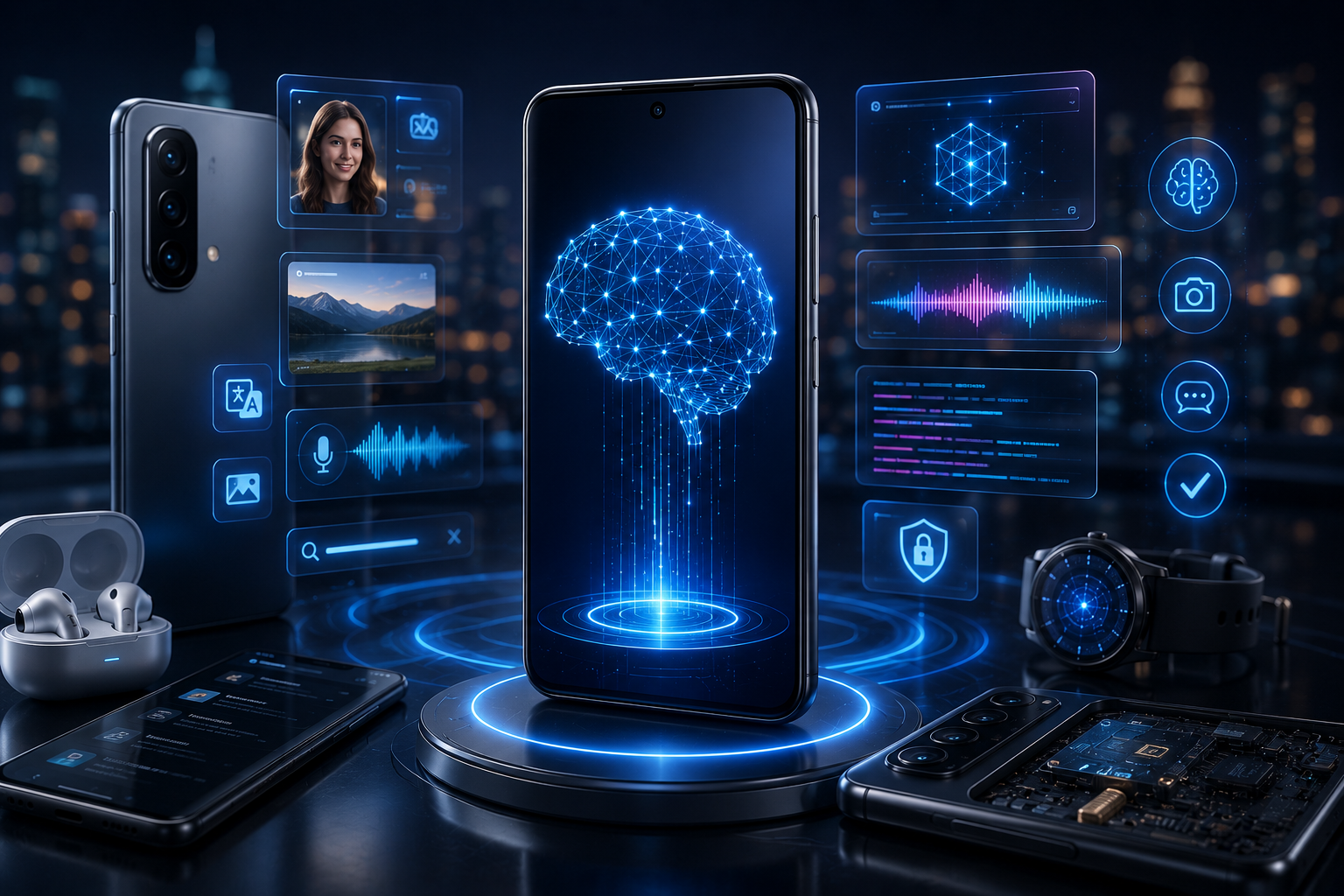
For the first time in years, the smartphone industry’s next act isn’t a camera upgrade, a thinner chassis, or a display trick. It’s a phone that stops waiting for you to tap something. The devices arriving this year are being designed around a different core idea entirely: instead of answering questions, they’re meant to get things done on your behalf.
That’s a bigger architectural shift than it sounds. It touches the chip, the operating system, and the permission model — not just the app that opens when you say “Hey Assistant.”
From Reactive Answers to Autonomous Action
The distinction the industry keeps returning to is simple: a chatbot gives you an answer, an agent tries to get something done. On a phone, that difference matters enormously, because the phone already holds someone’s identity, messaging, location, camera, payments, travel plans and calendar — and an agent needs permission to act across all of it, not just describe it back to you.
At WAIC 2026 in Shanghai, that shift moved from slide-deck promise to shipping hardware. Nubia launched what it’s calling the world’s first mass-produced AI agent smartphone, built with ByteDance’s Doubao AI, capable of autonomously executing multi-app tasks like booking flights, comparing prices and completing purchases without the user touching the screen. Honor went further structurally, rebuilding its MagicOS into what it calls an “Agentic OS” and unveiling a device with a mechanical camera gimbal designed around proactive perception rather than manual framing.
Western flagships are converging on the same idea through different paths. Samsung’s Galaxy S26 Ultra is built around cross-app action capabilities. Google’s Pixel 10 Pro pairs its Tensor G5 chip with Gemini Live 2.0 to run contextual assistance natively. Apple’s iPhone 17 Pro Max uses its A19 Pro processor to run on-device intelligence woven through iOS rather than layered on top of it.
The Numbers Behind the Shift
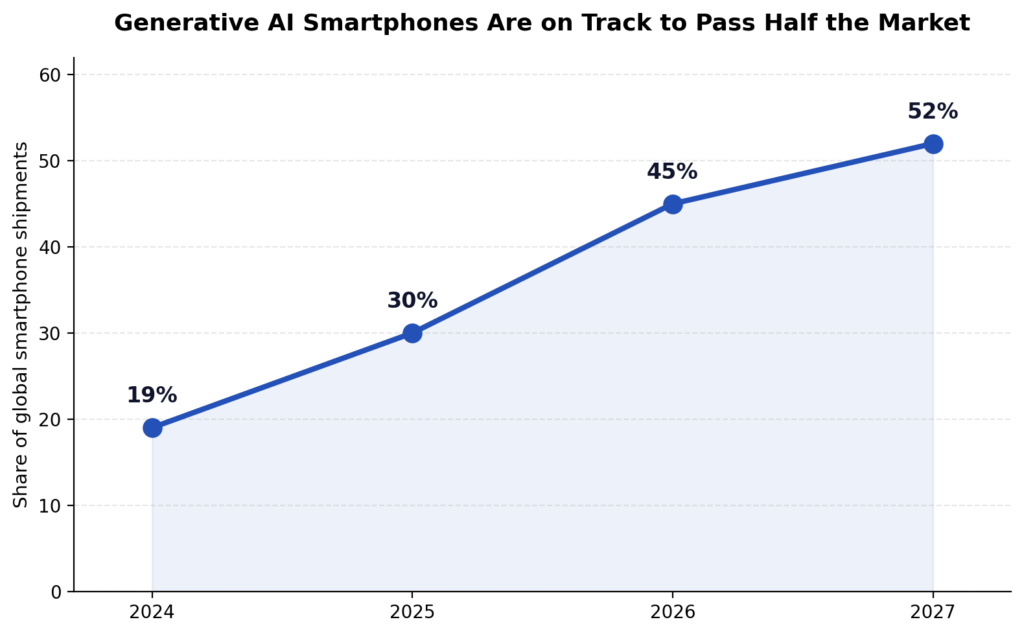
Generative AI smartphones made up roughly 19% of global shipments in 2024. That climbed to around 30% in 2025, and Counterpoint Research projects it will reach 45% in 2026 and 52% in 2027 — crossing the halfway mark of the entire global smartphone market in just three years. IDC’s longer-range forecast puts GenAI smartphone penetration above 70% by 2028 or 2029, driven largely by the technology finally reaching mid-range devices rather than staying confined to flagships.
Why the Chip Underneath Had to Change First
None of this works without new silicon. Qualcomm, Samsung and MediaTek are all shipping processors purpose-built for AI workloads rather than general computing with AI bolted on afterward, with dedicated Neural Processing Units capable of handling several trillion operations per second directly on the device. That local processing is what lets a phone run live translation, contextual suggestions and multi-step task planning without a round-trip to the cloud for every request — delivering faster responses, better reliability without a strong connection, and a real privacy advantage since raw data doesn’t have to leave the device.
A genuine surprise in the data: Despite running more AI workloads locally than ever, 2026-generation phones aren’t seeing worse battery life because of it. The same AI systems managing on-device intelligence are also learning usage patterns and aggressively idling unused background processes, offsetting much of the additional power draw.
The Real Battleground Isn’t the Model — It’s the Permission System
The more interesting competitive question in 2026 isn’t which company has the smartest underlying AI model. It’s which phone can safely take actions on someone’s behalf without creating a security or privacy nightmare. Hybrid architectures — on-device processing paired with private cloud for heavier reasoning — are becoming the default approach, and manufacturer differentiation is increasingly showing up in privacy controls and tool-access permissions rather than raw model benchmarks.
Smartphones are about to feel less like a grid of apps and more like a command terminal: you state intent, the device figures out which apps, accounts, permissions and steps are required, then does the work.
Why Vendors Need This Shift to Work
This transformation is happening against a backdrop of a maturing, increasingly saturated smartphone market. Global unit growth is expected to slow to roughly 2.6% annually between 2023 and 2028 as device lifecycles stretch and replacement cycles slow. With volume growth capped, vendors are leaning on AI-driven differentiation and higher average selling prices to keep revenue growing — the total smartphone market is still expected to reach a record value even as unit growth stays modest, because buyers are increasingly paying a premium for genuinely intelligent devices rather than simply better-specced ones.
What to Watch Next
- Whether mid-range phones get real agentic features, not just marketing labels. IDC expects 2026 to be the year this technology genuinely reaches mid-range devices, which is what actually drives the jump toward mainstream adoption.
- How permission and security models hold up under real use. An agent that can book flights and make purchases autonomously is also an agent that can make expensive mistakes or be exploited if the permissioning isn’t airtight.
- Whether Chinese and Western approaches converge or diverge. Nubia and Honor are rebuilding the OS itself around agents; Apple, Google and Samsung are layering deeper agentic capability into existing platforms. Which approach wins may shape how quickly the rest of the industry follows.






Leave a Reply