

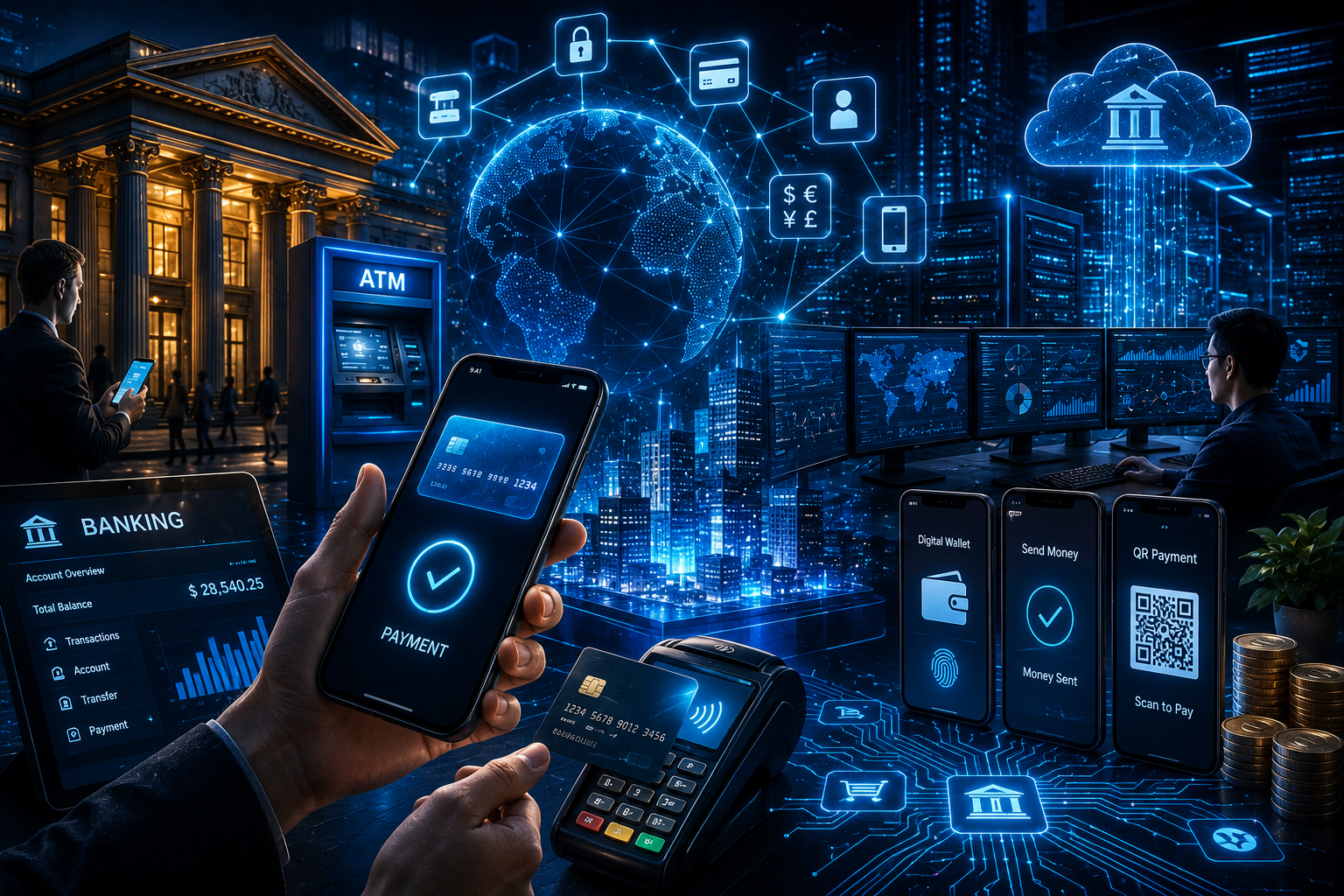
A practitioner’s guide to how financial technology actually works — the infrastructure, business models, regulation, and AI systems reshaping money for consumers, businesses, and the global economy. No hype, no price predictions — just the mechanics.
Educational guide, not financial advice
Key Takeaways
- FinTech is not a single product — it is a layer of technology (APIs, cloud infrastructure, data, and AI) that has been inserted into every part of the financial value chain: payments, lending, investing, insurance, and banking itself.
- A single card swipe or UPI payment triggers a coordinated handoff between five or six independent institutions — merchant, gateway, processor, network, and bank — that all have to agree in under two seconds.
- Banks aren’t struggling because of bad ideas; they’re struggling because decades-old core banking systems were never built for real-time, API-driven finance.
- AI has moved from a back-office experiment to the default engine behind fraud detection, credit decisions, and compliance — but regulation still requires a human to be accountable for the outcome.
- Building a FinTech product is a regulatory and security project first, and a coding project second. That ordering is what separates products that survive an audit from products that don’t.
- The next decade of FinTech is being shaped less by new apps and more by invisible plumbing: embedded finance, open banking, real-time rails, and digital identity.
What You’ll Learn in This Guide
- Why FinTech Changed the World
- What FinTech Actually Means
- How Digital Payments Work
- The Technology Behind Modern Banking
- How AI Is Transforming FinTech
- How FinTech Startups Build Products
- Challenges Facing the FinTech Industry
- Career Opportunities in FinTech
- The Future of FinTech (2026–2035)
- Glossary of FinTech Terms
- Frequently Asked Questions
1. Why FinTech Changed the World
For most of banking’s history, “financial infrastructure” meant a building. A customer walked into a branch, spoke to a teller, filled out a form in triplicate, and waited — sometimes days — for money to actually move. Credit decisions were made by a loan officer reading a file. Insurance was priced using tables that hadn’t changed in a generation. The ledger of record was, quite literally, a ledger: a physical book, later a mainframe file, that only the bank could see or touch.
That model wasn’t inefficient by accident — it was inefficient by design. Trust in finance has always depended on control: control over who can move money, who can see a balance, and who can approve a transaction. For a long time, the only credible way to guarantee that control was to centralize everything inside a small number of heavily regulated institutions and make customers come to them.
The Three Forces That Broke the Old Model
Three things happened roughly in parallel over the last two decades, and together they made the branch-first model obsolete.
The internet made distance irrelevant. Once a customer could authenticate over a network instead of in person, there was no technical reason a bank needed a branch near them at all. The first generation of online banking simply moved the paper form onto a screen — but it proved that trust could travel over a wire.
Smartphones made finance ambient. A phone in every pocket meant a bank branch in every pocket too — one that never closed, carried a camera for document capture, a biometric sensor for authentication, and a GPS for fraud checks. Mobile didn’t just make banking convenient; it changed who could realistically be a customer. Someone with no nearby branch and no credit history could now be onboarded in minutes using a phone number and an ID photo.
APIs and cloud computing unbundled the bank. Historically, a bank had to build everything itself — the ledger, the card processing, the fraud engine, the mobile app — because there was no other way to get it. Application programming interfaces changed that. A bank’s core ledger could now expose a narrow, secure interface that other companies could build on top of, without ever touching the underlying system. That single shift — the ability to rent financial infrastructure instead of building it — is the real starting gun for the FinTech era. It’s why a food delivery app can suddenly offer a debit card, and why a startup with twelve engineers can launch a lending product that would have taken a bank’s IT department three years to ship.
From “Banks Use Technology” to “Technology Companies Do Banking”
The distinction matters. A bank that digitizes its existing processes is still a bank. FinTech describes something different: companies — many with no banking license at all — that build financial products using the internet, APIs, cloud infrastructure, and data science as their primary tools, often partnering with a licensed bank behind the scenes to handle the parts that legally require one.
This is why FinTech has touched every corner of finance simultaneously rather than one product at a time. Payments got faster because settlement could be computed instead of physically cleared overnight. Lending got faster because a credit decision could pull hundreds of data points instantly instead of waiting for a human underwriter. Investing got cheaper because portfolio rebalancing could be automated instead of billed hourly. Insurance got more precise because risk could be priced per person instead of per broad category. None of these changes required a new financial invention — they required an infrastructure layer that made existing financial ideas cheap enough and fast enough to reach everyone.
Real-World Scenario
A small business owner in a tier-2 city needs a ₹2 lakh working-capital loan. Twenty years ago, that meant a branch visit, a physical file, collateral paperwork, and a multi-week wait for a committee decision — with a real chance of rejection for lack of a credit history. Today, a lending app can pull the business’s GST filings, bank statement flows, and payment-gateway settlement history via API, score the application algorithmically, and disburse funds to the owner’s account within hours — with no branch involved at all. The loan itself hasn’t changed. The infrastructure that delivers it has.
2. What FinTech Actually Means
“FinTech” is often used as a catch-all, which makes it feel vaguer than it actually is. In practice, it breaks down into a small number of well-defined categories, each solving a different problem in the financial system. Understanding these categories individually is the fastest way to actually understand the industry — most “FinTech companies” are really just one or two of the categories below, wrapped in a consumer-facing app.
| Category | What It Does | Practical Example |
|---|---|---|
| Digital Payments | Moves money between parties electronically, replacing cash and cheques | Tapping a phone to pay at checkout, or sending money via a UPI-style instant transfer |
| Digital Banking | Delivers core banking services (accounts, deposits, transfers) without a physical branch | A traditional bank’s mobile app that lets you open an account end-to-end on your phone |
| Neobanks | Digital-only banking brands, usually without their own banking license, built on a partner bank’s infrastructure | An app-based savings account with no physical branches anywhere |
| Lending Platforms | Originate, underwrite, and service loans using algorithmic risk models instead of manual underwriting | An instant personal loan approved using bank-statement analysis rather than a credit-bureau file alone |
| WealthTech | Automates investing, portfolio management, and financial planning | A robo-advisor that rebalances a portfolio automatically based on a risk profile |
| InsurTech | Applies data and automation to insurance pricing, underwriting, and claims | Usage-based auto insurance priced from real driving data instead of a flat demographic rate |
| RegTech | Automates compliance, reporting, and risk monitoring for financial institutions | Software that automatically screens every transaction against global sanctions lists |
| PayTech | The infrastructure layer that powers payments for other businesses (not the consumer brand itself) | The gateway and processing engine running quietly behind an e-commerce checkout page |
| Embedded Finance | Financial products offered inside a non-financial app, invisible as a separate “bank” | A ride-hailing app offering its drivers an instant-payout debit account |
| Open Banking | A regulatory and technical framework letting customers securely share their bank data with third-party apps via API | A budgeting app that pulls balances from three different banks into one dashboard, with the customer’s consent |
Digital Payments
This is the most visible layer of FinTech because everyone touches it daily. It covers everything that replaces physical cash or cheques with an electronic instruction to move money — card payments, wallet payments, and instant bank-transfer rails. The defining shift here isn’t just “no cash” — it’s speed. A cheque used to take days to clear; an instant payment rail settles in seconds.
Digital Banking vs. Neobanks
These two terms get conflated constantly, but the difference is structural, not cosmetic. A digital banking product is delivered by a licensed bank — the technology is new, but the institution underneath is the same regulated entity it always was. A neobank is a technology company that designs the app, the brand, and the customer experience, but partners with a licensed bank (or acquires a narrow license itself) to actually hold deposits and move money. The customer usually can’t tell the difference from the interface — but it matters enormously for who is legally accountable if something goes wrong, and it’s a distinction regulators increasingly require to be disclosed clearly. Related reading PhonePe Revenue Climbs 11% to ₹7,920 Crore, While Losses Increase — ValuFlash
PhonePe is a useful real-world illustration of this category: it’s a payments-and-financial-services platform built on top of India’s UPI rail rather than a bank with its own balance sheet in the traditional sense, and its financials show the classic FinTech growth pattern — revenue scaling quickly while the business still absorbs losses to fund distribution and new product lines.
Lending Platforms
Digital lending replaces a manual underwriting file with an automated risk model that can pull in bank-statement cash flows, GST or tax-filing data, payment history, and behavioral signals to make a decision in minutes rather than weeks. The technology doesn’t remove risk — it changes how risk is measured, often making credit accessible to people a traditional bureau-score model would have rejected outright for lack of history.
WealthTech
WealthTech automates the mechanical parts of investing and financial planning: portfolio construction based on a stated risk tolerance, automatic rebalancing, tax-loss harvesting, and goal-based savings tracking. It generally does not remove human judgment from complex financial planning — it removes the manual labor from portfolio maintenance, which is what used to justify high advisory fees for simple, repeatable tasks.
InsurTech
InsurTech applies the same data-driven logic to insurance: pricing risk using granular, often real-time data (driving behavior, IoT sensor data, health-tracker data) instead of broad actuarial categories, and using automation to speed up claims processing, which has traditionally been insurance’s slowest and most frustrating step for customers.
RegTech
RegTech is compliance infrastructure — software that automates the parts of financial regulation that used to require armies of analysts: screening every counterparty against sanctions and politically-exposed-person lists, monitoring transactions for suspicious patterns, and generating the regulatory reports banks are legally required to file. It’s less visible than a consumer app, but it’s often the difference between a FinTech company that can legally operate at scale and one that can’t.
PayTech
PayTech is the infrastructure layer underneath digital payments — the gateways, processors, and settlement engines that other businesses plug into rather than build themselves. A shopper never sees a PayTech company’s brand; they see the merchant’s checkout page, with the PayTech provider working invisibly in the background to authorize and route the transaction.
Embedded Finance
Embedded finance is what happens when a financial product stops looking like a bank product at all. A ride-hailing app offering drivers instant payouts to a built-in account, a point-of-sale system offering a merchant a business loan based on its own sales data, or an e-commerce checkout offering “buy now, pay later” at the exact moment of purchase — none of these require the customer to open a separate banking relationship. The financial product is stitched directly into a workflow the customer was already using.
Real-World Scenario
A freight logistics platform notices its drivers frequently ask for salary advances before payday. Rather than referring them to a bank, the platform embeds a lending product directly into its own driver app, using the platform’s own trip and earnings data — data no external bank would have access to — to underwrite same-day advances. The driver never leaves the app; the “bank” is invisible.
Open Banking
Open banking is the regulatory and technical framework that makes a lot of the above possible in the first place. It requires banks to expose a customer’s account data to authorized third-party apps through secure, standardized APIs — but only with the customer’s explicit consent. It’s the reason a budgeting app can show balances from three different banks in one dashboard, and the reason a lender can verify your income directly from your bank rather than asking you to upload a PDF statement. Europe’s PSD2 framework popularized this model, and it’s now being extended and tightened under PSD3 and the accompanying Payment Services Regulation, while India’s Account Aggregator framework and similar regimes elsewhere apply the same consent-based data-sharing principle.
3. How Digital Payments Work
A card tap or a UPI transfer looks instantaneous, but underneath it involves a coordinated handoff between several independent institutions, each with its own systems, risk checks, and legal obligations. Understanding this chain is the single most useful piece of FinTech literacy, because almost every payments product — regardless of what it’s branded as — is really just a different front end for this same underlying flow.
The Key Players in Any Payment
- Merchant — the business accepting payment for goods or services.
- Payment Gateway — the software layer that captures payment details at checkout (online or in-store) and encrypts them for transmission. Think of it as the digital equivalent of a card-swipe machine.
- Payment Processor — the engine that actually routes the transaction to the right network and bank, and handles the technical messaging between all parties.
- Acquiring Bank — the merchant’s bank, which receives the funds on the merchant’s behalf.
- Card Network (Visa, Mastercard, RuPay, and equivalents) — the rail that connects the acquiring side to the issuing side and sets the rules both must follow.
- Issuing Bank — the customer’s bank, which actually holds the customer’s money and approves or declines the transaction.
Instant account-to-account rails like India’s UPI compress several of these roles by routing directly between the payer’s and payee’s banks through a central switch (NPCI, in UPI’s case), which is why they can settle in seconds rather than the days a traditional bank transfer once took — but the same basic principle applies: two banks, and something in the middle coordinating trust between them.
The Payment Flow, Step by Step
- InitiationThe customer taps a card, scans a QR code, or authorizes a UPI request. The device captures the payment instruction.
- Gateway captureThe payment gateway encrypts the transaction details and sends them to the payment processor.
- Routing to the acquirerThe processor forwards the request to the merchant’s acquiring bank.
- Network handoffThe acquiring bank routes the transaction through the relevant card network or instant-payment switch to reach the customer’s bank.
- Issuer authorizationThe issuing bank checks the customer’s balance or credit limit, runs real-time fraud rules, and approves or declines — typically in under two seconds.
- Response relayThe approval (or decline) travels back through the same chain to the merchant’s checkout screen.
- SettlementAuthorization is not the same as money actually moving. The real transfer of funds between banks typically happens in a batch process, often the next business day (T+1).
- ReconciliationThe merchant’s internal records are matched against the bank’s settlement report to confirm every transaction was received correctly — the unglamorous but essential final step of every payment system.
Settlement vs. Authorization: The Distinction That Confuses Most People
When a payment “succeeds” on screen, all that has actually happened is that the issuing bank has promised to pay. The physical movement of funds between the issuing and acquiring banks — settlement — usually happens later, in bulk, through clearing arrangements between banks or via a central settlement system. This is why a merchant’s bank balance doesn’t jump the instant a sale happens, and why refunds and chargebacks are possible even after a payment shows as “successful” to the customer.
Fraud Detection and Chargebacks
Every step above carries its own fraud check — the issuer scores the transaction against the cardholder’s typical spending pattern, location, and device fingerprint before approving it. When fraud slips through, or a customer disputes a legitimate charge, the result is a chargeback: the issuing bank reverses the transaction and pulls the money back from the merchant, often with an additional fee. Chargeback rates are closely watched by acquiring banks and card networks — a merchant with a chargeback rate above a defined threshold can be flagged, fined, or dropped entirely, which is why fraud tooling is a core, non-optional part of any serious payments product rather than an add-on.
Real-World Scenario
A customer’s card is skimmed at a fuel pump and used for a fraudulent online purchase two states away. The issuing bank’s real-time fraud model flags the transaction’s location and merchant category as inconsistent with the customer’s normal pattern and declines it automatically — before the customer even notices anything is wrong. That silent decline is the fraud-detection layer doing its job; the customer never sees the machinery behind it.
4. The Technology Behind Modern Banking
Payments are the visible layer of FinTech. Underneath, banks and FinTech companies alike run on a stack of infrastructure that most customers never think about — and that stack is exactly where the industry’s biggest modernization struggle is playing out.
Core Banking Systems
A core banking system is the system of record for every account, balance, and transaction a bank holds — the ledger, in its modern form. Many large, established banks still run core systems built decades ago on mainframe architecture, often in COBOL. These systems are extremely reliable, which is precisely why replacing them is so risky — but they were also never designed for real-time processing, API access, or the transaction volumes modern digital products generate. A newer generation of cloud-native core banking platforms is built API-first from the ground up, which is one reason many neobanks can move faster than incumbent institutions: they aren’t dragging decades of architectural debt behind them.
APIs and Microservices
An API (application programming interface) is a defined, secure way for one piece of software to request something from another — a balance check, a fund transfer, an identity verification — without needing to know how the other system works internally. Modern financial platforms are typically built as microservices: many small, independently deployable services (one for payments, one for KYC, one for notifications) rather than a single giant application. This makes it possible to update, scale, or fix one part of the system without touching — or risking — everything else.
Cloud Computing
Cloud infrastructure lets a financial company rent computing power, storage, and specialized services instead of running its own data centers — which matters enormously for a startup that needs to scale from a few thousand to a few million users without a multi-year hardware procurement cycle. It also underwrites much of the current AI buildout across finance and technology broadly, since training and running large models requires computing capacity most companies would never build themselves. Related reading How AI Data Center Deals Are Financed — ValuFlash
The scale of capital now flowing into that underlying infrastructure — the data centers, chips, and power contracts behind cloud and AI capacity — is itself becoming a story finance has to track, because it directly shapes how affordable that computing capacity will be for everyone building on top of it, FinTech companies included.
Databases
Financial systems typically rely on strongly consistent relational databases for the ledger itself — where accuracy and the ability to guarantee no transaction is ever lost or double-counted matters more than raw speed — while using faster, more flexible databases for supporting functions like fraud scoring, analytics, or session data where near-instant response time matters more than perfect consistency.
Security, Encryption, and Authentication
Financial data is encrypted both in transit (as it moves across networks, typically via TLS) and at rest (as it sits in storage, typically via strong algorithms like AES-256). Sensitive data such as card numbers is often tokenized — replaced with a meaningless substitute value everywhere except the one secure system that can map it back to the real number — so that even a data breach elsewhere in the system exposes nothing useful. Authentication has moved well beyond passwords: multi-factor authentication, biometrics, and increasingly passwordless standards like passkeys are becoming the norm, because passwords alone are now considered one of the weakest links in the entire security chain.
KYC and AML
Know Your Customer (KYC) is the process of verifying who a customer actually is before letting them open an account — checking a government ID, matching a live selfie to a document photo, and increasingly running these checks entirely online through video or digital KYC flows. Anti-Money Laundering (AML) is the ongoing monitoring that follows: watching transaction patterns for signs of money laundering, screening customers against sanctions and politically-exposed-person lists, and filing suspicious activity reports when something doesn’t add up. Neither is optional — they are legal obligations enforced with real financial penalties for failure, and they are usually the single biggest source of friction in an otherwise frictionless-feeling digital onboarding flow.
Risk Management
Beyond fraud and compliance risk, financial institutions manage credit risk (will a borrower repay), operational risk (will a system fail or a process break), and increasingly model risk (is the AI model making a decision doing so accurately and fairly). Risk management isn’t a single team’s job in a modern FinTech company — it’s built into the architecture itself, from how much a lending algorithm is allowed to approve automatically to how quickly a fraud system can freeze an account.
Why Banks Are Modernizing Legacy Systems
The pressure to modernize isn’t cosmetic — it’s competitive and regulatory. Customers now expect real-time transfers, instant account opening, and 24/7 availability that decades-old batch-processing architecture simply cannot deliver without significant rework. Regulators increasingly expect open, API-accessible data under frameworks like open banking. And every year a legacy system stays in place, the pool of engineers who understand it shrinks further, making maintenance more expensive and modernization more urgent — a slow-moving but very real form of technical risk that boards now take seriously.
5. How AI Is Transforming FinTech
AI in finance is not a single technology — it’s a set of techniques applied to specific, high-volume, pattern-heavy problems where speed and scale matter more than any individual decision. That’s precisely why finance was one of the first industries to adopt machine learning seriously, well before the current wave of generative AI: fraud, credit, and compliance are exactly the kind of high-volume, data-rich problems machine learning is best suited to. Related reading AI-Powered Finance Automation — ValuFlash
Fraud Detection
Modern fraud systems don’t rely on a fixed set of rules alone — they use models trained on millions of past transactions to score how unusual a new transaction looks in real time, factoring in location, device, spending pattern, and even the behavioral rhythm of how someone types or taps. Increasingly, they also use graph-based techniques to spot fraud rings — clusters of seemingly unrelated accounts that are actually coordinated — patterns a rules-based system would never catch on its own.
Credit Scoring
Traditional credit scores rely heavily on a person’s borrowing history — which structurally excludes anyone who hasn’t borrowed before. AI-driven underwriting can incorporate alternative data — bank cash-flow patterns, utility payment history, business transaction volume — to assess creditworthiness for people a traditional bureau score would simply have no data on. This has been one of AI’s most genuinely inclusive applications in finance, though it comes with a real obligation: models trained on incomplete historical data can inadvertently reproduce past biases, which is why regulators increasingly require these models to be explainable and auditable, not just accurate.
Customer Support
AI-driven chat and voice assistants now handle a large share of routine banking queries — balance checks, transaction disputes, card blocks — freeing human agents for complex or emotionally sensitive cases. The best implementations are explicit about their limits: they escalate to a human quickly when a query falls outside their competence, rather than trying to force every conversation through an automated flow.
Risk Analysis and Compliance
AI is used to stress-test portfolios against hypothetical economic scenarios far faster than manual modeling ever could, and to automate the first pass of compliance monitoring — screening transactions against sanctions lists, flagging unusual patterns for human review, and drafting the regulatory reports compliance teams used to compile by hand.
Document Processing
Optical character recognition combined with natural language understanding now extracts data from ID documents, bank statements, and invoices automatically — turning what used to be a manual data-entry step in onboarding or lending into something that happens in seconds, with a human reviewer checking only the cases the model flags as uncertain.
Personalized Financial Insights and Automation
Spend categorization, budgeting nudges, and savings recommendations are largely AI-driven pattern recognition applied to a customer’s own transaction history. On the back-office side, robotic process automation and AI together now handle a large share of repetitive financial operations work — reconciliation, invoice matching, report generation — that used to consume enormous analyst hours.
Where Human Oversight Remains Essential
Regulation in most jurisdictions requires a human to be accountable for consequential financial decisions — a loan denial, an account freeze, a compliance escalation — even when a model made the initial recommendation. This isn’t regulatory conservatism for its own sake; it exists because models can be wrong in ways that are hard to detect from the outside, and because someone has to be answerable when they are. The realistic picture of AI in FinTech today is not “AI replaces the underwriter” — it’s “AI handles the volume, and a human handles the judgment calls the system flags or the law requires.”
6. How FinTech Startups Build Products
Building a consumer app and building a financial product are different disciplines, even when the end result looks similar on a screen. The gap between them is regulation, security, and trust — and skipping any of the three tends to surface later, usually at the worst possible moment (an audit, a breach, or a regulator’s inquiry).
The Realistic Build Lifecycle
- Market research — not just demand validation, but mapping who the actual competitors are, including incumbent banks that may respond by partnering rather than competing directly.
- Regulatory planning — determining which license, registration, or partnership structure the product legally requires before a single line of product code is written. This step alone can take longer than building the MVP.
- Security architecture — designing encryption, access control, and audit logging into the system from day one, not retrofitting it after a security review flags gaps.
- Technology stack selection — chosen as much for auditability, vendor stability, and long-term maintainability as for developer productivity, since financial software has a much longer required lifespan than a typical consumer app.
- Backend and ledger design — building a ledger that guarantees every transaction is recorded exactly once, even if a network call fails and retries (a property engineers call idempotency).
- Payments integration — connecting to a payment gateway, processor, or banking-as-a-service partner rather than building card or bank connectivity from scratch, which few companies ever attempt directly.
- Compliance operationalization — not a one-time certification but an ongoing function: transaction monitoring, reporting, and periodic audits that run for the life of the product.
- Cloud infrastructure — built for multi-region reliability and disaster recovery from the start, because a financial product’s downtime isn’t just an inconvenience, it’s money customers can’t access.
- Scaling — planning for load spikes (a payday, a flash sale, a market-moving news event) that can multiply transaction volume tenfold in minutes.
- Customer trust — built through transparency about fees and data use, responsive support, and clear communication when something goes wrong — trust, in finance, is the actual product being sold.
Why Finance Products Require More Than Code
A bug in a photo-sharing app is embarrassing. A bug in a ledger can mean money that legally doesn’t exist, or a customer who can’t access funds that are rightfully theirs. That difference in consequence is why financial software development leans so heavily on rigorous testing, formal audit trails, and — increasingly — external security certifications like SOC 2 or PCI DSS compliance, which exist specifically to prove to partners, regulators, and customers that the invisible parts of the system are trustworthy, not just the visible app.
A Simple Build-vs-Partner Decision Framework
| Component | Build in-house when… | Partner / use a provider when… |
|---|---|---|
| Payment processing | You are yourself becoming a PayTech infrastructure provider | You are a merchant or app that simply needs to accept payments (the vast majority of cases) |
| Banking license / deposits | You have the capital and multi-year runway for a full banking license | You want to launch faster via a banking-as-a-service or neobank-style partnership |
| KYC / identity verification | Rarely — regulatory liability and accuracy requirements are very high | Almost always — specialized vendors maintain the document and biometric expertise this requires |
| Core product logic | Always — this is your actual differentiation | Never outsource what makes your product unique |
7. Challenges Facing the FinTech Industry
Cybersecurity
Financial platforms are high-value targets by definition — attackers go where the money is. As FinTech products expose more functionality through APIs, the attack surface grows correspondingly; API-focused attacks (unauthorized data scraping, broken authentication between services) have become a leading category of financial-sector security incidents, alongside more familiar threats like phishing and ransomware.
Regulation
Financial regulation is fragmented by design — every country, and often every state or region within a country, has its own licensing regime, data rules, and reporting requirements. A product that’s fully compliant in one market may require a substantially different structure to operate legally in another, which is one of the biggest reasons FinTech expansion across borders is slower and more expensive than expansion in most other software categories. Regulators are also actively rewriting the rules under them — the EU’s overhaul of payments regulation through PSD3 and the accompanying Payment Services Regulation, for instance, is tightening fraud-liability and open-banking rules well beyond what the earlier PSD2 framework required.
Privacy
Financial data is among the most sensitive categories of personal data that exists, and privacy regulation has been tightening accordingly — India’s Digital Personal Data Protection Act, being rolled out in phases through 2026 and 2027, and Europe’s long-standing GDPR both impose strict obligations on how financial companies collect, store, and share customer data, with real financial penalties for failure. Meeting these obligations while still delivering the real-time, data-hungry personalization customers now expect is a genuine, ongoing engineering tension, not a solved problem.
Fraud and Identity Theft
As identity verification has gotten better, fraud has adapted — synthetic identity fraud (blending real and fabricated information to create a plausible but fake identity) and, increasingly, AI-generated deepfake attempts to bypass video KYC checks are now serious concerns for any platform doing digital onboarding. This is very much an arms race: fraud-detection models and fraud techniques are evolving in response to each other continuously.
Scalability
Financial platforms have to be built for their worst day, not their average day — a major sale event, a market crash, or simply payday for a large employer base can multiply normal transaction volume many times over in minutes, and a system that can’t absorb that spike doesn’t just lose business, it loses customer trust at the exact moment it matters most.
Cross-Border Payments
International payments still routinely take days and cost far more than domestic transfers, largely because they rely on a correspondent-banking chain — multiple intermediary banks, each taking a fee and adding delay, because no single bank has a direct relationship everywhere in the world. Newer real-time and blockchain-adjacent settlement approaches are chipping away at this, but cross-border payments remain one of the least modernized corners of the entire financial system.
Compliance Costs
Compliance isn’t a line item — for many FinTech companies it’s one of the largest ongoing operating costs, covering licensing fees, compliance headcount, audit costs, and the RegTech software needed to monitor everything continuously. This cost scales with regulatory complexity, which is part of why compliance-heavy categories like lending and payments tend to consolidate around a smaller number of well-capitalized players over time. Related reading How To GST Return Filing: A Complete Step-by-Step Guide — ValuFlash
Routine tax and regulatory filing obligations, like GST return filing for Indian businesses, are a good example of the unglamorous compliance work that RegTech is increasingly built to automate — turning a recurring manual filing burden into a scheduled, largely automated process.
Customer Trust
Trust in financial products is built slowly and lost quickly — a single high-profile outage or breach can undo years of brand-building, because the product being sold isn’t really the app, it’s the customer’s confidence that their money is safe and accessible. That’s why customer communication during an incident — not just the technical fix — is treated as seriously as the fix itself by mature FinTech operators.
8. Career Opportunities in FinTech
FinTech’s breadth — spanning software, data, risk, compliance, and product — means it draws talent from far more backgrounds than “banking” once did. The table below covers the core roles and what they actually involve day to day.
| Role | What They Do | Core Skills |
|---|---|---|
| Software Engineer | Builds the systems that move, store, and process money — APIs, ledgers, mobile and web apps | Backend/API development, distributed systems, security-conscious coding |
| Data Analyst | Turns transaction and customer data into insight that shapes product and risk decisions | SQL, statistics, data visualization, domain knowledge of financial metrics |
| Risk Analyst | Assesses credit, market, or operational risk and builds models to quantify it | Statistics, financial modeling, regulatory knowledge |
| Fraud Analyst | Monitors transaction patterns, investigates flagged cases, and tunes fraud-detection rules and models | Pattern recognition, investigative reasoning, familiarity with fraud typologies |
| Compliance Specialist | Ensures products and operations meet KYC, AML, and licensing obligations across markets | Regulatory knowledge, attention to detail, cross-functional communication |
| Product Manager | Defines what gets built, balancing customer need, regulatory constraint, and business viability | Prioritization, stakeholder management, working knowledge of financial regulation |
| Cloud Engineer | Builds and maintains the infrastructure financial systems run on — scalable, secure, highly available | Cloud platforms (AWS/Azure/GCP), infrastructure-as-code, reliability engineering |
| Cybersecurity Engineer | Protects financial systems and data from attack, and responds when incidents occur | Network and application security, encryption, incident response |
| AI Engineer | Builds and maintains the models behind fraud detection, credit scoring, and personalization | Machine learning, model evaluation and explainability, MLOps |
| Business Analyst | Bridges technical teams and business stakeholders — translating requirements into specs and metrics into decisions | Process mapping, data fluency, financial-domain communication |
Skills That Transfer Across Every FinTech Role
Regardless of specific role, three things consistently separate strong FinTech candidates: comfort with ambiguity in a heavily regulated environment (rules change, and products have to adapt), enough financial-domain literacy to understand why a requirement exists rather than just what it says, and the ability to think about a system’s failure modes, not just its happy path — because in finance, the failure modes are what regulators, auditors, and customers actually remember.
Future Demand
Demand is shifting less toward “more of the same roles” and more toward hybrid skill sets — engineers who understand compliance, risk analysts who can work with machine-learning models, and compliance specialists fluent enough in data to audit an algorithm rather than just a policy document. That convergence, driven heavily by AI’s expanding role in financial decision-making, is one of the clearest hiring trends in the sector right now.
9. The Future of FinTech (2026–2035)
None of the trends below are speculative technology — each is already live in some markets and scaling in others. The interesting question for the next decade isn’t whether they’ll matter, but how fast they close the gap between “available” and “everywhere.”
Embedded Finance Keeps Expanding
Opportunity: Financial products will keep showing up inside non-financial apps — payroll platforms offering earned-wage access, e-commerce platforms offering merchant loans, software platforms offering business bank accounts — because the host platform already has the data and the trust relationship a standalone bank would have to build from scratch. Challenge: Regulatory accountability gets more complex as more non-bank companies offer bank-like products, and regulators are actively working to close the resulting oversight gaps.
AI Moves From Assistive to Foundational
Opportunity: AI is shifting from a tool that flags things for humans to a system that increasingly drives entire workflows end-to-end, from initial credit decisioning to real-time compliance monitoring. Challenge: Explainability and bias auditing become harder, not easier, as models grow more capable — and the amount of capital now pouring into the underlying AI infrastructure is itself becoming a factor markets watch closely. Related reading Why Wall Street Is Watching AI Spending More Closely Than Profits — ValuFlash
That dynamic — markets scrutinizing AI infrastructure investment as closely as reported earnings — is a useful signal for FinTech specifically, since so much of the industry’s next decade of product capability depends on the cost and availability of the compute this spending is building.
Open Banking Becomes Open Finance
Opportunity: The same consent-based data-sharing model pioneered for bank accounts is extending to investments, pensions, and insurance, enabling a genuinely complete view of a person’s financial life across providers. Challenge: Standardizing data formats and consent mechanisms across an even wider set of financial products, and across borders, is a significantly harder coordination problem than open banking alone.
Central Bank Digital Currencies (CBDCs)
Opportunity: A number of central banks are piloting digital versions of their national currency, which could offer faster settlement and new tools for monetary policy and financial inclusion. Challenge: CBDCs raise unresolved questions about privacy, the role of commercial banks in a system where the central bank can issue digital currency directly, and how such currencies interoperate with existing payment rails — questions most pilots are still actively working through rather than having answered.
Digital Identity
Opportunity: Reusable, verifiable digital identity — where a person proves who they are once, securely, and reuses that proof across multiple financial providers — could dramatically cut onboarding friction and fraud simultaneously. Challenge: Building this without creating a single, highly attractive target for identity theft, and without excluding people who lack strong existing documentation, is a genuinely hard design problem.
Real-Time Payments Go Global
Opportunity: Instant domestic payment rails, proven at massive scale in markets like India’s UPI, are increasingly being linked across borders, and instant-payment mandates (like the EU’s push toward mandatory instant credit transfers) are pushing the rest of the world toward “money moves in seconds” as the default expectation rather than the exception. Challenge: Cross-border instant settlement still has to reconcile very different regulatory, currency, and banking-infrastructure environments — it’s a harder problem than scaling a single domestic rail.
Financial Inclusion
Opportunity: Alternative-data credit scoring, mobile-first banking, and low-cost digital onboarding continue to bring people who were previously unreachable by traditional finance — due to cost, distance, or lack of documentation — into the formal financial system. Challenge: Inclusion done carelessly can mean over-lending to people without the data to support responsible limits; the technology has to be paired with genuinely responsible underwriting, not just broader access.
Automation Reaches the Back Office
Opportunity: Reconciliation, reporting, and compliance monitoring — historically enormous manual-labor sinks inside financial institutions — are increasingly automated end-to-end, freeing skilled staff for judgment-heavy work. Challenge: Automating a process doesn’t remove the requirement for human accountability when that process affects a customer’s money or a regulator’s report — someone still has to own the outcome.
Glossary: FinTech Terms Explained in Plain English
Acquiring BankThe bank that receives payment funds on a merchant’s behalf. API (Application Programming Interface)A defined, secure way for one software system to request data or action from another. AML (Anti-Money Laundering)Ongoing monitoring and reporting obligations designed to detect and prevent illicit financial flows. CBDC (Central Bank Digital Currency)A digital form of a country’s official currency, issued directly by its central bank. ChargebackA reversal of a payment, initiated by the issuing bank, usually due to fraud or a customer dispute. Core Banking SystemThe system of record that holds every customer account, balance, and transaction at a bank. Embedded FinanceA financial product offered inside a non-financial app or platform, without the customer needing a separate banking relationship. Issuing BankThe customer’s own bank, which approves or declines a transaction and ultimately provides the funds. KYC (Know Your Customer)The identity-verification process required before a customer can open a financial account. NeobankA digital-only banking brand, typically built on a licensed partner bank’s infrastructure rather than its own banking license. Open BankingA regulatory framework requiring banks to share customer data with authorized third parties via secure APIs, with the customer’s consent. Payment GatewayThe software that captures and encrypts payment details at the point of checkout. Payment ProcessorThe engine that routes a transaction between the merchant’s bank, the card network, and the customer’s bank. ReconciliationThe process of matching a company’s internal transaction records against a bank’s settlement report. RegTechSoftware built specifically to automate compliance, reporting, and regulatory risk monitoring. SettlementThe actual movement of funds between banks, which typically happens after — not at the same moment as — payment authorization. TokenizationReplacing sensitive data, like a card number, with a meaningless substitute value everywhere except the one secure system that can reverse it. WealthTechTechnology that automates investment management, portfolio rebalancing, and financial planning.
Frequently Asked Questions
Is FinTech the same thing as cryptocurrency?
No. Cryptocurrency and blockchain are one narrow slice of the broader FinTech landscape. The vast majority of FinTech — digital payments, digital banking, lending platforms, WealthTech, InsurTech, RegTech — runs on conventional infrastructure and has nothing to do with crypto.
Do I need a banking license to build a FinTech product?
Not always. Many FinTech companies partner with a licensed bank behind the scenes (a “banking-as-a-service” arrangement) rather than obtaining a full banking license themselves, which is significantly faster and less capital-intensive — though the specific license or registration required depends heavily on what the product actually does and where it operates.
Why do bank transfers sometimes take days if payments can be instant?
It depends on the rail used. Instant-payment systems (like UPI-style networks) settle in seconds. Traditional wire transfers or cross-border payments often route through a chain of correspondent banks, each adding processing time, which is why they can still take multiple business days. Is digital lending
Riskier than traditional bank lending?
Not inherently — the risk profile is different, not automatically higher. Digital lending often uses a wider range of data to assess risk, which can be more accurate for people with thin traditional credit files, but it also depends heavily on the quality and fairness of the underlying model, which is why regulators increasingly require these models to be explainable and auditable.
What’s the difference between a payment gateway and a payment processor?
A gateway captures and encrypts the payment details at checkout — it’s the interface. A processor is the engine that actually routes the transaction to the right bank and network and handles the technical messaging. In practice, many companies offer both functions bundled together, which is part of why the terms get used interchangeably.
Can AI make financial decisions without any human involvement?
Legally, in most jurisdictions, no — not for consequential decisions like loan denials or account closures. Regulation generally requires a human to be accountable for such outcomes, even when an AI model generated the initial recommendation.
What skills matter most for a career in FinTech if I’m coming from a non-finance background?
Technical skill (engineering, data, or security) combined with enough financial-domain literacy to understand why regulatory and risk requirements exist — not just what they say — tends to matter more than a finance degree specifically. Many strong FinTech hires come from general software, data science, or cybersecurity backgrounds and pick up domain knowledge on the job.
Closing Thoughts
FinTech isn’t a category of apps — it’s what happens when the infrastructure underneath money finally catches up to the internet. Every idea covered in this guide, from instant payments to algorithmic credit scoring to embedded lending, existed conceptually long before it was technically or economically feasible at scale. What changed wasn’t the financial theory. It was the plumbing: APIs that let institutions connect without merging, cloud infrastructure that made scale affordable, and data science that made risk measurable in real time instead of after the fact.
That’s also why this series is framed around infrastructure and principles rather than specific products or predictions about which company wins. Products change constantly; the underlying mechanics — how a payment actually settles, how a credit decision actually gets made, how a compliance obligation actually gets discharged — are durable enough to still be true a decade from now. Understanding them is what separates genuinely understanding FinTech from simply using it.
fintechdigital bankingpayments infrastructureopen bankingregtechembedded financeAI in finance
This article is part of an educational series on financial technology. It explains how systems, infrastructure, and business models work and is not investment, legal, or financial advice, and does not recommend any specific product, company, or asset.






Leave a Reply