

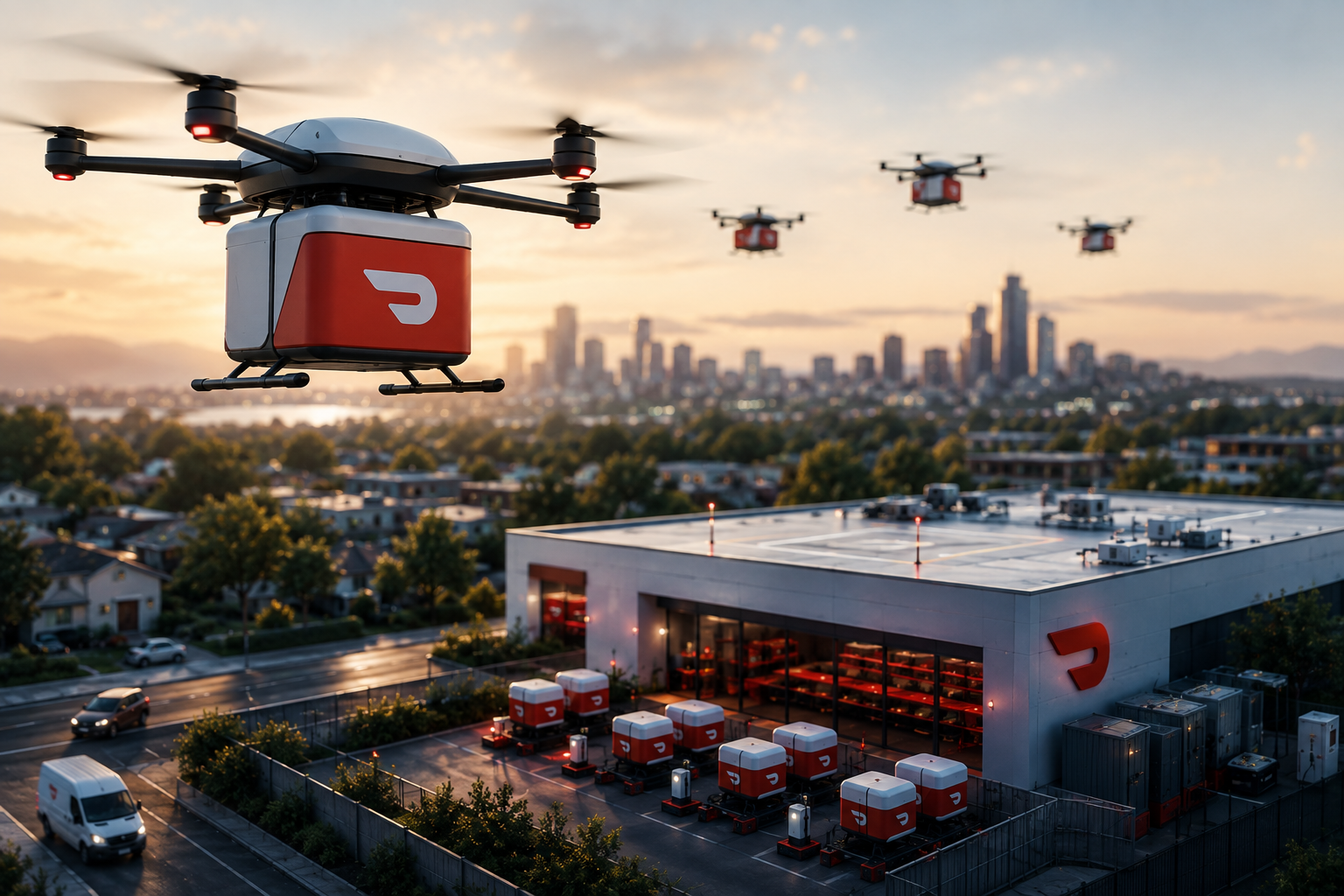
DoorDash just did something most companies in the autonomous delivery space haven’t: it built its own aircraft. On July 29, 2026, the company unveiled DoorDash Air, an in-house drone delivery operation, and confirmed it had received Part 135 air carrier certification from the FAA — the approval required to legally run a commercial drone delivery service in the United States.
What makes this genuinely interesting isn’t just that DoorDash built a drone. It’s that the company spent four years working with drone delivery specialists, supported tens of thousands of deliveries through those partnerships, and is keeping every one of those relationships intact anyway. DoorDash isn’t replacing its partners. It’s becoming a competitor to them, on its own network, at the same time.
What DoorDash Actually Built
DoorDash Air came out of DoorDash Labs, the same in-house robotics and autonomy team that built Dot, the company’s 350-pound autonomous sidewalk delivery robot currently operating in the Phoenix suburbs of Tempe, Mesa, Gilbert and Chandler, plus Fremont, California. The drone itself is American-designed and built, with most components sourced domestically. DoorDash says it can complete deliveries under five miles in an average of less than 25 minutes.
The FAA certification DoorDash secured covers operations within visual line of sight — a baseline requirement, not the finish line. To fly autonomously over longer distances without a human operator keeping the aircraft in view, DoorDash will still need Beyond Visual Line of Sight approval, the same certification Amazon, Wing and Zipline have already secured in recent years.
The Data That Explains the Investment
DoorDash’s existing drone partnerships have already produced a number worth paying attention to: businesses involved in its partner drone pilots saw DoorDash order volume rise by roughly 30%, and that increase held steady through the nine weeks following launch, rather than fading as novelty wore off.
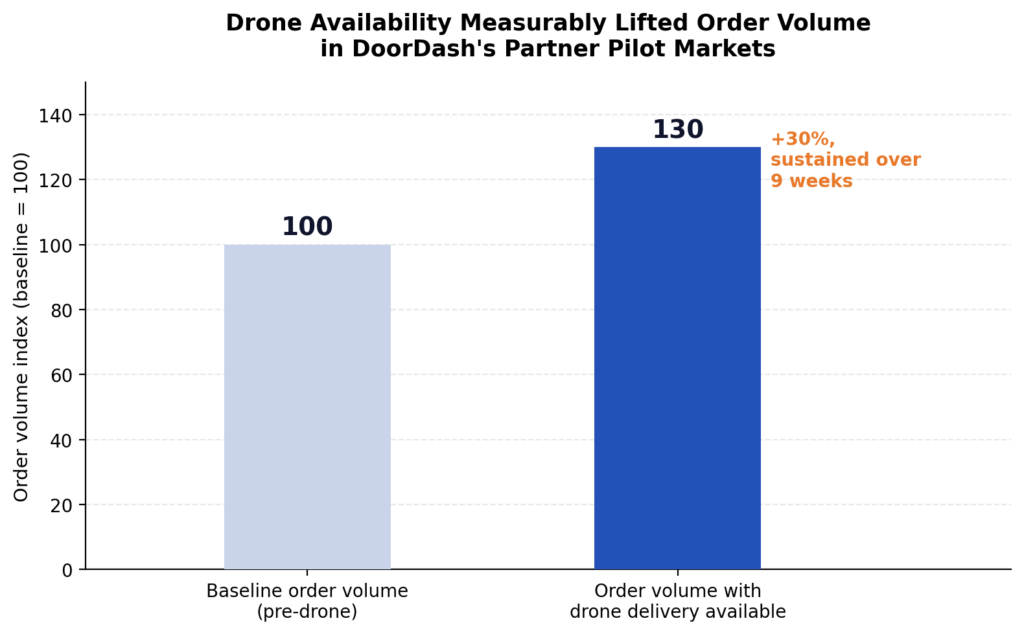
That’s a real commercial signal, not just a curiosity: faster delivery on a meaningful share of orders appears to genuinely change customer behavior, not just generate a short-lived press bump.
Why Build Instead of Just Scaling the Partnerships?
The strategic logic comes down to a familiar platform-economics question: who captures the value as delivery gets cheaper? Every drone delivery DoorDash routes through Wing or Flytrex comes with a partner’s margin attached. Every delivery routed through DoorDash’s own aircraft doesn’t. As drone technology matures and costs fall, a company that owns the hardware and airline operations captures those savings directly; a company that only routes traffic to partners has to negotiate for a share of them.
The real bet isn’t on drones specifically: DoorDash is positioning itself as the network that owns every delivery option — human Dashers, sidewalk robots, drones and outside partners — plus the routing intelligence that decides which method handles each order. Owning more of the stack means owning more of the economics as automation costs fall.
That’s the job of DoorDash’s Autonomous Delivery Platform, which assigns each order to a Dasher, a Dot robot, a drone, or an outside delivery partner in real time based on the order, the route, and delivery conditions. Mid-range orders under five miles look well suited to aircraft; apartment buildings, large orders and complex handoffs still favor a human courier. DoorDash isn’t picking one delivery method and betting the company on it — it’s building the decision layer that picks the cheapest viable method for each individual order.
DoorDash Isn’t the Only One Playing This Game
| Company | Drone delivery approach |
|---|---|
| DoorDash | Building its own fleet (DoorDash Air) while maintaining partnerships with Wing and Flytrex |
| Amazon | Operates its own Prime Air aircraft and drone delivery infrastructure |
| Uber Eats | Partnership-only approach, working with Flytrex for US drone delivery |
| Walmart | Partnership-only approach, working with both Wing and Zipline |
The pattern that emerges is telling: the companies building their own aircraft, DoorDash and Amazon, are also the two building the broadest logistics platforms around that hardware — not just a delivery feature, but an entire routing and fulfillment layer. Companies staying partnership-only, like Uber Eats and Walmart, are treating drones as one delivery option among several rather than a core piece of infrastructure to own outright.
What to Watch Next
- Whether DoorDash secures Beyond Visual Line of Sight approval. Visual-line-of-sight operation limits where and how far DoorDash Air can actually fly commercially — the BVLOS certification is what unlocks real scale.
- How fast DoorDash actually deploys. The company hasn’t given a detailed timeline for when its own aircraft will handle live orders, and it’s expected to start with limited pilot programs rather than a broad rollout.
- Whether owning the hardware actually beats paying partner margins at scale. Vertical integration only pays off if DoorDash can operate its own aircraft more cheaply than it would cost to keep routing volume through Wing and Flytrex indefinitely.








Leave a Reply