


Amazon’s stock jumped more than 10% in after-hours trading following its second-quarter 2026 results, and the reason wasn’t the retail business. It was Amazon Web Services posting its fastest growth in 18 quarters and once again proving it’s the division doing the real profit-generating work for the entire company — e-commerce empire and all.
Total net sales crossed $200 billion in a single quarter for the first time ever, up 20% year-over-year to $200.6 billion. But the number that mattered most to investors sat one line down: AWS revenue hit $42.2 billion, up 37% year-over-year, comfortably beating analyst expectations of 31% growth.
The Profit Math That Explains Everything
Here’s the figure that captures the whole story. AWS generated roughly 21% of Amazon’s total revenue in the quarter, but it delivered close to 61% of the company’s total operating profit. Total operating income came in at $27.5 billion for the quarter, up 43% year-over-year, and AWS alone contributed $16.6 billion of that — up from $10.2 billion a year earlier, at an operating margin of 39.4%, an expansion of 650 basis points from the prior year.
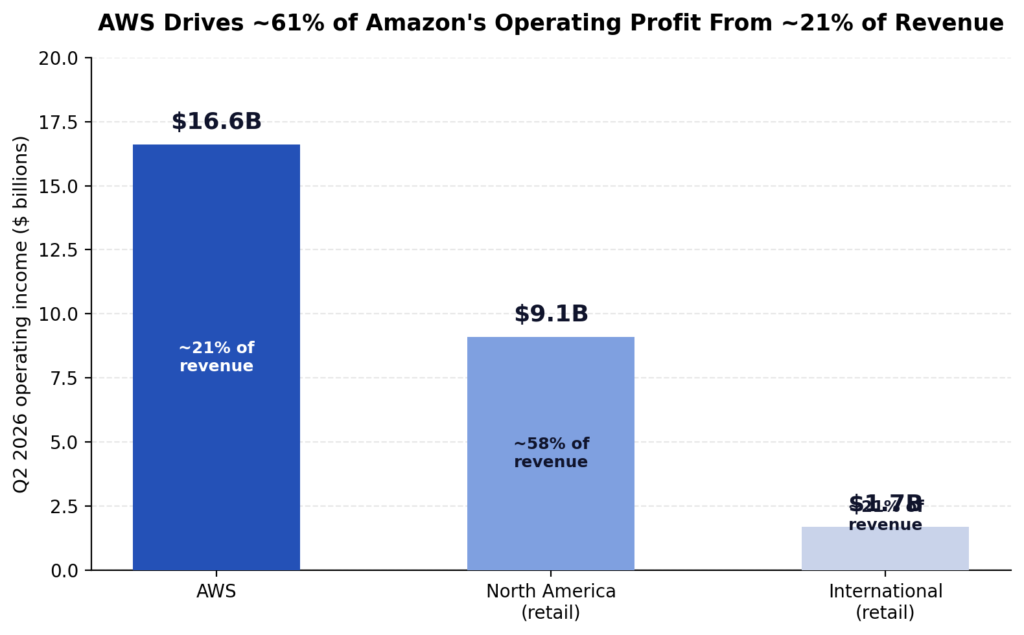
Compare that to the retail side of the business. Amazon’s North America segment posted a 7.9% operating margin ($9.1 billion on $116.2 billion in sales), while the International segment came in at a 4.1% margin ($1.7 billion on $42.2 billion in sales). Retail remains Amazon’s biggest revenue generator by far, but it’s cloud computing that turns that scale into actual profit.
The AI Story Inside the Cloud Story
AWS’s acceleration isn’t happening in spite of the AI boom — it’s happening because of it. CEO Andy Jassy noted that the company’s AI and chips businesses each individually eclipsed annualized revenue run rates of more than $25 billion, growing at triple-digit rates and drawing strong adoption from major AI labs. AWS’s total annualized revenue run rate now stands at $169 billion, and the division’s backlog of contracted work that hasn’t yet come online reached $496 billion — a figure that gives real visibility into how much AI-driven cloud demand is still ahead, not just already realized.
Why the margin expansion matters: AWS grew its operating margin even while scaling capacity to meet AI demand, driven by efficiency gains and capacity optimization rather than simply raising prices. That’s a meaningfully different story than a division growing revenue by spending its way there.
The Capex Bill Behind the Growth
None of this growth is free. Capital expenditures reached roughly $53 to $54 billion in the second quarter alone, up 68% year-over-year, and Jassy told investors the company now expects full-year capital spending to reach $220 billion — almost entirely tied to AI infrastructure. Trailing twelve-month property and equipment purchases climbed to $169 billion, up 64% year-over-year.
That spending is heavy enough to have flipped Amazon’s free cash flow negative on a trailing basis: free cash flow swung to an outflow of $7.6 billion for the trailing twelve months, compared with an $18.2 billion inflow a year earlier, driven by a $66.1 billion year-over-year jump in AI-related infrastructure purchases. Operating cash flow, notably, still grew 33% to $161.4 billion over the same period — the business is generating plenty of cash, it’s just reinvesting essentially all of it and then some back into AI capacity.
A Separate Story Inside the Net Income Number
Amazon’s headline net income of $62.6 billion, more than triple the $18.2 billion reported a year earlier, needs a caveat: it includes $53.4 billion in non-operating pre-tax income, primarily from the appreciation of Amazon’s investment in Anthropic. That’s a real gain, but it’s an investment markup, not operating performance — the underlying operating income figure of $27.5 billion is the number that actually reflects how the business itself performed this quarter.
How AWS Stacks Up Against Cloud Rivals
| Cloud provider | Q2 2026 operating margin |
|---|---|
| AWS | 39.4% |
| Google Cloud | 35.6% |
AWS remains the largest cloud provider by revenue and now posts a wider margin than Google Cloud as well, reinforcing that even as competition in AI infrastructure intensifies, Amazon’s cloud business isn’t just growing — it’s growing more profitably than its closest publicly disclosed comparison point.
What to Watch Next
- Whether capacity constraints ease or worsen. Amazon flagged capacity constraints as a headwind even during an acceleration quarter — demand for AWS’s AI infrastructure is outrunning how fast the company can bring new capacity online.
- How long the $220 billion capex commitment holds. That figure represents a significant bet that AI-driven cloud demand will keep growing fast enough to justify sustained negative free cash flow.
- Whether the $496 billion backlog converts on schedule. A large contracted backlog is only valuable if it lands as recognized revenue at the margins AWS has been posting.





Leave a Reply