


This was a genuinely busy week for tech dealmaking, and the pattern across the announcements is more interesting than any single price tag. Buyers weren’t just acquiring revenue or customer lists — they were acquiring very specific capabilities that have suddenly become urgent: securing the AI agents flooding into enterprise systems, owning more of the AI compute stack, and controlling chip supply chains outright rather than depending on someone else’s.
The Week’s Standout Deal: Cyera Buys Oasis Security for $1 Billion
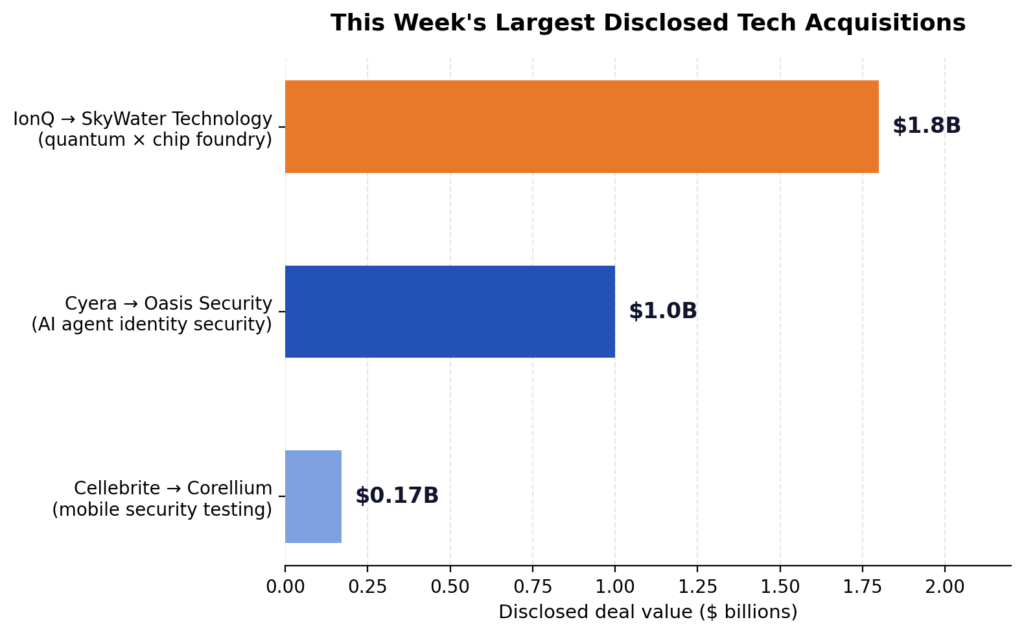
Israeli cybersecurity unicorn Cyera signed a letter of intent to acquire fellow Israeli startup Oasis Security for approximately $1 billion — roughly $700 million in cash, with the rest paid in Cyera shares. Oasis builds technology for securing non-human identities: the service accounts, tokens, digital keys and, increasingly, autonomous AI agents that now operate inside enterprise systems with real access to sensitive data.
The deal is Cyera’s third acquisition of 2026 and its largest by a wide margin, following smaller purchases of Trail Security, Ryft, Genie Security, Shape AI and Otterize. It’s also the second-largest cybersecurity acquisition of the year, trailing only Accenture’s roughly $3.2 billion purchase of a majority stake in industrial security firm Dragos. Oasis will operate as an independent unit within Cyera once the deal closes, and its roughly 80-person team joins a combined company serving more than 500 enterprise customers.
The Rest of the Week’s Notable Deals
Nscale acquires Anyscale
London-based AI cloud provider Nscale agreed to acquire San Francisco startup Anyscale, which helps enterprises scale AI workloads across large GPU clusters for training, inference and reinforcement learning — folding a specialized compute-orchestration layer directly into Nscale’s infrastructure business.
IonQ closes its acquisition of SkyWater Technology
Quantum computing company IonQ cleared its final regulatory hurdle to close its $1.8 billion acquisition of SkyWater Technology, the largest exclusively U.S.-based semiconductor foundry. The deal, closing July 31, makes IonQ the only trapped-ion quantum computing company with a fully domestic, Pentagon-accredited chip supply chain — a vertical integration move aimed squarely at supply chain independence rather than adding a typical venture-backed startup to its portfolio.
Cellebrite acquires Corellium for $170 million
Israeli mobile forensics firm Cellebrite bought mobile testing startup Corellium in a cash-and-equity deal, consolidating capabilities in the mobile security testing space.
IBM acquires Seek AI
IBM picked up Seek AI, a platform that lets users query enterprise data using natural language, with the technology set to become a core piece of Watsonx AI Labs, IBM’s New York-based AI accelerator.
AMD acquires Brium
AMD acquired Brium, a stealth startup focused on AI software optimization, in a move widely read as an attempt to challenge Nvidia’s software advantage rather than just its hardware.
What the Pattern Actually Reveals
Look across these deals together and three themes stand out clearly.
AI agent security has become its own urgent category, almost overnight. Oasis Security didn’t exist as a company until 2022, yet it commanded a $1 billion exit because enterprises are deploying AI agents faster than they can govern what those agents are allowed to touch. As Oasis co-founder Danny Brickman put it, non-human identities have become one of the central security challenges of the AI era — and buyers are moving fast enough that competitors expect new AI security startups to keep raising seed rounds at $20 to $30 million valuations, prices that will only climb as the category matures.
Industry watchers expect more consolidation in AI security specifically, as specialized point solutions get absorbed by larger platforms before they have the chance to scale independently.
Vertical integration is replacing dependency on outside vendors. IonQ didn’t buy SkyWater to add revenue — it bought a chip foundry to stop depending on someone else’s chip supply chain. AMD’s purchase of Brium reads the same way: buying software optimization talent rather than continuing to compete purely on hardware specs against Nvidia’s deeply entrenched software ecosystem.
Big, established platforms are still choosing to buy rather than build. IBM didn’t build its own natural-language enterprise data querying tool from scratch; it bought Seek AI and folded it directly into an existing AI accelerator. That’s become the default playbook across this cycle: acquire a team that’s already solved a specific, narrow problem rather than spend years building comparable capability internally.
Why Israel Keeps Showing Up in the Biggest Deals
Both Cyera and Oasis were founded by veterans of Israel’s Talpiot program and its intelligence technology units, continuing a well-established pattern in cybersecurity exits. Cyera’s founders, CEO Yotam Segev and CTO Tamar Bar-Ilan, are Talpiot graduates and Unit 8200 veterans; Oasis’s founders come from Unit 81, the IDF Intelligence Corps’ technological unit. Israeli-founded companies have produced some of the largest cybersecurity exits of the past several years, and this week’s deal extends that streak rather than breaking it.
What to Watch Next
- Whether AI agent security consolidation accelerates further. With Oasis setting a new benchmark exit value for the category, expect more specialized non-human-identity startups to draw acquisition interest before they can scale as independent companies.
- Whether vertical integration deals like IonQ-SkyWater become more common. As supply chain security becomes a competitive and national-security concern simultaneously, more tech companies may look to own critical infrastructure outright rather than contract for it.
- How quickly acquired teams actually integrate. Several of this week’s deals promise the acquired company will “operate independently” post-close — a pattern worth tracking, since how quickly that independence actually erodes often says more about a deal’s real strategic intent than the press release does.








Leave a Reply