


Every enterprise security team is fighting the same losing battle right now: employees are adopting AI tools faster than anyone can vet them. A new Israeli startup called Glow just raised $180 million at a $1.2 billion valuation on a bet that AI itself is the only thing fast enough to fix that problem — by rebuilding endpoint security from the ground up.
It’s a rare full-circle moment for the cybersecurity industry: the same technology that’s creating the biggest new attack surface in a decade is also being pitched as the cure.
Who Is Glow, and Why Is Everyone Talking About It?
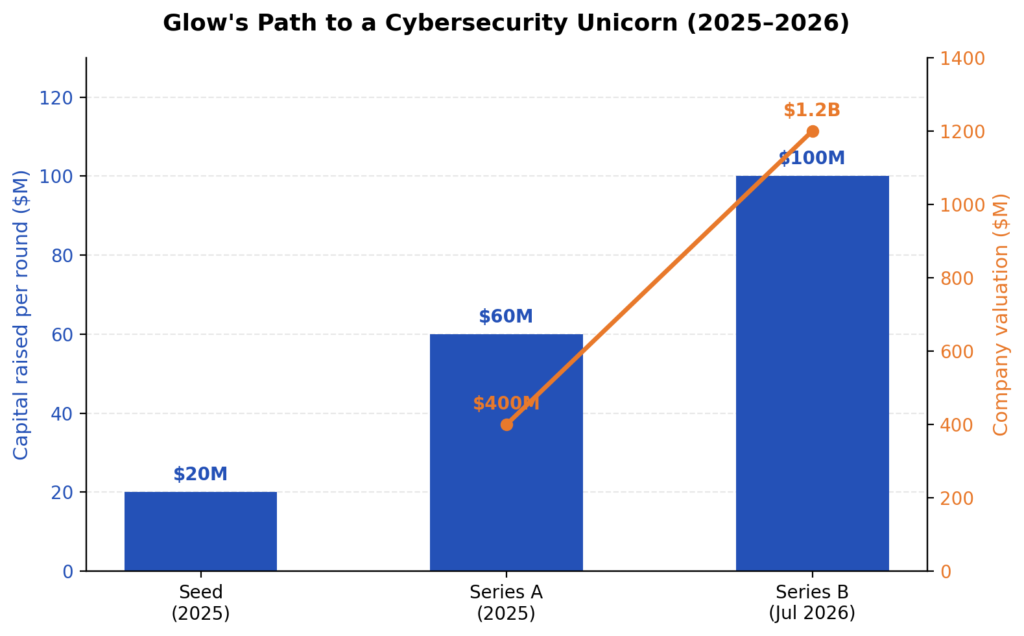
Glow emerged from stealth in July 2026 after raising three funding rounds in roughly a year — a $20 million seed round, a $60 million Series A at a $400 million valuation, and now a $100 million Series B that values the company at $1.2 billion. That trajectory, seed to unicorn in about twelve months, is the kind of pace usually reserved for the hottest names in AI infrastructure, not endpoint security.
The round was led by Sequoia Capital, Cyberstarts, Greenoaks and Redpoint Ventures, with Index Ventures, Swish Ventures, Lux Capital and Holly Ventures also participating. That’s a heavyweight investor bench for a company that’s barely a year old.
The Founding Team Has Serious Pedigree
Glow was founded in 2025 by three people who’ve each spent years inside the systems they’re now trying to replace:
- Roi Tiger (CEO) — spent nine years at Meta as VP of Engineering, after Meta acquired Onavo, the company he originally founded.
- Omer Singer (CTO) — previously head of cybersecurity strategy at Snowflake, with earlier experience in Israel’s Unit 8200.
- Ophir Arie (VP of R&D) — formerly VP of R&D at industrial security firm Claroty, and a graduate of the Talpiot program and Unit 8200.
The leadership bench extends further. Chief Product Officer Arnon Joseph led Meta Israel’s product group, and COO Emily Heath brings a CISO’s-eye view of the problem: she previously held that role at United Airlines and DocuSign, sat on Wiz’s board through its $32 billion acquisition by Google, and was a partner at Cyberstarts.
“I sat in the CISO seat for a long time, and I can tell you the tools available to us were never built for what enterprises face today. Every enterprise wants to move faster with AI. The question isn’t whether they’ll adopt it — it’s whether security can keep up.”
Why Employee Devices Became the Weak Link
Glow’s core bet is that the corporate laptop, not the network perimeter or the cloud, has become the most dangerous piece of enterprise infrastructure. Employees are the ones downloading new AI copilots, connecting autonomous agents to internal systems, and installing tools that IT hasn’t reviewed — often faster than security teams can catch up.
That shift shows up in the numbers. According to data cited by the company, regular use of AI tools on corporate devices — sanctioned or not — jumped from roughly 15% to 45% of employees in a single year. Every one of those tools is a potential new entry point for an attacker.
The core problem, in plain terms: Traditional endpoint security was built to catch known threats using rules and signatures. It was never designed for a world where employees connect new AI agents to company systems every week, and where attackers are using that same AI to move faster than defenders can respond.
How Glow’s Approach Is Different
Rather than adding another point solution to the stack, Glow is positioning itself as a single, prevention-first layer for the entire endpoint. The platform relies on specialized AI agents that continuously map an organization’s devices and software, analyze behavior in real time, and automatically decide which applications should be allowed to run and which should be blocked or removed.
CEO Roi Tiger frames it as a return to an old security principle that never quite worked at scale before:
“Prevention was always the right answer in security. It just never worked at enterprise scale without blocking the business. AI solves that.”
The pitch matters because the endpoint security market Glow is entering is already crowded and enormous — roughly $40 billion, by Tiger’s own estimate — and dominated by established players like CrowdStrike and SentinelOne. Glow’s argument isn’t that those companies are bad at what they do; it’s that the market has fragmented into too many narrow point solutions, none of which was designed with AI-driven risk in mind from day one.
What This Means in Practice for Security Teams
| Traditional endpoint security | Glow’s AI-first approach |
|---|---|
| Relies on signatures and known threat patterns | Continuously analyzes behavior to catch novel, AI-generated threats |
| Multiple specialized tools per use case | Single platform covering devices, applications and data |
| Manual review slows AI tool adoption | Automated policy enforcement designed to keep pace with AI adoption |
| Reactive: responds after a threat is detected | Prevention-first: aims to stop risky software before it runs |
The Bigger Trend: Cybersecurity’s AI Arms Race
Glow’s rise fits into a broader pattern playing out across the cybersecurity industry in 2026. Attackers are using AI to automate more convincing phishing and faster intrusion attempts, and security vendors are racing to answer with AI of their own — from AI-driven SIEM platforms to natural-language-aware phishing detection. Venture capital has taken notice: cybersecurity has become one of the hottest sectors for AI-focused funding this year, and Glow’s twelve-month path from seed to unicorn is one of the clearest signals yet of how much capital is chasing this shift.
Glow says it has already signed enterprise customers across healthcare, retail and financial services, and plans to use its new funding to expand go-to-market operations in the United States and grow its research arm, Glow Labs. The company currently employs around 100 people, roughly 65 of them in Israel, with operations split between Israel and the U.S.
What to Watch Next
- Whether prevention-first actually scales. Automatically blocking software sounds great until it breaks something an employee genuinely needs — the real test is whether Glow’s AI agents can tell the difference reliably enough not to slow the business down.
- How incumbents respond. CrowdStrike and SentinelOne aren’t standing still; both have been investing heavily in their own AI-driven detection and response capabilities.
- Whether the unicorn valuation holds up against revenue. A $1.2 billion valuation on a company that’s roughly a year old will draw scrutiny as Glow moves from stealth into a competitive sales cycle.
For now, Glow is a bet that the fastest-growing security risk inside most companies — unmanaged AI adoption on employee devices — needs an equally fast, AI-native answer. Whether that bet pays off will depend less on the funding headline and more on whether the platform can protect employees without getting in their way.






Leave a Reply