

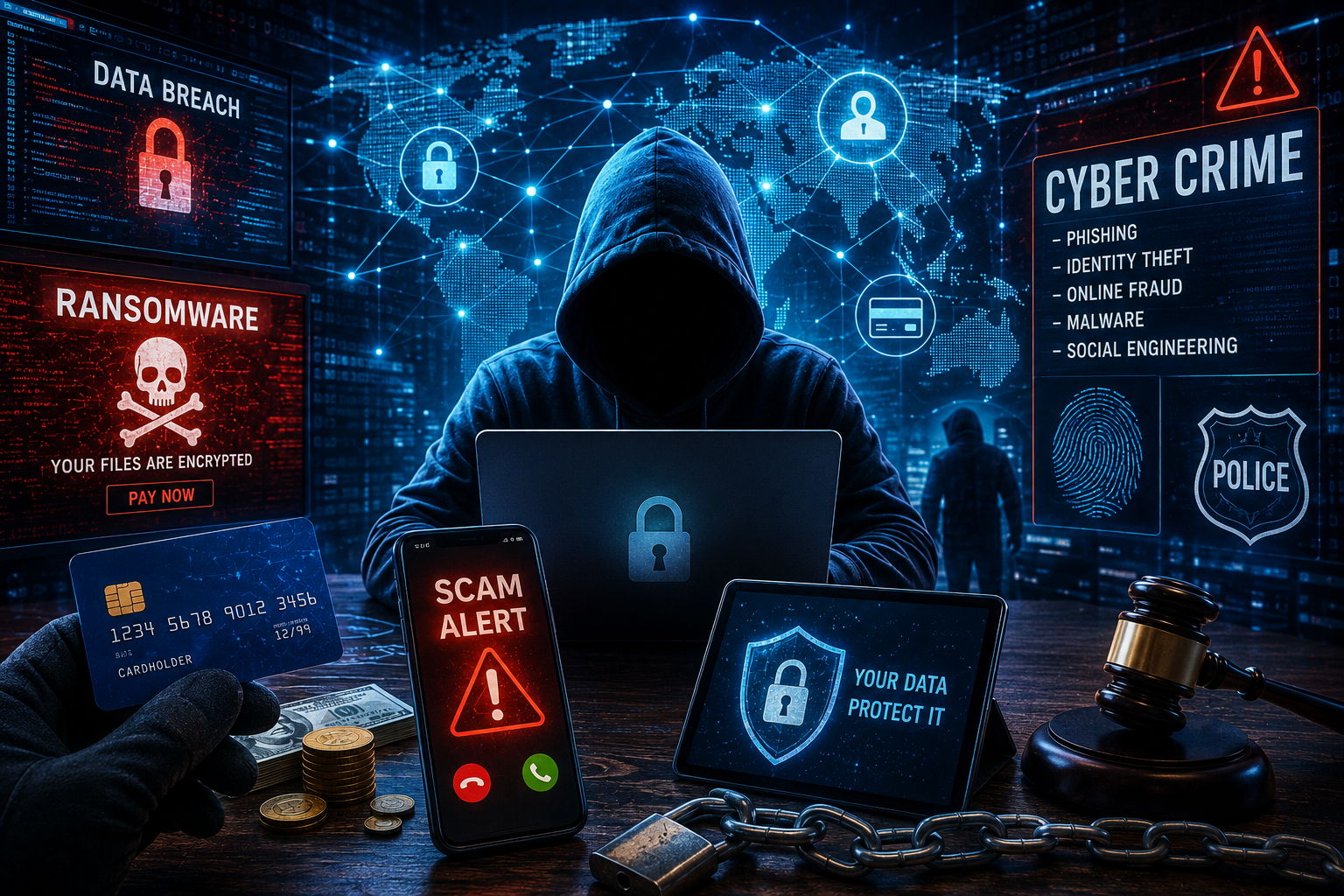
Cyber crime is any criminal activity that uses a computer, a network, or a connected device either as the target or as the tool. It ranges from a single scam email aimed at one person to coordinated operations run by organized groups spanning several countries. Unlike traditional crime, it does not require physical proximity to a victim, does not respect national borders, and can be carried out at a scale no individual criminal could ever achieve in person.
This guide explains what cyber crime actually is, why it keeps growing, who commits it, how it is investigated, and — most importantly — how individuals and organizations can reduce their exposure to it. The goal is a lasting understanding of the subject, not a list of this year’s headlines.
Why This Topic Matters
Nearly every part of modern life now depends on some form of connected system: banking, healthcare records, workplace communication, personal identity documents, even physical infrastructure like power grids. That dependence is exactly what makes cyber crime consequential. A single successful attack can affect a household, a hospital, or an entire supply chain.
Understanding cyber crime matters for three groups in particular:
- Individuals, who need to recognize common tactics like identity theft and scams before becoming a victim
- Businesses, which face financial, legal, and reputational damage from breaches, fraud, and ransomware
- Policymakers and security professionals, who need a clear picture of the incentives driving this activity in order to respond effectively
The specific tools attackers use will keep changing. The underlying motivations and patterns — financial gain, low risk of consequences, and scale — tend to stay remarkably consistent over time.
Core Concept
Definition box:
Cyber crime: Any illegal activity that involves a computer, a network, or a digital device, either as the primary target of the crime or as the method used to carry it out.
Cyber crime is best understood as ordinary criminal motives — theft, fraud, extortion, exploitation — carried out through digital means. What changes is not the intent behind the crime, but the reach, speed, and anonymity available to the person committing it.
Common Categories of Cyber Crime
| Category | What it involves |
|---|---|
| Identity theft | Stealing personal information to impersonate someone, often for financial fraud |
| Online predatory behavior | Using digital platforms to target and exploit vulnerable individuals, particularly minors |
| Business Email Compromise (BEC) | Impersonating a trusted contact, such as an executive or vendor, to trick an organization into transferring money or data |
| Ransomware | Encrypting a victim’s files or systems and demanding payment for their release |
| Intellectual property theft | Stealing trade secrets, proprietary code, or confidential research for competitive or financial gain |
How It Works
While the details vary by crime type, most cyber crime follows a recognizable pattern:
- Reconnaissance — the attacker gathers information about a target, whether that’s a person’s email habits or a company’s network structure.
- Initial access — the attacker gains entry, commonly through a deceptive email, a stolen password, or an unpatched software vulnerability.
- Execution — the actual crime takes place: data is stolen, files are encrypted, funds are redirected, or a victim is manipulated into taking an action.
- Monetization — the attacker converts the crime into financial gain, often through fraud, extortion payments, or selling stolen data.
- Covering tracks — the attacker attempts to stay anonymous, frequently using techniques designed to obscure their identity and location.
Why Money Laundering Has Gotten Easier
A significant part of what sustains cyber crime economically is how easily proceeds can be moved and hidden. Cryptocurrency plays a central role in this.
Definition box:
Cryptocurrency: Money that exists only in digital form, secured through cryptography and recorded on a public ledger, rather than issued and tracked by a central bank or physical currency.
Certain services, commonly called tumblers or mixers, take incoming cryptocurrency and split it into many smaller transactions, routed through numerous intermediate accounts before reaching its final destination. This makes it significantly harder for investigators to trace funds back to their original source.
Real Examples
- A fraudulent wire transfer initiated after an employee receives an email that appears to come from a company executive, requesting an urgent payment to a new account.
- A hospital’s patient records system locked by ransomware, with attackers demanding payment before restoring access.
- A stolen social security number used to open credit accounts in someone else’s name, discovered only when debt collectors contact the victim.
- A small manufacturing company’s proprietary designs exfiltrated by an attacker and later found for sale, or used by a competitor.
- A coordinated network of compromised devices (“bots”) used to flood a company’s servers with traffic, taking its website offline.
Why Cyber Crime Continues to Rise
| Driver | Explanation |
|---|---|
| Low barrier to entry | Many attack techniques are well documented and require limited technical skill to execute |
| Low risk of getting caught | Jurisdictional boundaries and anonymization tools make prosecution difficult |
| High return for low effort | A single successful scam or ransomware attack can generate significant profit relative to the effort involved |
| Massive scale | The same attack can be sent to thousands or millions of potential victims simultaneously |
| Easier money laundering | Cryptocurrency and mixing services simplify converting criminal proceeds into usable funds |
Benefits (of Understanding Cyber Crime)
| Benefit | Why it matters |
|---|---|
| Better personal protection | Recognizing common tactics reduces the likelihood of falling victim to them |
| Stronger organizational defenses | Understanding attacker incentives helps prioritize security spending effectively |
| Faster incident response | Familiarity with typical attack patterns shortens the time needed to detect and contain an incident |
| Informed policy and regulation | A clear picture of the problem supports more effective laws and enforcement cooperation |
Drawbacks and Limitations of Current Defenses
| Limitation | Why it matters |
|---|---|
| Jurisdictional complexity | Attacks routed through multiple countries make legal pursuit slow and often unsuccessful |
| Attribution difficulty | Determining who is actually behind an attack, rather than just which system it came from, is technically hard |
| Resource imbalance | Defenders must protect against every possible attack; attackers only need one successful attempt |
| Human factor | Even strong technical defenses can be bypassed through social engineering aimed at employees |
Best Practices
For individuals:
- Use unique, strong passwords for each account, ideally managed through a password manager
- Enable multi-factor authentication wherever it’s offered
- Be skeptical of unexpected messages requesting money, credentials, or personal information, even if they appear to come from someone familiar
- Monitor financial and credit statements regularly for unfamiliar activity
- Keep devices and software updated to patch known vulnerabilities
For organizations:
- Verify high-value payment requests through a second communication channel, especially for wire transfers
- Train employees to recognize phishing and BEC tactics on a recurring basis, not as a one-time event
- Maintain regularly tested backups, stored separately from the main network, to reduce ransomware leverage
- Apply the principle of least privilege, limiting each employee’s system access to what their role actually requires
- Have a documented incident response plan in place before an attack happens, not after
Checklist: Reducing exposure to common cyber crime
- Multi-factor authentication enabled on all critical accounts
- Payment and wire transfer requests verified through a second channel
- Backups tested and stored separately from the main network
- Employee security awareness training scheduled regularly
- Software and systems kept current with security updates
- Incident response plan documented and reviewed
Common Mistakes
- Assuming a business is too small to be targeted. Smaller organizations are often targeted precisely because they tend to have weaker defenses.
- Trusting communication based on appearance alone, such as an email that looks legitimate but has a slightly altered sender address.
- Paying a ransom without addressing the underlying vulnerability, which often leads to repeat attacks.
- Reusing passwords across multiple accounts, so one breach compromises many.
- Treating security training as a formality rather than an ongoing practice, leaving staff unprepared for evolving tactics.
- Failing to report incidents, which limits law enforcement’s ability to identify patterns and pursue attackers across cases.
Use Cases
- Personal financial protection — recognizing identity theft and fraud attempts before financial damage occurs.
- Corporate risk management — building security awareness and incident response into standard business operations.
- Law enforcement and policy — understanding attacker incentives to prioritize enforcement resources and cross-border cooperation.
- Insurance and risk assessment — evaluating cyber risk exposure for individuals and organizations alike.
Industry Applications
| Industry | Relevance |
|---|---|
| Financial services | High-value target for fraud, BEC, and identity theft schemes |
| Healthcare | Sensitive patient data and critical systems make it a frequent ransomware target |
| Manufacturing | Intellectual property theft can undermine years of research and development |
| Retail and e-commerce | Large volumes of customer payment data make it attractive to attackers |
| Critical infrastructure | Attacks on utilities or transportation systems can have consequences beyond financial loss |
| Small and mid-sized businesses | Often targeted due to comparatively limited security resources |
Organizations building out a broader security posture may also want to review how cybersecurity works for a more technical, defense-focused breakdown that complements the concepts covered here.
Who Commits Cyber Crime
Cyber criminals are not a single, uniform group. Broadly, they tend to fall into a few recurring categories:
- State-sponsored groups, operating on behalf of a government to target organizations or infrastructure in other countries, often for espionage or strategic advantage
- Organized hacking groups, motivated primarily by financial gain, frequently through ransomware or large-scale fraud
- Individual opportunists, including less experienced attackers using widely available tools to target easy victims
The line between these categories can blur, particularly as tools and techniques developed by more sophisticated groups eventually become accessible to less skilled attackers.
Catching Cyber Criminals
Cyber criminals often operate with a meaningful degree of anonymity, and many are never identified or prosecuted. When arrests do happen, they frequently result from mistakes made by the attacker — reused infrastructure, careless communication, or complacency after a long run of success — rather than a single decisive technical breakthrough by investigators.
Law enforcement also faces a structural challenge: attack traffic is often routed through multiple countries before reaching its final source. Tracing an intrusion back through one jurisdiction frequently reveals that the trail continues into another, and cooperation across borders — while sometimes effective — can be slow, inconsistent, and dependent on the political relationship between the countries involved.
This is part of why cyber crime investigations often extend well beyond identifying the immediate technical source of an attack, and why international cooperation between law enforcement agencies has become an increasingly important part of pursuing these cases.
Future Outlook
A few underlying dynamics are likely to remain relevant regardless of how specific attack techniques evolve:
- The economics will keep favoring attackers unless the risk-to-reward balance shifts meaningfully, through stronger international enforcement cooperation or more effective financial tracing.
- Automation will continue lowering the skill barrier, making sophisticated attack techniques accessible to a wider range of people, not just skilled specialists.
- Cross-border cooperation will remain the central bottleneck in prosecution, more so than any single technical defense.
- Organizations will increasingly treat cyber risk as a core business risk, not a purely technical one, integrating it into financial planning, insurance, and executive-level decision-making rather than leaving it solely to IT departments.
The specific attack methods making headlines today will eventually be replaced by new ones. The core pattern — low cost, low risk, high potential reward, at scale — is the part worth understanding deeply, because it explains why cyber crime keeps adapting rather than disappearing.
Frequently Asked Questions
What is the difference between cyber crime and cybersecurity? Cyber crime refers to the criminal activity itself — the attacks, fraud, and theft carried out through digital means. Cybersecurity refers to the practices and technologies used to prevent, detect, and respond to that activity. One describes the threat; the other describes the defense.
Is ransomware still a major threat? Ransomware remains one of the most damaging forms of cyber crime because it directly disrupts operations, not just data confidentiality. Its continued effectiveness comes from the immediate operational pressure it creates, which pushes some victims toward paying even when doing so is discouraged.
Why is cryptocurrency associated with cyber crime? Cryptocurrency itself is a legitimate financial technology, but certain features — pseudonymous transactions and the availability of mixing services — make it easier for criminals to move and obscure proceeds compared to traditional banking, which has more established tracing and reporting requirements.
Can individuals really be targeted, or is it mostly businesses? Both. Businesses are attractive due to larger potential payouts, but individuals are targeted constantly through identity theft, phishing, and scams, precisely because they are typically easier to compromise than a well-defended organization.
What is Business Email Compromise (BEC)? BEC is a scam where an attacker impersonates a trusted figure, such as an executive or supplier, usually by email, to convince someone within an organization to transfer money or sensitive information. It relies on social engineering more than technical hacking.
Why do cyber criminals rarely get caught? Anonymity tools, cross-border operations, and the sheer volume of attacks make investigation resource-intensive and slow. Many successful arrests occur because the attacker made an operational mistake, not because of a technical breakthrough by investigators.
Are state-sponsored cyber attacks different from criminal ones? Often, yes, in motive. State-sponsored activity is frequently aimed at espionage, strategic disruption, or intelligence gathering rather than direct financial gain, though some state-linked groups also engage in financially motivated crime.
What should someone do immediately after suspecting identity theft? Contact financial institutions to secure affected accounts, place a fraud alert or credit freeze with credit bureaus, and file a report with the appropriate national or local authority. Acting quickly limits how much additional damage can occur.
Does paying a ransom guarantee data recovery? No. There is no guarantee that paying will result in working decryption or that stolen data won’t still be leaked or sold. This uncertainty is a key reason many security and law enforcement bodies advise against paying whenever possible.
How does international law enforcement cooperation actually work in cyber crime cases? Agencies in different countries share evidence and coordinate investigations, but effectiveness depends heavily on the diplomatic and legal relationship between the countries involved. When an investigation leads to a country without strong cooperation agreements, the trail often goes cold.
Key Takeaways
- Cyber crime applies familiar criminal motives — theft, fraud, extortion — through digital tools that offer greater scale, speed, and anonymity.
- It continues rising because it is low-cost, low-risk, and highly scalable for attackers, while remaining resource-intensive to investigate and prosecute.
- Cryptocurrency and mixing services have made laundering criminal proceeds significantly easier.
- Attackers span a spectrum from state-sponsored groups to organized criminal operations to individual opportunists.
- Cross-border jurisdiction remains the single biggest obstacle to catching and prosecuting cyber criminals.
- The most effective defenses combine technical controls with consistent human awareness, since many attacks succeed through manipulation rather than pure technical exploitation.
Final Thoughts
Cyber crime persists not because it is unstoppable, but because the current balance of risk and reward still favors the attacker in most cases. That balance shifts slowly, through better international cooperation, financial tracing, and — just as importantly — through individuals and organizations making themselves harder, less profitable targets.
Understanding how and why these crimes happen is the first real layer of defense. The specific scams and tools will keep changing; the underlying incentives, and the habits that reduce your exposure to them, tend to stay the same.





Leave a Reply