

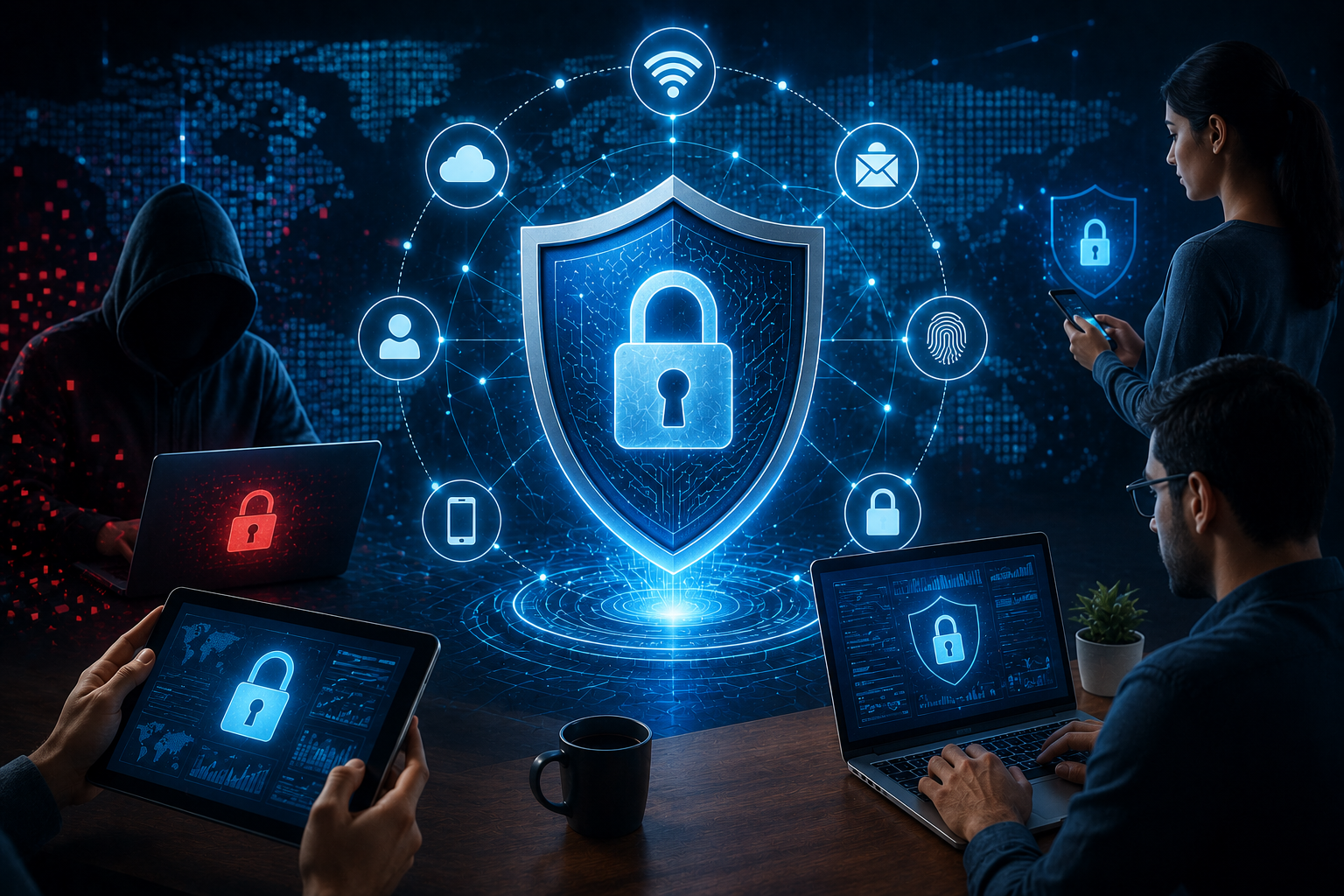
Every online action carries some degree of risk. Logging into a bank account, opening an email attachment, or connecting a new smart device to home Wi-Fi all create small openings that a careless moment can turn into a serious problem. Cybersecurity awareness is the practice of recognizing those openings before they’re exploited — and it’s one of the few security measures that costs nothing but attention and habit.
This guide explains what cybersecurity awareness actually involves, the threats it protects against, and how individuals, organizations, and governments each carry part of the responsibility for keeping digital systems safe.
What Cybersecurity Awareness Actually Means
Cybersecurity awareness is the working knowledge of how cyber threats operate and what safe digital behavior looks like in practice. It’s less about memorizing technical terms and more about building instincts: pausing before clicking an unfamiliar link, noticing when a request for information feels off, and knowing what to do when something goes wrong.
Security researchers consistently point to human error — not software flaws — as the leading cause of breaches. Firewalls and antivirus software can only do so much if the person behind the keyboard hands over a password or opens an infected file. Awareness closes that gap. It turns every user into an active part of the defense system rather than the weakest link in it.
Why This Matters More Than Ever
Digital systems now sit underneath nearly everything: banking, healthcare records, workplace communication, shopping, and personal relationships. That convenience comes with exposure. A single compromised account can lead to drained savings, stolen identities, or a company’s confidential data ending up for sale.
The financial and reputational cost of a breach rarely stays contained to one victim. A business that loses customer data faces legal penalties, operational downtime, and a trust deficit that can take years to rebuild. An individual whose identity is stolen may spend months untangling fraudulent accounts and damaged credit.
What’s changed is who’s responsible for prevention. Cybersecurity used to be treated as an IT department’s job. It’s now understood as a shared responsibility — every person with an internet connection is a potential entry point, and every person who understands the risks is a layer of defense.
Common Cyber Threats Worth Knowing
Recognizing a threat is the first step to avoiding it. The most common categories include:
- Phishing attacks — fraudulent emails, texts, or messages designed to trick someone into revealing passwords, financial details, or other sensitive information. These often mimic trusted brands or coworkers.
- Malware and ransomware — malicious software that damages systems, steals data, or locks files until a ransom is paid.
- Password attacks — attempts to guess, steal, or reuse leaked credentials, often successful because people reuse the same password across multiple accounts.
- Data breaches — unauthorized access to stored information, frequently the result of a weak point somewhere in a company’s systems rather than a single dramatic hack.
- Social engineering — psychological manipulation that convinces someone to bypass normal security procedures, such as a caller impersonating IT support to get a password reset.
These categories overlap constantly. A social engineering call might set up a phishing email, which delivers malware, which then leads to a data breach. Understanding each piece makes the full chain easier to spot and interrupt.
Practical Habits for Individuals
Most personal cybersecurity risk can be reduced through a small set of consistent habits rather than complex technical knowledge:
- Use a unique, strong password for every account. Reusing passwords means one leaked credential can unlock several accounts at once. A password manager makes this practical without requiring memorization.
- Turn on two-factor authentication wherever it’s offered. This adds a second checkpoint — usually a code sent to your phone or generated by an app — so a stolen password alone isn’t enough to break in.
- Slow down before clicking links or opening attachments. Check the sender’s actual email address, not just the display name, and be skeptical of urgent language pushing you to act immediately.
- Keep software and operating systems updated. Many updates exist specifically to patch security vulnerabilities that attackers actively look for.
- Limit what personal information you share publicly. Details like a birthdate, pet’s name, or mother’s maiden name are often used as security question answers or password-recovery clues.
None of these steps require technical expertise. They require consistency, which is why awareness — not just access to security tools — is what actually determines outcomes.
Building Awareness Inside Organizations
Organizations face a different scale of risk than individuals. A single employee’s mistake can expose an entire customer database, and interconnected systems mean one weak point can compromise many others.
Effective organizational security programs typically combine:
| Measure | Purpose |
|---|---|
| Regular staff training | Keeps employees current on new threats and reinforces safe habits |
| Security audits and vulnerability assessments | Identifies weak points before attackers find them |
| Firewalls and intrusion detection systems | Monitors and blocks unauthorized access attempts |
| Clear data access and device-use policies | Limits exposure by ensuring only the right people can reach sensitive systems |
| A defined incident response plan | Reduces damage and recovery time when a breach does occur |
Training is often the most overlooked of these. Technical defenses are only as strong as the people operating within them, and a well-trained employee who recognizes a phishing attempt can stop a breach that no firewall would have caught. Organizations that treat training as a recurring practice — not a once-a-year checkbox — see measurably fewer successful attacks.
The Role of Governments and Public Policy
Individual habits and company policies matter, but large-scale cyber threats — attacks on power grids, hospitals, or financial systems — require coordination that only governments can provide. Government responsibility in this space generally includes:
- Setting and enforcing cybersecurity regulations and data protection standards
- Supporting information-sharing between public agencies and private companies
- Protecting critical infrastructure such as energy, healthcare, and banking systems
- Running public education campaigns that raise baseline awareness across the population
A country’s cybersecurity posture is only as strong as its weakest connected system, which is why national frameworks tend to focus heavily on critical infrastructure and cross-sector cooperation rather than any single industry.
Why Awareness Has to Be Ongoing, Not One-Time
Cyber threats evolve constantly. A defense that works today may be obsolete within a year as attackers find new methods and technologies create new points of exposure. This is why cybersecurity awareness works best as a continuous habit rather than a training session completed once and forgotten.
Practical ways to keep awareness current include revisiting basic safety practices periodically, staying alert to new scam patterns as they emerge, and treating every unfamiliar request for information — whether by email, phone, or text — with the same healthy skepticism regardless of how long you’ve been online.
Best Practices at a Glance
- Treat unexpected urgency in a message as a warning sign, not a reason to act fast.
- Separate personal and work accounts, and never reuse passwords between them.
- Back up important data regularly so a ransomware attack can’t hold it hostage.
- Verify requests for sensitive information through a second channel before responding.
- Apply security updates as soon as they’re available rather than postponing them.
Common Mistakes That Undermine Awareness
- Assuming security is someone else’s job. Awareness only works when everyone, not just IT staff, treats it as a shared responsibility.
- Reusing passwords across accounts. This turns one small breach into a much larger one.
- Ignoring software updates. Delayed updates leave known vulnerabilities open far longer than necessary.
- Overlooking social engineering. Many people are trained to spot suspicious links but not trained to question a convincing phone call or in-person request.
- Treating training as a one-time event. Awareness fades without repetition, especially as new threats emerge.
Where Cybersecurity Awareness Is Headed
As artificial intelligence, cloud computing, and connected devices become more embedded in daily life, the attack surface keeps expanding. AI-generated phishing messages are harder to distinguish from genuine communication, and every new smart device added to a home or office network is another potential entry point.
This doesn’t mean the fundamentals change — strong passwords, skepticism toward unsolicited requests, and timely updates remain effective regardless of how sophisticated attacks become. What it does mean is that awareness has to keep pace with new technology rather than assume yesterday’s precautions are permanently sufficient.
Key Takeaways
- Cybersecurity awareness is the practical knowledge that turns every user into a layer of defense rather than a point of weakness.
- Most breaches trace back to human error, which makes awareness one of the highest-value, lowest-cost security investments available.
- Individuals, organizations, and governments each carry distinct but interconnected responsibilities for digital safety.
- Awareness only works as an ongoing habit — threats evolve, and static knowledge becomes outdated.
- Simple, consistent practices like unique passwords, two-factor authentication, and cautious clicking prevent the majority of common attacks.
Frequently Asked Questions
What is the simplest way to improve personal cybersecurity? Start with unique passwords for every account and two-factor authentication wherever it’s available. These two habits alone prevent a large share of common account takeovers, and neither requires technical skill.
Why is human error considered the biggest cybersecurity risk? Technical defenses like firewalls can be bypassed if a person is tricked into handing over credentials or clicking a malicious link. Attackers often find it easier to manipulate a person than to break through software protections directly.
How often should organizations train employees on cybersecurity? Ongoing, recurring training works far better than a single annual session. Threats change frequently, and awareness fades over time without reinforcement, so short, regular refreshers tend to be more effective than infrequent long ones.
What should someone do if they suspect a phishing attempt? Avoid clicking any links or downloading attachments, verify the sender through a separate channel if the message claims to be from someone you know, and report it through your email provider or workplace IT team rather than responding directly.
Will artificial intelligence make cybersecurity threats worse? AI is making some attacks, like phishing messages, more convincing and harder to detect at a glance. The core defenses — skepticism, verification, and consistent security habits — remain effective, but staying informed about how threats evolve becomes more important as the technology advances.
Conclusion
Cybersecurity awareness isn’t a technical specialty reserved for IT professionals — it’s a practical skill set that belongs to everyone who uses a connected device. The threats will keep changing, but the underlying principle stays the same: informed, consistent habits are the most reliable defense available, at any scale, against a threat landscape that never stops moving.




Leave a Reply