


Enterprise software spent the last couple of years in an uncomfortable position: still essential to how businesses run, but no longer the thing venture investors were most excited to fund. AI absorbed the spotlight, and enterprise software startups had to compete for capital against companies promising to reinvent entire categories from scratch. That dynamic has shifted meaningfully in 2026, and the numbers behind the shift are genuinely striking.
The Headline Number: Funding Is on Track to Nearly Quadruple
Global SaaS startup funding reached $166.8 billion in full-year 2025. In just the first six months of 2026, SaaS startups have already raised $317.1 billion — putting the full year on pace to land around $634.2 billion, a roughly 280% increase year-over-year.
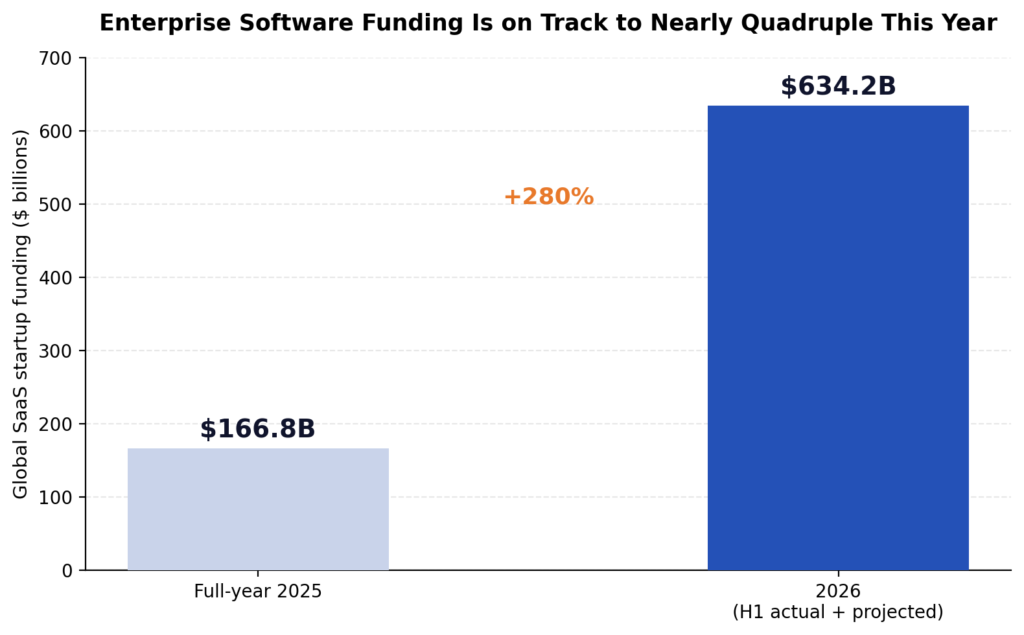
That’s not a modest rebound. It’s the kind of number that would have sounded implausible even twelve months ago, when SaaS was being treated as the sector AI was actively displacing rather than one AI was about to supercharge.
This Recovery Doesn’t Look Like 2021
The critical nuance is that this isn’t broad-based enthusiasm returning to enterprise software the way it did during the last major boom. It’s capital concentrating into a smaller number of much larger, more carefully underwritten rounds. Series B activity actually declined in 2025 — total capital raised at that stage dropped 16% quarter-over-quarter and 26% year-over-year by the third quarter — even as late-stage rounds captured a full 68% of North American venture funding overall.
Valuation discipline tells the same story. Where SaaS companies once commanded 20 to 30 times annual recurring revenue at Series B during the 2021 peak, 2026 benchmarks cluster around 8 to 12 times ARR for companies with genuinely strong fundamentals. Growth above 40% year-over-year still commands a premium multiple of 7 to 10 times revenue; growth below 20% gets priced at just 3 to 5 times. The pitch that worked at seed stage doesn’t carry investors at later rounds anymore — the actual numbers have to do the talking.
What changed in how investors evaluate these companies: Boards and investors are now asking detailed questions about customer acquisition payback periods, LTV-to-CAC ratios, and Rule of 40 performance before approving expansion capital — a level of financial scrutiny that was frequently waived during the 2021 boom in favor of pure growth-rate storytelling.
A Real Example of What’s Winning Capital
Spend-management platform Ramp closed a $750 million round led by Iconiq, GIC and the Ontario Teachers’ Pension Plan, setting a $44 billion valuation for the seven-year-old company. That’s not a speculative early bet on an unproven idea — it’s a mature, revenue-generating enterprise software business with a specific, well-understood product, raising at a scale that signals real investor conviction rather than fear of missing out on the next big narrative.
Why the Turnaround Is Happening Now
Part of the answer is that AI adoption inside the enterprise has moved past its most uncertain phase. As one venture investor put it heading into 2026, AI is hitting a further inflection point in enterprise settings as security questions and technology choices get largely resolved, with businesses substantially increasing how fast they build and deploy software as a result. Another investor framed 2026 bluntly as a “fundamentals-first” year, where capital rewards real revenue growth, efficiency and genuine AI advantage, and actively punishes companies offering AI branding wrapped around old ideas.
Enterprise AI spending grew from $1.7 billion in 2023 to $11.5 billion in 2024 to $37 billion in 2025 — a 3.2x year-over-year growth rate that now represents more than 6% of the entire software market within just three years of ChatGPT’s launch.
That spending growth matters directly for enterprise software investors: it’s evidence that real corporate budgets are shifting toward AI-enabled software products, not just that founders are pitching AI features. Investors funding enterprise software today are betting on companies actually capturing a share of that growing spend, not just riding a narrative.
The Recovery Isn’t Uniform
| Segment | What the data shows |
|---|---|
| Horizontal enterprise software & AI-enabled platforms | Driving most of the headline funding surge, with large, well-underwritten rounds |
| Vertical SaaS | Down roughly 43% year-to-date in 2026 versus the comparable 2025 period, with fewer top-tier investors participating in deals |
| Software VC deal count overall | Rose about 12% in 2025 to an estimated 9,200 deals, still well below the 2021 peak of 16,446 |
| Enterprise software IPOs since 2020 | Roughly 75% still trade below their initial valuation, keeping many top private companies from rushing to go public |
What to Watch Next
- Whether the recovery broadens beyond mega-rounds. A handful of massive raises driving the headline total is a different, more fragile story than broad-based investor conviction across the sector.
- Whether vertical SaaS catches up. If capital stays concentrated in horizontal platforms while specialized vertical products keep losing funding share, that could shape which problems actually get solved by well-capitalized startups over the next few years.
- Whether the IPO window finally reopens. With most recent enterprise software IPOs still underwater relative to their debut valuations, a successful high-profile listing could meaningfully change how willing top private companies are to go public rather than stay private and keep raising.








Leave a Reply