

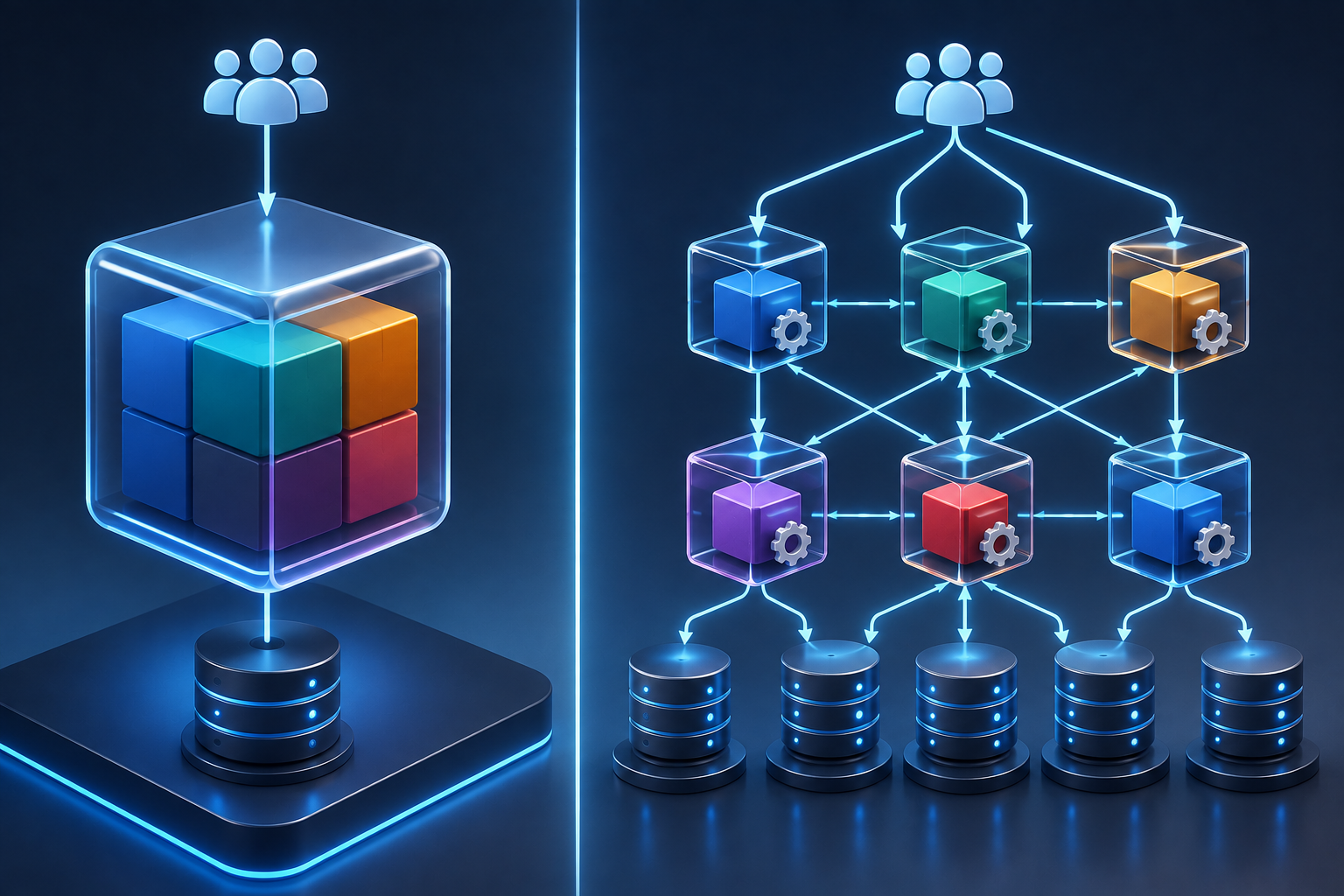
Every SaaS founder eventually asks the same question, usually at the worst possible time: should this be a monolith or microservices? The honest answer is almost never “microservices, obviously” — despite how often that’s the assumption in engineering circles. Architecture is a trade-off decision, not a maturity badge, and getting it wrong in either direction can quietly sink a product long before anyone notices.
This article isn’t about generating an app with a single AI prompt. If a prompt could produce your entire production architecture, your client could type that prompt themselves. Real software engineering means understanding what’s actually happening underneath — the code, the databases, the APIs, the infrastructure, and the trade-offs that determine whether a product survives its first real spike in traffic.
What Is Software Architecture?
Software architecture is the structural design of an application — how its pieces are organized, how they communicate, and how responsibility is divided across the system. At the simplest level, most SaaS products share a similar chain:
Frontend → Backend → API → Business Logic → Database → Infrastructure
Consider a project management SaaS product with Users, Projects, Tasks, Teams, and Billing. A user logs in (authentication), creates a project (business logic), assigns a task (data write), and gets billed monthly (a background process). Every one of these actions moves through the same chain, and architecture is the decision about how tightly or loosely those pieces are connected to each other.
What Is a Monolithic Application?
A monolith is a single, unified application where all major functionality — authentication, users, projects, billing, notifications, admin — lives inside one codebase and deploys as one unit.
Frontend
   ↓
Backend Application
   ├── Authentication
   ├── Users
   ├── Projects
   ├── Billing
   ├── Notifications
   └── Admin
   ↓
Database
It’s worth being direct about a common misconception: “monolith” does not mean bad architecture, outdated technology, unscalable design, or poor engineering. Some of the largest, most reliable software systems in the world run as well-structured monoliths. A monolith built with clear internal boundaries can absolutely support significant traffic and a large, active user base.
What Is Microservices Architecture?
Microservices split an application into independently deployable services, each owning a specific business capability, typically communicating through an API gateway.
API Gateway
   ↓
User Service   Project Service   Billing Service   Notification Service
   ↓
Individual databases/services where appropriate
The defining characteristics aren’t just “multiple codebases” — they’re clear service boundaries, independent deployment, explicit communication between services, clear ownership per team, failure isolation (one service crashing shouldn’t take down the whole system), and the ability to scale each service independently based on its own load.
Monolith vs. Microservices — Core Differences
| Dimension | Monolith | Microservices |
|---|---|---|
| Codebase | Single, unified | Multiple, independently owned |
| Deployment | One deployable unit | Independent per service |
| Database | Typically one, logically separated | Often separate per service |
| Scaling | Whole application scales together | Each service scales independently |
| Development | Simpler locally, faster early iteration | Requires more coordination |
| Debugging | Easier — single process, single log stream | Harder — distributed tracing required |
| Infrastructure | Simpler | Requires gateway, discovery, orchestration |
| Team structure | Works well for small, unified teams | Suits multiple autonomous teams |
| Failure modes | One failure can affect the whole app | Failures can be isolated to one service |
| Monitoring | Centralized, straightforward | Requires distributed observability tooling |
| Cost | Lower operational overhead | Higher infrastructure and tooling cost |
| Complexity | Lower to start, can grow internally messy | Higher from day one |
| Startup suitability | Generally strong fit | Usually premature |
| Enterprise suitability | Can still work well at scale | Often justified at sufficient org size |
Why Startups Often Should Start With a Monolith
Early-stage startups need to validate product, market, users, and business model — not infrastructure sophistication. Every hour spent wiring up service discovery is an hour not spent figuring out whether anyone actually wants the product.
Premature microservices introduce real costs before a startup has earned the need for them: network calls where function calls used to work, distributed debugging across multiple services, service discovery configuration, monitoring complexity across independent systems, more complicated deployment pipelines, data consistency problems once information is split across databases, and meaningfully higher infrastructure costs.
The guiding principle is simple: solve product complexity before introducing distributed-system complexity. A startup that hasn’t found product-market fit gains nothing from an architecture built to survive organizational scale it doesn’t have yet.
When Microservices Actually Make Sense
Microservices become genuinely justified under a specific set of conditions — and traffic volume alone isn’t one of them. Legitimate reasons include large engineering teams that need to work independently without stepping on each other, components with independent scaling requirements, strong and well-understood service boundaries, a real need for independent deployment cycles, different technology requirements across components, high organizational complexity spanning multiple teams, and specific components with dramatically different workload patterns than the rest of the system.
Notice what’s missing from that list: “we have a lot of users.” High traffic is frequently solved by scaling a monolith horizontally, discussed further below — it’s rarely, by itself, sufficient justification for the operational cost of a distributed system.
A Real SaaS Example: InvoiceFlow
Picture a fictional SaaS product called InvoiceFlow, offering authentication, customer management, invoices, payments, reports, email notifications, and subscription billing.
Version 1: Modular Monolith
InvoiceFlow launches as a single application with clearly separated internal modules — Auth, Customers, Invoices, Payments, Reports, Notifications — all deployed together, sharing one database, communicating through internal function calls rather than network requests.
Version 2: Potential Service Separation
Eighteen months later, InvoiceFlow’s Notification module is under dramatically higher load than the rest of the system — every invoice triggers multiple emails, and volume has scaled with customer growth far faster than, say, the Reports module. At this point, extracting Notifications into its own service, scaled independently, becomes a reasonable, evidence-based decision — not a default architectural starting point.
This is the core lesson: architecture should evolve in response to real, observed bottlenecks, not theoretical future scale.
Modular Monolith — The Middle Ground
A modular monolith deploys as a single unit but enforces clear internal boundaries between modules, each with defined interfaces:
Application
   ├── Auth Module
   ├── User Module
   ├── Billing Module
   ├── Invoice Module
   ├── Notification Module
   └── Reporting Module
This structure keeps the simplicity of shared deployment while establishing clean internal boundaries, well-defined internal APIs between modules, and — critically — a much easier future path to extracting any individual module into its own service, since the boundary already exists in the code even before it exists in infrastructure. For most SaaS startups, this is genuinely one of the strongest architectural starting points available: simple to operate, but not architected in a way that punishes future growth.
Database Architecture
A monolith typically runs one primary database with modules logically separated inside it — separate schemas or clearly namespaced tables, but one physical database to manage, back up, and query.
Microservices often move toward separate databases owned by individual services. This isn’t automatically required — some microservices architectures share a database, particularly early on — but full separation is common in mature implementations.
Database separation introduces real challenges worth naming directly: cross-service transactions become significantly harder to guarantee, some data ends up duplicated across services, keeping that duplicated data consistent takes deliberate engineering effort, joins across service boundaries generally aren’t possible at the database level anymore, and synchronization between services needs its own explicit strategy. None of this makes database-per-service wrong — but it should be a deliberate choice, not an assumed default.
API Communication
Inside a monolith, modules communicate through direct function or method calls within the same running process — fast, synchronous, and simple to reason about.
In microservices, communication crosses the network — HTTP, REST, gRPC, or message brokers — and that shift changes the nature of failure entirely. Consider Billing Service calling User Service to verify an account before processing a payment. What happens if User Service is temporarily unavailable? In a monolith, this scenario doesn’t exist — it’s a function call. In microservices, it’s a real, everyday distributed-systems problem requiring an explicit answer: timeout, retry, fallback, or fail gracefully.
The Hidden Cost of Microservices
Adopting microservices typically requires a meaningful new layer of supporting infrastructure: an API gateway, service discovery, load balancing per service, centralized logging across services, distributed monitoring, distributed tracing to follow a single request across multiple services, secrets management, more complex CI/CD pipelines, container orchestration, message queues, and alerting tuned for a distributed environment.
Every item on that list is real, ongoing operational responsibility — not a one-time setup cost. Teams evaluating microservices need to honestly weigh this infrastructure burden against the architectural benefits before committing.
Scaling a Monolith
Vertical scaling means giving the existing application more resources — more CPU, more RAM, a more powerful database instance. It’s simple, but it has a ceiling.
Horizontal scaling is where a monolith’s story gets more interesting than many assume:
Multiple Application Instances
        ↓
   Load Balancer
        ↓
Shared Database / Cache
Running several identical instances of a monolith behind a load balancer is a well-established, effective scaling strategy — a properly built monolith can absolutely scale horizontally to handle substantial traffic, which is a big part of why monolithic architecture isn’t automatically a scalability liability the way it’s sometimes portrayed.
Scaling Microservices
Microservices offer scaling granularity a monolith can’t match — Notification Service might run 100 instances during a traffic spike while Billing Service runs 5 and Admin Service runs 2, each scaled to its own actual load rather than the system’s peak as a whole.
This granularity is genuinely valuable when workloads across services differ dramatically. But it comes with real cost and operational complexity — more moving pieces to monitor, more independent scaling policies to tune, and more infrastructure to keep healthy simultaneously.
Load Balancer: Where Does It Fit?
User → Load Balancer → App Server 1 / App Server 2 / App Server 3A load balancer distributes incoming traffic across multiple server instances, performs health checks to route around unhealthy servers, enables failover when an instance goes down, and is a foundational piece of horizontal scaling in either architecture — monolith or microservices. For a deeper technical breakdown of exactly how this component operates under real production traffic, see how load balancers actually route and distribute requests across SaaS infrastructure at scale.
Caching in SaaS Architecture
User → Application → Cache → DatabaseCaching — commonly implemented with tools like Redis — stores frequently accessed data, session information, and rate-limiting counters somewhere faster to read than the primary database. It’s a genuinely powerful performance lever, but it’s worth stating plainly: caching does not automatically solve scalability. It reduces load on specific hot paths; it doesn’t fix an architecture with deeper structural bottlenecks.
Background Jobs and Queues
Not all work belongs inside an HTTP request-response cycle. Consider a file upload that needs processing, an email sent, and a report generated. Doing all of that synchronously means:
Upload → Process → Send Email → Generate Report → Return Response
— a slow, fragile chain where any single step failing blocks the whole response. The better pattern:
Upload → Queue → Worker → Processing
The request returns quickly, and a background worker picks up the actual work from a queue, with retry logic and failure handling built in separately from the user-facing request. Conceptually, this pattern is commonly implemented with tools like RabbitMQ, Kafka, SQS, or Redis-based queues — the specific tool matters less than understanding why the pattern exists in the first place.
Authentication in a SaaS Architecture
Authentication confirms who a user is — typically through registration, login, and a resulting session or token. Authorization determines what that authenticated user is allowed to do — a distinct concept often conflated with authentication, but genuinely separate in practice.
A realistic SaaS role structure might include Owner, Admin, Manager, and Member, each with different permissions across the same set of features. Getting this distinction right — authenticating correctly, then authorizing precisely — is foundational to a secure SaaS product, and it’s a mistake to treat “logged in” as equivalent to “allowed to do anything.”
Security Considerations
A serious production SaaS application needs to account for HTTPS everywhere, properly hashed passwords (never stored in plain text), disciplined secrets management, thorough input validation, correctly enforced authorization on every relevant endpoint, rate limiting to prevent abuse, protection against SQL injection, secure cookie and token handling, regularly updated dependencies, and logging practices that never expose sensitive data in plaintext logs.
It’s worth being explicit: architecture does not automatically make software secure. A perfectly designed microservices system can still be riddled with vulnerabilities, and a simple monolith can be genuinely hardened. Security is a discipline applied within an architecture, not a property the architecture grants automatically.
Deployment Architecture
A realistic production setup for either architecture typically looks like:
Internet
   ↓
CDN / Reverse Proxy
   ↓
Load Balancer
   ↓
Application Servers
   ↓
Cache
   ↓
Database
   ↓
Object Storage
   ↓
Background Workers
Each layer serves a distinct purpose: the CDN and reverse proxy handle edge traffic and static assets, the load balancer distributes requests, application servers run business logic, the cache absorbs repeated reads, the database persists core data, object storage holds files and media, and background workers process asynchronous jobs pulled from queues. For a broader look at how these pieces connect end-to-end in a real system, this series has covered the complete path from an incoming user request through to a working production SaaS deployment.
Docker and Containers
Containers solve a specific, practical problem: ensuring an application runs consistently across development, staging, and production environments, isolated from whatever else happens to be installed on a given machine.
Docker’s core value is consistent environments, simplified deployment, process isolation, and reproducibility. Here’s an important clarification worth stating directly: using Docker does not automatically mean a company needs microservices. Plenty of well-run monoliths deploy in containers precisely because containers make deployment more reliable — independent of how many services the application is split into.
CI/CD
Developer → Git → CI → Tests → Build → Deploy → Production
Continuous integration and continuous deployment pipelines automate testing, build the application consistently, deploy it reliably, and support fast rollbacks when something goes wrong in production. This isn’t optional infrastructure for “serious” companies only — production engineering, including a working CI/CD pipeline, is part of what separates a real SaaS product from a personal project that happens to be online.
Monitoring and Observability
Effective monitoring rests on logs (what happened), metrics (how the system is performing numerically), traces (the path a specific request took through the system), and alerts (notification when something crosses a concerning threshold).
Common metrics worth tracking include CPU and memory utilization, request latency, error rate, database performance, and API response time. Monitoring matters in any architecture, but it becomes especially critical in distributed systems — when a request can touch five different services, understanding where it slowed down or failed requires observability tooling a monolith’s single process and single log stream simply doesn’t need.
What Happens When a Service Fails?
Consider a concrete scenario: the Payment Service goes down.
In a monolith: if Payment functionality is a module within the same application, a failure there might affect the whole process, depending on how tightly coupled the code is — a poorly isolated monolith can see one failing feature take down the entire app.
In microservices: Payment Service going down is isolated by design, but every other service that depends on it now needs an explicit answer — a timeout so the caller doesn’t hang indefinitely, retries with sensible limits (not infinite retries, which can worsen an outage), circuit breakers that stop calling a clearly failing service temporarily, queuing the request for later processing, or graceful degradation that lets the rest of the product keep functioning without payments temporarily available.
Neither architecture makes failure handling automatic — both require deliberate design.
Can a Monolith Become Microservices Later?
Yes — and this evolution, done well, is one of the healthiest patterns in real SaaS engineering:
Stage 1: Simple monolith → Stage 2: Modular monolith → Stage 3: Identify a genuine bottleneck → Stage 4: Extract one specific service → Stage 5: Monitor its behavior in isolation → Stage 6: Extract additional services only when a new bottleneck justifies it.
This progression avoids the common trap of designing for distributed-system complexity before a single real bottleneck has actually appeared. Architecture earned through evidence tends to outperform architecture assumed in advance.
How Real SaaS Companies Should Choose Their Architecture
A grounded decision framework asks: How large is the engineering team? How complex is the product, genuinely? Are modules tightly coupled or cleanly separable? Do specific components need independent scaling? Do different teams own clearly distinct domains? What’s the actual operational budget? How mature is the organization’s DevOps practice? How important is independent deployment, concretely? And — most importantly — what are the actual, observed bottlenecks, rather than hypothetical future ones?
Answering these honestly, rather than defaulting to whatever architecture is currently fashionable, is what separates deliberate engineering from cargo-cult architecture.
Tech Stack Does Not Equal Architecture
MERN, PERN, Java Spring Boot, Python Flask, Django, and .NET are technology choices — languages and frameworks. Architecture is a separate decision layered on top of that choice.
A MERN application, for example, can be built as a monolith, a modular monolith, a full microservices system, or a serverless/hybrid setup. Choosing a tech stack and choosing an architecture are genuinely distinct decisions, and conflating the two — assuming a specific framework implies a specific architecture — leads to muddled thinking about what’s actually being decided.
How AI Changes Software Development — Without Replacing Engineering
AI tools genuinely help developers with boilerplate code, debugging assistance, documentation, test generation, code explanation, refactoring suggestions, research, and rapid prototyping. That’s real, practical value.
What AI does not eliminate is the need to actually understand architecture, security, database design, infrastructure, performance characteristics, failure handling, deployment, debugging, and the underlying business requirements driving all of it. A developer who understands architecture can use AI as a genuine force multiplier — directing it precisely, catching its mistakes, and integrating its output into a coherent system. A developer who doesn’t understand architecture can generate a large volume of code without understanding what was actually built, which tends to surface as a serious problem the moment something breaks in production. This distinction is exactly why tool usage alone doesn’t substitute for the engineering judgment a real, functioning business requires underneath it.
Skills a Freelancer Should Learn
A serious freelance full-stack developer needs working knowledge across frontend, backend, databases, APIs, Git, testing, deployment, basic Linux administration, Docker, cloud fundamentals, security, caching, queues, monitoring, and system design.
Superficial familiarity with ten frameworks is worth considerably less than a genuine, working understanding of the underlying engineering concepts that transfer across any framework a client happens to be using.
How to Build a Real SaaS as a Freelancer
A practical phase-by-phase roadmap: Phase 1 — gather real requirements. Phase 2 — decide on architecture deliberately. Phase 3 — design the database schema. Phase 4 — build backend APIs. Phase 5 — build the frontend. Phase 6 — implement authentication properly. Phase 7 — write real tests. Phase 8 — deploy to production. Phase 9 — set up monitoring. Phase 10 — plan for scaling as real usage data comes in.
AI can meaningfully assist across several of these phases — generating boilerplate, suggesting test cases, explaining unfamiliar code — but it functions as a productivity layer within this process, not a replacement for making the actual engineering decisions at each phase.
Final Decision: Monolith or Microservices?
Choose a modular monolith when:
- The team is small
- The product is new and unproven
- Product-market fit isn’t validated yet
- Operational resources are limited
- Rapid iteration matters more than distributed scalability
Consider microservices when:
- Strong, well-understood service boundaries already exist
- Independent scaling is a genuine, demonstrated need
- Multiple teams need to deploy independently without blocking each other
- Real operational maturity exists to support the added complexity
- There’s a specific, justified business or technical reason — not just scale for its own sake
The guiding principle worth carrying forward: start with the simplest architecture that can responsibly support the product, and introduce complexity only when the product has actually earned it.
Frequently Asked Questions
What is a monolithic architecture? A monolithic architecture is a single, unified application where all major functionality is built and deployed together as one codebase, typically sharing one primary database.
What are microservices? Microservices are an architectural approach where an application is split into independently deployable services, each owning a specific business capability and communicating over the network, usually through an API gateway.
Is a monolith bad for SaaS? No. A well-structured monolith, especially a modular one, is a strong architectural choice for many SaaS products, particularly in early stages, and can scale significantly through proper horizontal scaling.
Should startups use microservices? Generally not at the outset. Most startups benefit more from validating their product and business model with a simpler architecture, introducing microservices later only when a specific, evidence-based need arises.
Can a monolith scale? Yes. Monoliths can scale both vertically (more resources per instance) and horizontally (multiple instances behind a load balancer), and this approach handles substantial production traffic for many real companies.
Can a monolith become microservices? Yes, and this is often the healthiest path — starting as a modular monolith, then extracting specific services only once real, observed bottlenecks justify the added complexity.
What is a modular monolith? A modular monolith is a single deployed application with clearly separated internal modules and well-defined interfaces between them, combining the operational simplicity of a monolith with boundaries that make future service extraction easier.
What is the difference between architecture and tech stack? Tech stack refers to the specific languages and frameworks used (like MERN or Java Spring Boot). Architecture refers to how the application’s components are structurally organized and how they communicate — a separate decision layered on top of the tech stack choice.
Does Docker require microservices? No. Docker and containers are valuable for consistent environments and reliable deployment regardless of architecture — plenty of monoliths run successfully inside containers.
Can AI build a production SaaS architecture? AI can meaningfully assist with parts of the development process — boilerplate, debugging, documentation, and prototyping — but it doesn’t replace the engineering judgment required to make sound architectural, security, and infrastructure decisions for a real production system.
Conclusion
Monolith versus microservices isn’t a question with a universally correct answer — it’s a trade-off decision shaped by team size, product maturity, operational capacity, and real, observed bottlenecks rather than hypothetical future scale. Most SaaS products are better served starting as a modular monolith: simple enough to move fast, structured enough to evolve deliberately when the product genuinely earns that complexity. Understanding why that progression makes sense — not just which buzzword to reach for — is what separates real software engineering from generating a plausible-looking application and hoping the underlying architecture holds up under real users.






Leave a Reply