

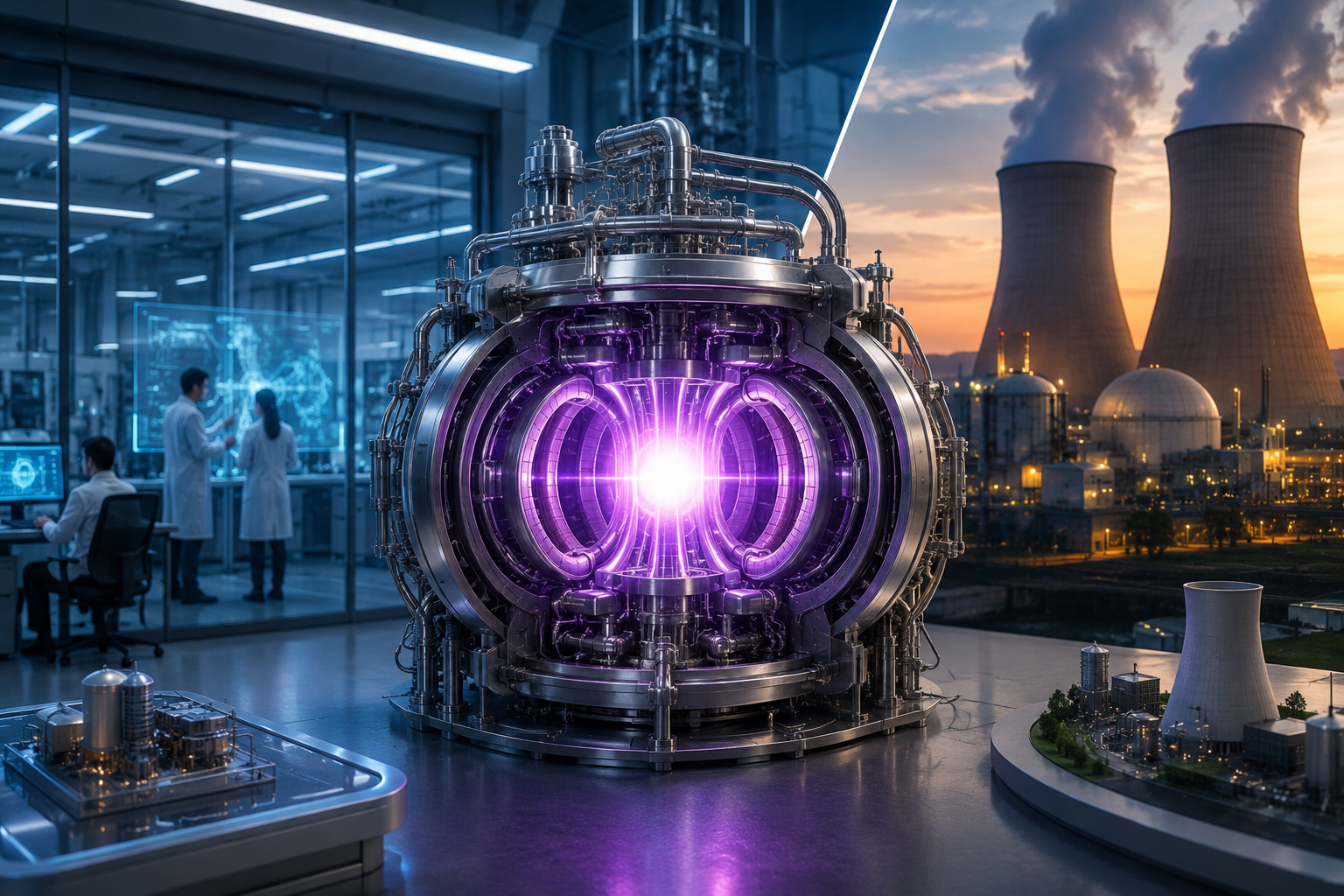
Ask most people to picture nuclear energy, and they’ll picture the same thing: reactor cores, meltdown risk, decades of radioactive waste. That mental image is accurate for fission—but increasingly, fusion companies argue it has nothing to do with them. Around the world, a growing number of fusion startups are pushing regulators to stop lumping their technology in with fission and instead create dedicated rules that reflect what they say is a fundamentally different, and fundamentally safer, physical process.
The United States has already made this shift. Now India’s emerging fusion sector is fighting the same battle, and the outcome could shape whether the country’s fusion companies can compete for capital against international rivals who already operate under a lighter regulatory touch.
Why Fusion Companies Say They’re Different
The core scientific argument is straightforward. Fission works by splitting heavy atoms apart, a process that creates long-lived radioactive waste and carries the risk of runaway chain reactions and meltdowns if containment systems fail. Fusion works the opposite way: it combines light atoms together, and its main byproduct is inert helium rather than dangerous radioactive material.
There’s also a critical safety distinction that fusion advocates lean on heavily: fusion reactions aren’t self-sustaining in the way fission chain reactions are. If confinement is lost—whether that’s the magnetic fields holding plasma in place or the mechanism compressing a fuel pellet—the fusion reaction simply stops. There’s no equivalent to a fission meltdown, where the reaction can continue generating dangerous heat even after operators lose control.
Because of that difference, fusion companies argue that regulatory tools built for fission—large exclusion zones, extensive site requirements, and lengthy facility licensing processes—simply don’t map onto the actual risk profile of a fusion plant.
How the U.S. Already Settled This Question
The United States offers the clearest precedent for how this argument can play out. Back on April 14, 2023, the five commissioners of the U.S. Nuclear Regulatory Commission voted unanimously to regulate fusion machines under 10 CFR Part 30, the same byproduct materials framework used for particle accelerators, medical isotope facilities, and industrial irradiators—rather than under the framework governing fission power reactors. Congress reinforced that decision through the bipartisan ADVANCE Act, and in February 2026, the NRC released a formal proposed rule to implement the framework, covering tritium handling, neutron-activation products, and waste streams instead of the emergency cooling systems fission regulation is built around.
The Fusion Industry Association has been explicit about what this accomplished: fusion energy is now, in its words, permanently and completely separated from the regulation of nuclear fission in the U.S. That regulatory clarity matters enormously for a capital-intensive, long-horizon industry—it gives investors and developers a predictable path instead of years of uncertainty about which rulebook applies. The results are visible in the funding numbers: private fusion companies globally have raised roughly $9.8 billion to date, and at least three U.S. companies are now actively pursuing permits or building grid-scale fusion plants.
India’s Fusion Sector Wants the Same Clarity
India’s fusion startups are now making a strikingly similar case to their own regulators. Companies including Agnira Sanlayan Pvt. Ltd. (ASPL Fusion) and Anubal Fusion have formally asked NITI Aayog, India’s policy think tank, to classify fusion facilities under a dedicated legal framework, separate from the country’s existing atomic energy laws.
The specific complaint is that India’s atomic energy regulations, updated under the SHANTI Act, continue to apply the same strict safety standards designed for fission reactors to fusion facilities as well—despite the fact that fusion doesn’t handle the same category of radioactive material or carry the same meltdown risk. Prabhat Ranjan of ASPL Fusion has been a vocal advocate for change, arguing that the large exclusion zones and stringent site requirements currently enforced for fission plants simply aren’t necessary for fusion technology.
The Practical Cost of Regulatory Overlap
For India’s fusion startups, this isn’t just an abstract classification debate—it’s creating tangible operational friction. Companies report that being bundled into the same blanket “nuclear” category as fission makes it harder to secure office space, obtain permits for research facilities, and access specialized materials that end up restricted under rules designed with fission’s radioactive material handling in mind.
That friction is showing up directly in the funding numbers. In 2026, Indian fusion startups raised approximately $6.8 million in total funding—a figure that looks especially small set against the $1.18 billion secured by their counterparts in the United States over a similar period. While regulatory classification isn’t the only factor behind that gap, it’s a meaningful one: unclear or overly restrictive rules make it harder for investors to size up risk, timelines, and the path to commercialization, all of which directly affects how much capital a sector can attract.
What’s at Stake in Getting This Right
The broader significance here goes beyond any single company’s paperwork headaches. Regulatory clarity has historically been one of the biggest predictors of how quickly a capital-intensive energy technology can scale, precisely because investors need confidence in the rules before they’re willing to commit long-term capital to a technology that may take years to reach commercial viability.
Countries that get this classification question settled early may end up with a real competitive advantage in the global race to commercialize fusion energy. The UK was the first country to establish a fusion-specific regulatory framework, followed by the U.S. codifying its own separation through legislation. If India’s fusion sector wants to compete for both talent and capital on a global stage, resolving its own regulatory ambiguity may be just as important as any individual company’s technical progress.
Conclusion
The push from fusion startups—in India and elsewhere—for regulation separate from fission reflects a genuine scientific distinction, not just industry lobbying for lighter rules. Fusion’s inherent safety profile really is different from fission’s, and a growing number of regulators, starting with the U.S. and the UK, have already agreed. Whether India follows that same path will likely shape how competitive its fusion sector can be in a global race where capital is already flowing heavily toward countries that have given their fusion industries regulatory clarity.








Leave a Reply