

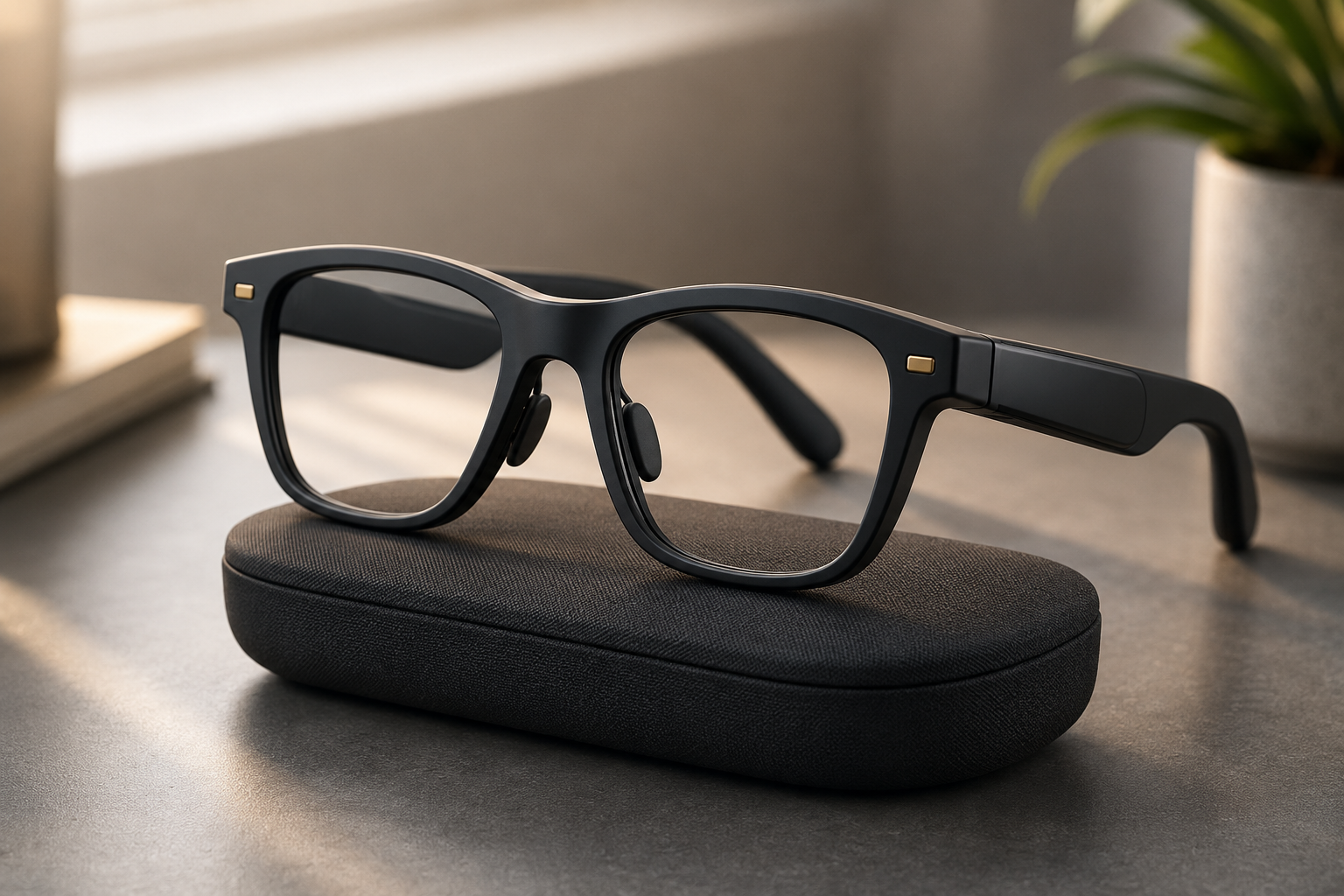
Every major smart glasses launch in the last two years has followed the same formula: put a camera on your face, point it at an AI model, and let the device “see” the world for you. Meta built its entire Ray-Ban strategy around it. Snap stuffed its new Specs with sensors. Apple is rumored to be circling the same idea.
Then a three-year-old startup out of Shenzhen raised $150 million this month at a $1 billion valuation — by doing the opposite. Even Realities builds smart glasses with no camera, no speaker, and no recording indicator light at all. Its pitch is blunt: the most trustworthy camera is the one that was never installed.
That bet just got a billion-dollar vote of confidence. Here’s what’s actually inside these glasses, why “no camera” might be a feature rather than a limitation, and whether display-first glasses can hold their own against the camera-and-AI giants.
Table of Contents
- Who Is Even Realities?
- What the G2 Actually Does Without a Camera
- The $150M Round: Why Investors Bet on Less, Not More
- Camera Glasses vs. Camera-Free Glasses
- Where the G2 Still Falls Short
- Is Camera-Free the Future, or a Niche?
- Conclusion
Who Is Even Realities?
Even Realities was founded in 2023 in Shenzhen by a team that includes CEO Will Wang, who previously worked at Apple on the Apple Watch and iPhone. The rest of the founding team blends backgrounds in consumer tech with experience at European luxury eyewear houses, which shows up clearly in how the glasses are designed — they’re built to pass as ordinary premium eyewear first, and “smart” second.
The company moved fast. Its first product, the Even G1, launched in 2024 and was the lightest waveguide smart glasses on the market at the time, according to Wang. Even reportedly became the first company in its category to sell more than 10,000 units, and the team grew from roughly 30-40 people in 2024 to several hundred today.
Its second-generation product, the G2, launched late last year and is the version making headlines now.
What the G2 Actually Does Without a Camera
The G2’s whole design philosophy rests on one missing part: there is no camera and no speaker, and that omission is intentional. Instead, the glasses use:
- A monochrome heads-up display — a green, neon-board-style display embedded directly in the lens that stays legible in any lighting condition
- A 1,200-nit, 60Hz display — up from 1,000 nits and a sluggish 20Hz refresh rate on the original G1
- Four microphones for voice commands and live translation, doubled from two on the G1
- A companion ring (Even R1) — used to tap and swipe through menus without speaking commands out loud in public
- A lightweight build — the frames weigh about 35 grams and are made from magnesium alloy, with titanium alloy temples
Functionally, the glasses are aimed less at consumers who want AI photo tools and more at people who are frequently in meetings, presenting, or traveling between languages. Core features include real-time translation, turn-by-turn navigation prompts, meeting transcription, and a teleprompter mode.
One independent reviewer noted that a “prep notes” feature lets users upload meeting materials in advance, with the AI surfacing short contextual explainer bubbles during a conversation — the kind of quiet, in-the-moment assist a camera-based device would typically try to replicate visually instead.
The $150M Round: Why Investors Bet on Less, Not More {#the-150m-round}
The funding round, led by Meituan and existing backer Tencent, values Even Realities at $1 billion. It’s a notable outcome for a company explicitly positioning itself against the dominant design trend in its own category.
A few numbers put the round in context:
| Metric | Detail |
|---|---|
| Round size | $150 million (pre-Series B) |
| Valuation | $1 billion |
| Lead investors | Meituan, Tencent |
| Founded | 2023, Shenzhen |
| Starting price (G2) | $599 |
| Typical order value | Close to $1,000 with prescription lenses and ring |
| U.S. share of user base | More than half |
What stands out to industry watchers isn’t just the valuation — it’s that the company reportedly maintains meaningful sales volume and is profitable, in a hardware category where most competitors are burning cash at scale. A premium-priced device turning a profit suggests there’s a real paying market for the camera-free approach, not just a theoretical one.
The timing also matters. Meta has been dealing with a well-publicized privacy backlash tied to its camera-equipped Ray-Ban line, including a lawsuit alleging overseas contractors reviewed user footage, and lawmakers are reportedly working on rules aimed at covert recording. Against that backdrop, a company whose core pitch is “there’s nothing here to leak” has an easier story to tell.
Camera Glasses vs. Camera-Free Glasses
The smart glasses market is splitting into two distinct philosophies, aimed at fairly different buyers.
| Camera-and-AI Glasses (Meta, Snap) | Camera-Free Glasses (Even Realities) | |
|---|---|---|
| Core function | Capture photo/video, run visual AI on what you see | Display notifications, translation, navigation in your line of sight |
| Privacy model | Camera can be turned off; recording light present | No camera hardware exists to begin with |
| Primary use case | Content creation, hands-free capture, visual AI assistants | Meetings, travel, presentations, live translation |
| Social friction | People nearby may not trust when it’s recording | No recording concern to manage |
| Market position | Mainstream, dominant share (Meta controls the majority of shipments) | Smaller, utility-focused, premium tier |
Neither model is inherently “better” — they’re solving different problems. Camera glasses are chasing a mainstream, all-purpose device. Even Realities isn’t trying to out-feature that category; it’s serving people who want a display without the social and privacy cost of a camera on their face.
Where the G2 Still Falls Short
No product this new is without rough edges, and going camera-free doesn’t fix everything. Reviewers who’ve used the G2 for months point to a few consistent issues:
- Phone dependency. The glasses lean heavily on a Bluetooth connection to a companion app, and that link has historically been unreliable — improving with software updates, but still not seamless.
- No major maps integration. Navigation runs through Even’s own app rather than Google Maps or Apple Maps, and testers found the routing frequently pulled incorrect addresses.
- Translation is one-directional in view. Live translation works well, but the other person in the conversation can’t see the translated text unless they’re also running the app.
- Voice recognition in noisy environments. Ambient noise has caused the assistant to mishear or fail to activate in real-world testing.
- Bulky charging case. The case recharges the glasses up to seven times on a single charge, but it’s large enough that it doesn’t fit comfortably in a pocket.
None of these are dealbreakers, but they’re a reminder that “no camera” solves a privacy and social-friction problem — not a software-maturity problem.
Is Camera-Free the Future, or a Niche? {#is-camera-free-the-future-or-a-niche}
The honest answer is: it depends on which bet plays out. The global smart glasses market is expected to more than double by 2030, and right now camera-equipped devices dominate shipment volume by a wide margin. If AI-powered visual understanding — glasses that can identify what you’re looking at, translate signs in real time, or recognize objects — ends up being the feature that defines the category, camera-free glasses may stay a smaller, utility-focused tier rather than the mainstream choice.
But Even Realities isn’t trying to win that fight. Its bet is that a large group of buyers — professionals in back-to-back meetings, frequent travelers, people who simply don’t want to be mistaken for someone secretly filming a room — will pay a premium for a device that removes the question entirely rather than answering it with a policy or an indicator light. A profitable, billion-dollar business built on that idea suggests the bet isn’t purely theoretical anymore.
Conclusion
Even Realities’ billion-dollar valuation is a signal worth paying attention to, even if you have no plans to buy a pair of smart glasses this year. It suggests that “more sensors” isn’t the only viable strategy in wearable tech — and that for a meaningful slice of buyers, a device that can’t record you is more appealing than one that can, just with a switch to turn it off. Whether that stays a profitable niche or becomes the design language Apple and others eventually borrow from is the more interesting question the next few years will answer.
What do you think — would you rather wear glasses that show you information, or glasses that can see the world for you? Let us know in the comments.






Leave a Reply