

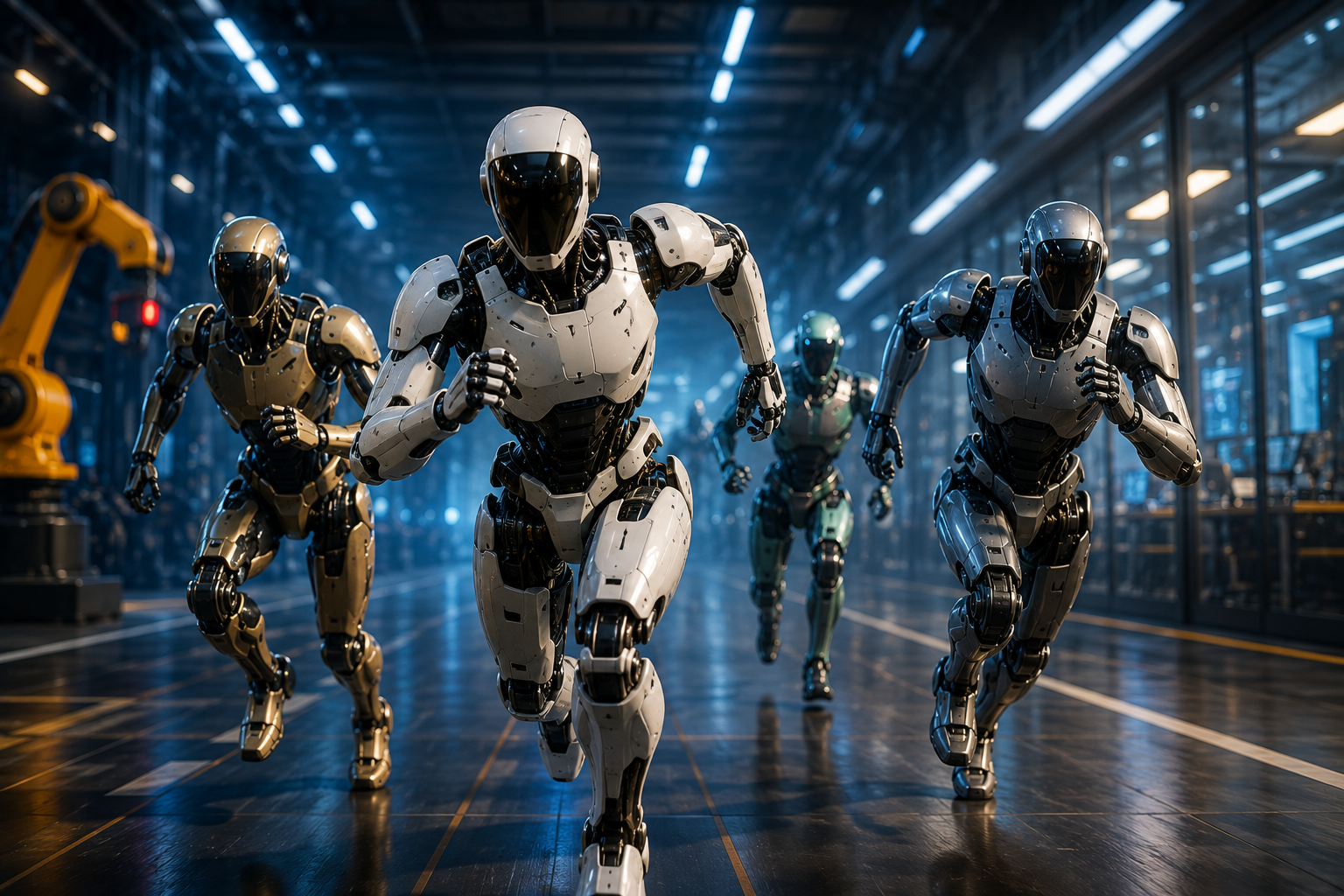
Humanoid robots have spent years living mostly in demo videos — impressive clips of machines dancing, backflipping, or folding a single towel under carefully controlled conditions. In 2026, that’s starting to change, at least for a handful of companies. Real robots are now working real shifts at a major international airport, a Chinese manufacturer has scaled from 1,000 to 10,000 units in a matter of months, and Nvidia has thrown its weight behind a standardized robotics platform meant to do for humanoid robots what Android did for phones.
At the same time, a growing number of researchers and institutional investors are pushing back on how much of the industry’s momentum is real deployment versus carefully staged spectacle. Here’s where the race actually stands: who’s shipping, who’s still mostly demonstrating, and what’s genuinely separating the two.
The Moment That Actually Matters: Haneda Airport
If there’s one deployment industry analysts point to as evidence this technology is becoming genuinely operational, it’s Japan Airlines’ decision to deploy Boston Dynamics’ electric Atlas robots at Tokyo’s Haneda Airport starting in May 2026. This wasn’t a press conference stunt — it’s a three-year operational commitment from a legacy aviation carrier operating in one of the world’s most safety-conscious regulatory environments.
The business case behind it is concrete: Japan’s working-age population is projected to decline by 31% between 2023 and 2060, Haneda handles roughly 85.9 million passengers annually, and JAL currently operates around 4,000 ground handling workers — a labor pool that’s only going to get harder to staff. Notably, Boston Dynamics has committed its entire 2026 production allocation of electric Atlas units to Hyundai and Google DeepMind, underscoring just how constrained near-term humanoid robot supply actually is relative to demand.
China’s Manufacturing Scale
While Japan and the US are leaning on safety-certified, slower-scale deployments, China is competing on raw manufacturing volume. AgiBot produced its 10,000th humanoid robot in late March 2026, scaling up from just 1,000 units in 2025 — a roughly tenfold increase in a matter of months. Industry analysts attribute China’s advantage specifically to manufacturing scale and a deeper, more mature component supplier ecosystem, which allows Chinese firms to compress costs faster than competitors elsewhere, even as the US and Europe differentiate through more advanced AI, system architecture, and formally safety-certified deployments.
The core hardware bottlenecks constraining rapid scale-up industry-wide are consistent across regions: actuators — particularly harmonic drives — along with force and tactile sensors and dexterous robotic hands, all of which currently rely on a limited supplier base and carry high technical barriers to entry.
The Marathon Robot That Wasn’t Quite What It Looked Like
In April 2026, a viral moment captured the industry’s mix of genuine progress and inflated spectacle at once. At the Beijing E-Town Half Marathon, a humanoid robot named “Lightning” — built by Chinese smartphone maker Honor, with long legs modeled on elite human runners and motors cooled using a liquid-circulation system adapted from Honor’s own smartphones — completed the 21-kilometer course in 50 minutes and 26 seconds, technically faster than the human half-marathon world record.
The catch, widely reported afterward, is that the same robot also crashed into a barricade during the race, fell, and had to wait for its human handlers to set it back upright before continuing. Coverage of the event has since treated it as a genuine milestone and a cautionary example simultaneously — real evidence of mobility and endurance progress, wrapped in a performance that still required human intervention to complete.
Nvidia’s Bet on a Common Platform
One of the more structurally significant developments this year came from outside the robot makers themselves: Nvidia’s Isaac GR00T Reference Humanoid Robot, a standardized, open research platform aimed at academic institutions and designed to accelerate humanoid robot research broadly rather than compete directly as a commercial robot maker. Nvidia has described GR00T’s goal as giving researchers a common hardware and software foundation so they can focus on harder problems like reasoning, dexterity, and navigation, rather than each research group separately rebuilding basic infrastructure from scratch.
In a closely related move, Nvidia selected Unitree Robotics — a Chinese startup based in Hangzhou — as a key hardware partner for the GR00T platform, lending the company significant credibility. Almost simultaneously, Unitree cleared a major regulatory hurdle on its path toward an IPO on the Shanghai Stock Exchange, a combination of events industry commentary has framed as a meaningful signal about where the global center of gravity in humanoid hardware manufacturing may be heading.
Meet the Main Contenders
A genuinely crowded field has formed around this technology, with meaningfully different strategies:
- Tesla Optimus — Tesla has more than 50 Gen 2 units already working in factories on sorting and hauling tasks, with a stated plan to begin mass-production ramp in early 2026, scaling toward a stated long-term ambition of 1 million units annually by 2030. Skeptics, including robotics researcher Rodney Brooks, have publicly questioned how much of that timeline is realistic versus aspirational.
- Figure AI — Figure’s Figure 03 model, standing roughly 5’6″ and weighing about 132 pounds with 35 degrees of freedom, runs on the company’s Helix AI system and has demonstrated natural-language task handling like laundry folding from comparatively minimal training data. CEO Brett Adcock has stated an ambition of 100,000 units deployed over the next four years, with OpenAI and Nvidia both backing the company.
- 1X Technologies — Backed by OpenAI, 1X has shifted from wheeled industrial robots toward its Neo robot, explicitly marketed as a home assistant capable of chores like folding laundry, unloading dishwashers, and general tidying. Neo is reportedly available to buy for $20,000 or rent for $499 per month, with deliveries expected to begin in 2026.
- Budget and niche players — Not every competitor is chasing scale at the high end. Noetix’s $1,400 Bumi robot, a modular and dance-capable design aimed at hobbyists, reportedly sold out its preorders instantly. Deep Robotics’ DR02 is positioned differently still, built for rugged environments with an IP66 rating and an operating range from -20°C to 55°C while carrying 20-kilogram payloads.
Why Institutional Investors Are Getting More Skeptical
Not everyone tracking this space is convinced the funding pace matches the technology’s actual readiness. One widely discussed moment came in January 2025, when sixteen Unitree robots performed a traditional Yangge folk dance before more than a billion viewers at China’s Spring Festival Gala broadcast — a clip that spread rapidly and triggered a wave of investor interest in humanoid robotics exposure within days. By February 2026, four separate Chinese robotics firms had reportedly paid a combined 100 million yuan for placement in the same annual broadcast, featuring robots performing kung fu backflips alongside child performers.
That kind of choreographed spectacle is exactly what a growing number of institutional investors, independent researchers, and operators who actually deploy automated systems in real facilities are pushing back on — asking, more bluntly, how much of what’s currently being funded can perform genuinely useful work in a real operational environment, versus how much is primarily engineered to attract the next funding round.
What Actually Separates the Real Deployments From the Hype {#what-actually-separates-the-real-deployments-from-the-hype}
Industry analysts tracking this space consistently point to the same handful of unglamorous signals as the real test of progress, rather than any single viral demo:
- Repeatable deployments in real customer environments — not a one-time demo, but a robot doing the same task reliably across many shifts.
- Manipulation of irregular objects — reliably picking up, orienting, and placing items that aren’t pre-positioned for the robot’s convenience.
- Stable mobility around real-world clutter — navigating ramps, tight spaces, and people, not just flat, empty demo floors.
- Battery life suited to actual work shifts — a robot that needs frequent charging remains a demo unit rather than a genuine employee replacement.
- Recovery from mistakes without human rescue — arguably the clearest tell of all, given that even headline-grabbing demonstrations like the Beijing marathon robot still required human intervention after a fall.
Conclusion
The humanoid robot race genuinely has moved past pure demo-reel territory in 2026 — Japan Airlines’ multi-year Haneda deployment and AgiBot’s rapid production scale-up are real evidence of that. But the same year has also produced plenty of reminders that viral spectacle and operational readiness aren’t the same thing, from a marathon-winning robot that still needed human handlers to right it after a fall, to Chinese firms paying seven figures for choreographed broadcast placements. The companies worth watching most closely over the next year aren’t necessarily the ones producing the most dramatic clips — they’re the ones whose updates quietly shift from demos toward uptime, service contracts, and repeat orders from customers who don’t need the spectacle to be convinced.






Leave a Reply