

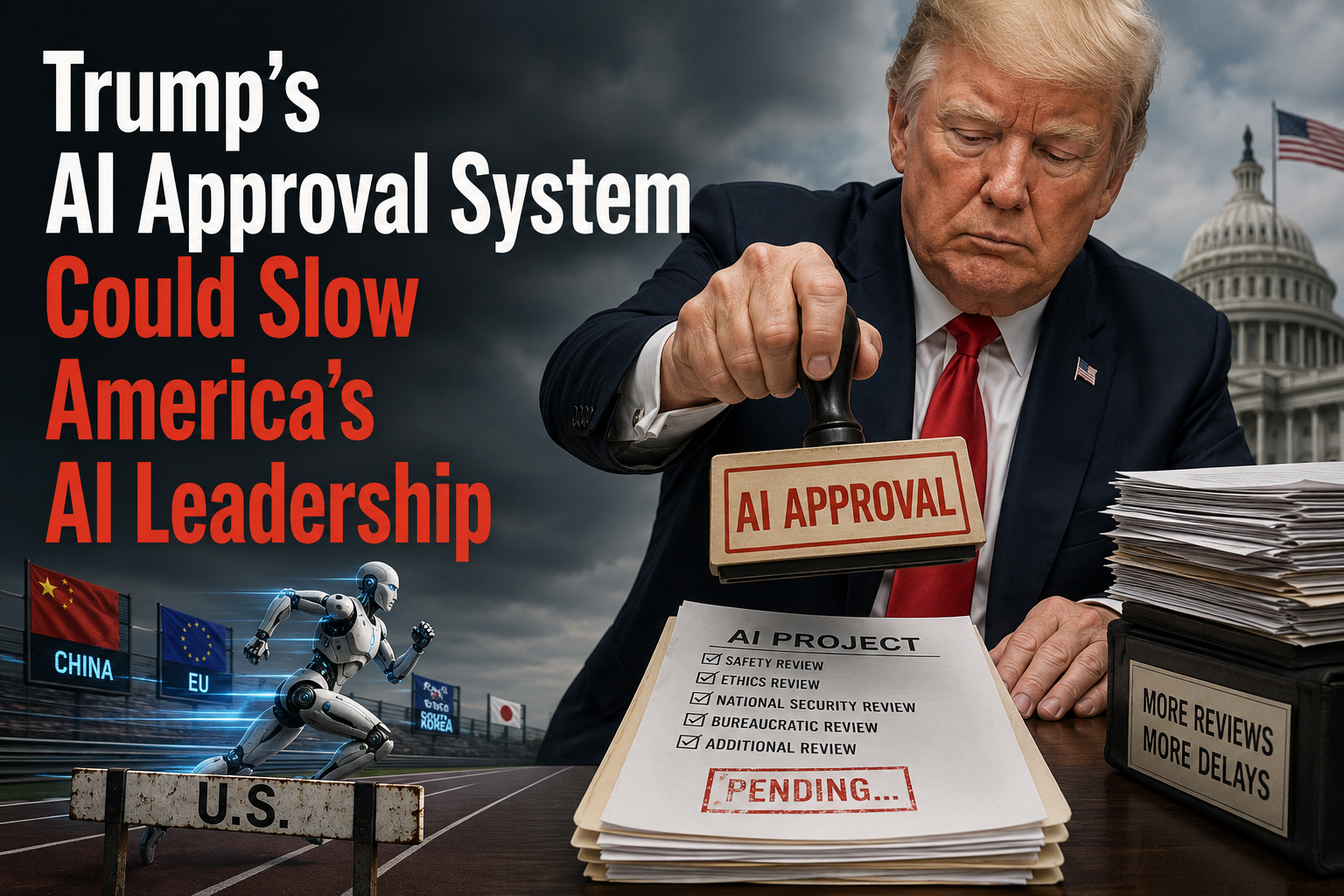
For years, the United States has promoted itself as the world’s AI powerhouse, encouraging innovation with relatively limited government intervention. But recent decisions by the Trump administration suggest that the country’s approach to artificial intelligence is entering a new phase—one where access to the most advanced AI models increasingly depends on federal approval rather than company choice.
The shift has surprised many in the technology industry because it contrasts with the administration’s earlier promise of reducing regulation. Instead of a completely open market, developers are now facing a system where some of the world’s most capable AI models are released only to selected organizations after discussions with U.S. officials.
A Sudden Change in AI Policy
When President Donald Trump returned to office, his administration argued that excessive AI regulation could weaken American innovation and allow China to close the technology gap. Senior officials repeatedly emphasized that the United States should remain the global leader in artificial intelligence through faster development rather than heavier regulation.
That message appeared consistent until June 2026, when the White House introduced an executive order asking leading AI companies to provide the government with early access to frontier AI systems for cybersecurity evaluation. Officials described the process as voluntary and insisted it was not a licensing system.
However, the events that followed created a very different impression.
OpenAI announced that its latest frontier model, GPT-5.6 Sol, would initially be available only to a limited group of trusted partners instead of receiving a broad public rollout.
Frontier AI Models Face Government Oversight
Around the same time, Anthropic’s advanced Mythos 5 model became subject to export restrictions that limited access to roughly one hundred approved American organizations before those controls were relaxed in early July. Reports indicated that government officials were actively involved in determining how and when some of these powerful AI systems could be released.
The result was an unusual situation where some organizations received early access while others—including several international partners—had to wait without clear public guidelines.
Why Transparency Matters
Artificial intelligence companies generally accept that frontier models require additional security testing. Advanced AI can potentially assist in sophisticated cyber operations, making national security a legitimate concern.
The problem, according to many industry experts, is not the existence of oversight but the lack of transparency.
Businesses planning billion-dollar AI investments need predictable rules. If companies cannot estimate when new models will be approved or who will be allowed to use them, investment decisions become far more difficult.
Former government advisers and technology executives have argued that AI regulation should rely on published standards rather than case-by-case decisions that are difficult for the public to understand.
China Continues to Narrow the Gap
The policy debate comes at a critical moment for global AI competition.
Chinese AI laboratories have made significant progress over the past year, with several open-weight models approaching the capabilities of leading American systems while remaining considerably cheaper to operate.
Researchers have also noted that open AI ecosystems in China continue expanding rapidly, increasing international adoption and reducing dependence on proprietary American models.
If American developers face repeated launch delays while competitors continue releasing models more quickly, the United States could gradually lose part of its technological advantage.
The Economic Stakes Are Enormous
Building a frontier AI model requires massive computing infrastructure and billions of dollars in investment.
AI companies typically recover much of those costs during the first months after launch, when their newest models offer the strongest competitive advantage.
Every delay shortens that commercial window.
For investors, uncertainty can become almost as damaging as regulation itself. Companies are far more willing to invest when they understand the rules in advance than when approval depends on unpredictable government decisions.
The Industry Wants Clearer Rules
Despite public disagreements, many leading AI companies actually support federal oversight.
The difference lies in how that oversight should operate.
Some companies favor a dedicated government regulator, while others believe an independent industry organization could evaluate AI safety using transparent technical benchmarks. Regardless of the preferred model, most stakeholders agree that consistency and clarity are essential for long-term innovation.
Final Thoughts
The Trump administration says its objective is to protect national security without slowing American innovation. That balance is becoming increasingly difficult to achieve as AI systems grow more powerful.
Security reviews are important, but they must be accompanied by transparent policies that companies, investors, and researchers can understand.
Without clear rules, uncertainty may discourage investment, delay innovation, and encourage businesses to explore alternative AI ecosystems outside the United States. In a global race where technology evolves every few months, predictability may become just as valuable as innovation itself.
Sources
- White House AI Executive Order and AI policy framework.
- Recent reporting by Reuters, The Wall Street Journal, Axios, and other major technology publications on OpenAI, Anthropic, and U.S. AI policy developments.






Leave a Reply