

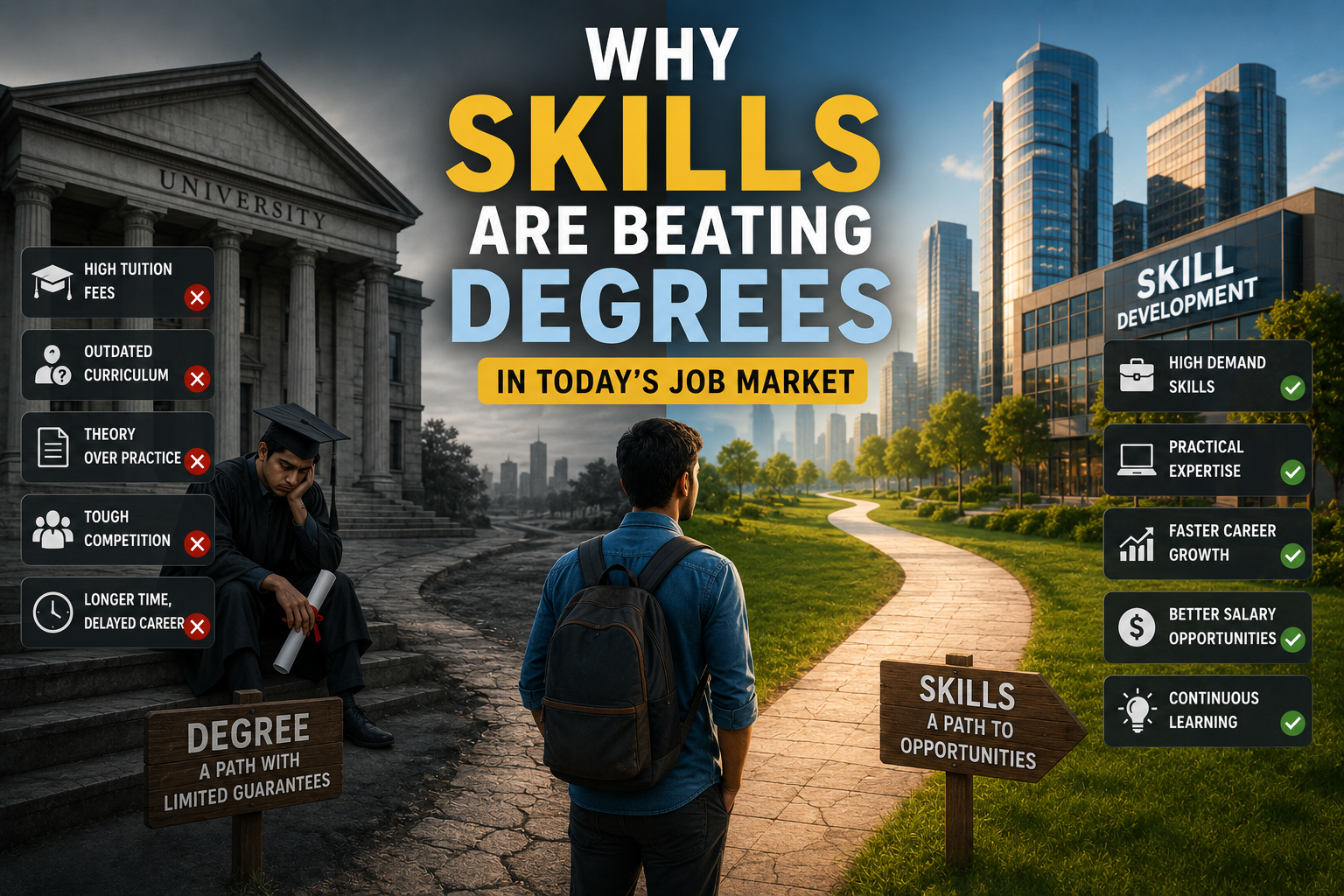
A college degree used to function like an insurance policy. Spend three or four years studying, collect the certificate, and a stable job was supposed to follow. That arrangement is quietly falling apart, and the data behind it is far more dramatic than most parents or students realize.
Recent labour force survey data from India put the picture in stark terms: unemployment among people holding a college degree sits at roughly 13%, while unemployment among people with no formal degree at all is close to zero. The national average unemployment rate, for comparison, hovers around 3%. In other words, holding a degree currently correlates with a higher chance of being unemployed than holding no degree whatsoever.
That’s not an argument against education. It’s a signal that something structural has shifted in how hiring actually works, and anyone planning a career — or planning one for their children — needs to understand why.
The Real Reason Degree Holders Are Struggling
The explanation isn’t that degrees have become useless overnight. It’s psychological, and it’s about sunk cost.
When someone invests three to five years, a significant amount of money, and countless competitive exams into earning a degree, they naturally expect a return that matches that investment. That expectation makes it harder to accept a job that feels “beneath” the effort put in. So candidates wait. They hold out for a role that matches their self-image as a graduate.
Meanwhile, the job market doesn’t wait. Roles get filled by people willing to start immediately. Five months become seven. New hiring trends emerge — increasingly shaped by AI-driven automation — and the graduate who was selective six months ago is now sitting at home with no job, no income, and a shrinking sense of direction.
Compare that to someone without a degree. They typically don’t carry that same psychological weight. They take the job that’s available, build experience, and start earning immediately — even if the first role isn’t glamorous. There’s no ego tied to a certificate, so there’s no barrier stopping them from taking the first rung of the ladder.
This doesn’t mean a degree is worthless. For genuinely licensed professions — medicine, law, chartered accountancy, core engineering roles that require regulatory certification — a degree remains non-negotiable. But for a large and rapidly growing category of modern careers, what actually gets someone hired is proof of capability, not a printed qualification.
What Changed: Why Employers Now Prioritize Proof of Work
Three shifts explain why skills have overtaken credentials in hiring decisions.
Verification has become visual and immediate. A hiring manager evaluating a video editor doesn’t ask for a transcript — they ask for a show reel. Someone applying for a design role shares a portfolio link. A developer shares a GitHub profile. These are direct, unfiltered demonstrations of ability that a degree simply cannot replicate.
Learning infrastructure has become nearly free. A decade ago, acquiring a specialized skill required access to an institution — a university lab, a expensive certification course, or a mentor inside a company. Today, Google and Meta run free certification programs for digital advertising. Free tutorials, structured online courses, and open-source communities have replaced the gatekeeping role universities used to play.
Remote work erased geography as a barrier. A skilled freelancer working from a small town can now serve clients in Mumbai, Dubai, or New York with nothing but a laptop and a stable internet connection. The market no longer cares which college a candidate attended — it cares whether they can deliver the work.
A Trading Lesson That Applies to Every Career
There’s a useful parallel in India’s retail trading data. Regulatory research on futures and options traders has repeatedly found that around 90% of retail traders lose money in a given year, with the average loss running into thousands of rupees. Only a small minority — roughly one in ten — consistently profits.
What separates that profitable minority isn’t luck or insider knowledge. It’s discipline: knowing when not to act emotionally, how much capital to risk, and when to exit a position rather than chase a loss. That discipline is a skill built through repeated practice, not something any classroom teaches through lectures and exams.
Careers work the same way. There is no course that reliably produces a great salesperson, a brilliant video editor, or a sharp growth marketer on its own. What produces competence is deliberate practice, feedback, and refinement — repeated enough times that instinct replaces guesswork. The people who build real skill in a field consistently outperform those who only hold a credential related to it.
Six Careers Where Skill Outweighs Qualification
Setting aside licensed professions that legally require formal degrees, here are six career paths where demonstrated ability consistently beats a certificate.
1. Performance Marketing
Every paid ad you see on Google, YouTube, Instagram, or a streaming platform like Hotstar exists because of performance marketing — the discipline of running, measuring, and optimizing digital ad campaigns for a specific return on spend.
This field has grown rapidly alongside the rise of direct-to-consumer (D2C) brands — companies that sell exclusively through their own websites without any physical retail presence. A new fashion label, a niche food brand, or an independent sportswear company can now build a multi-crore business purely through digital advertising, without ever opening a store.
Behind those uncannily well-timed ads — the one for hiking boots that appears right after a conversation about a trekking trip — sits a genuine analytical discipline: understanding consumer personas, tracking behavioral signals, and targeting audiences with precision. None of this is taught in a typical college marketing course.
What it takes: Certifications in Google Ads and Meta Ads (both free), hands-on campaign management experience, and a habit of tracking metrics like cost-per-acquisition and return on ad spend.
Realistic earning path: An entry-level performance marketer at a smaller digital agency can expect ₹3–4 lakh per year. With two to three years of hands-on experience managing real client budgets, that figure typically rises to ₹6–9 lakh annually — often without any four-year degree behind it.
2. Web and App Development
Software development remains one of the most durable skill-based careers, and AI coding tools have made it more accessible rather than less relevant.
It’s worth being clear-eyed here: tools that generate an app from a text prompt in minutes can produce something that looks impressive in a demo but collapses under real usage. Poor database architecture, weak security, and code that can’t scale past a handful of users are common outcomes of relying purely on AI-generated shortcuts. Understanding why code works — not just prompting a tool to produce it — is what separates a developer who can ship a reliable product from someone who can only generate a prototype.
A memorable example of this mindset in action: a hobbyist developer connected their brokerage investment account to a home automation setup, wiring a green bulb to light up when their portfolio was in profit and a red one when it dipped into a loss. It’s a small, almost playful project — but it demonstrates real technical fluency: API integration, real-time data handling, and hardware control combined into something functional and shareable. Projects like this, posted publicly, routinely catch the attention of recruiters and hiring managers far more effectively than a resume line reading “completed coding bootcamp.”
What it takes: A structured three-to-six-month bootcamp to build fundamentals, followed by continuous building — websites, small apps, automation scripts — each one solving a specific, narrow problem rather than attempting something overly ambitious.
Best practice: Maintain a public GitHub profile documenting every project. It becomes a living resume that speaks louder than any transcript.
3. UI/UX Design
User Interface (UI) design governs how something looks and how a person interacts with it — colors, layout, button placement, menu structure. User Experience (UX) design governs how it feels to use — the responsiveness of a click, the flow between screens, the intuitiveness of a form.
This isn’t limited to apps and websites. Physical products — a car dashboard, a microwave control panel, a smartphone’s button layout — are all UI/UX problems in disguise. The discipline sits at the intersection of empathy and technical execution: a good designer has to think from the user’s perspective while also understanding how design translates into functional code.
AI-assisted tools like Figma’s generative features have made basic layout work faster, but they haven’t replaced the eye for detail, color theory, and visual hierarchy that separates a professional-grade interface from a generic one. That instinct develops slowly, through repeated critique and iteration — not overnight.
What it takes: Mastery of tools like Figma, a strong understanding of design principles (contrast, spacing, visual hierarchy), and a portfolio on a platform like Behance or Dribbble showing real projects — ideally ones built for actual clients or personal products, not just design exercises.
4. Video Editing
Short-form and long-form video editing has become one of the most consistently lucrative skill-based careers, and demand for it has increased rather than decreased alongside the growth of AI video tools.
Here’s the counterintuitive point worth understanding: AI-generated video is capable of producing raw footage, but it’s notoriously inconsistent — inconsistent lighting, broken continuity, awkward pacing. Even fully AI-assisted video projects require a skilled human editor to stitch the pieces into something coherent. A five-to-seven-minute video that holds a viewer’s attention from start to finish, particularly for non-entertainment content like education or finance, is a genuine craft. Anyone can generate footage; far fewer people can edit it into something an audience wants to keep watching.
What it takes: Proficiency in editing software (Premiere Pro, DaVinci Resolve, or CapCut for short-form), a sharp instinct for pacing and retention, and — critically — a body of published work that proves you can hold attention, not just cut clips together.
Career trajectory: Editors who specialize in retention-focused long-form content or high-volume short-form content for creators and brands regularly earn well above typical entry-level corporate salaries within three to five years, often working fully remotely and setting their own hours.
5. Sales (B2C and B2B)
Sales remains one of the oldest skill-based careers, and it has aged remarkably well. It splits into two broad categories:
- B2C (business-to-consumer): Selling directly to individual customers — a subscription, a product, a service.
- B2B (business-to-business): Selling to organizations — negotiating institutional contracts, managing longer sales cycles, and closing larger deals.
B2B is generally considered the harder skill to build, but it also tends to be more lucrative, since deal sizes are larger and relationships are longer-term. A company that sells subscriptions to individual consumers through ads is doing B2C; the same company negotiating a bulk membership deal with a university is doing B2B — a completely different skill set involving negotiation, stakeholder management, and contract terms.
What it takes: Confidence, comfort with rejection, negotiation skills, and the ability to build trust quickly. Most sales roles combine a fixed base salary with performance-based variable pay, which means skilled salespeople can often out-earn people in “higher status” corporate roles within a few years.
A related path — affiliate marketing: This is a lighter-touch form of selling where you share a trackable link to a product or service, and earn a commission whenever someone makes a purchase through it. It existed offline long before the internet — home product demonstration businesses used exactly this model, where hosts earned commission on sales made during informal gatherings. Today it’s entirely digital: a newsletter recommending a book through an Amazon affiliate link, a creator promoting a financial app, or a blogger linking to software they genuinely use. It requires no formal sales role, no cold calling, and can be built entirely around content you’re already creating.
6. Ethical Hacking
Ethical hacking involves deliberately searching for security vulnerabilities in websites, apps, or databases — and then reporting them responsibly rather than exploiting them.
Every digital product has some risk of a “loophole” — a gap that could expose user data like emails, phone numbers, or payment details. An ethical hacker’s job is to find that gap before a malicious actor does, document it clearly, and report it through legitimate channels. Many companies run formal “bug bounty” programs that pay cash rewards based on the severity of the vulnerability found.
What it takes: A strong understanding of web security fundamentals, patience for methodical testing, and — importantly — clear, professional reporting skills. A hacker who can identify a critical vulnerability but can’t explain it clearly to a non-technical team has only done half the job.
Realistic outcome: Skilled ethical hackers routinely negotiate compensation — sometimes a one-time payment for critical findings, sometimes an ongoing monthly retainer to continue testing a company’s systems as they release new features. Compensation is based entirely on demonstrated findings, not credentials.
Comparison at a Glance
| Career Path | Core Skill Required | Entry Barrier | Typical Starting Income (India) |
|---|---|---|---|
| Performance Marketing | Ad platform fluency, analytics | Low — free certifications available | ₹3–4 LPA, scaling to ₹6–9 LPA |
| Web/App Development | Programming logic, architecture thinking | Moderate — requires structured practice | Varies widely; project-based or salaried |
| UI/UX Design | Visual design, user empathy | Moderate — requires portfolio building | Entry-level design salaries, scaling with portfolio |
| Video Editing | Storytelling, pacing, software fluency | Low — tools are accessible | Varies by niche; strong upside with retention skill |
| Sales (B2C/B2B) | Communication, negotiation | Low — often trained on the job | Base + variable, high upside |
| Ethical Hacking | Security testing, technical reporting | Moderate — requires self-study | Project or bounty-based, highly variable |
A Practical Roadmap: How to Build a Skill-Based Career Without Dropping Out
None of this is an argument for skipping college. It’s an argument for using college years differently.
- Stay enrolled. A degree still provides social exposure, a professional network, and a psychological safety net — none of which should be dismissed casually.
- Identify two or three areas of genuine interest from the list above (or beyond it) during your first year. Watch long-form tutorials, not short clips, to get an honest sense of what actually holds your attention.
- Progress from free to paid learning. Move from free YouTube tutorials to structured paid courses, and eventually to a focused three-to-six-month bootcamp once you’ve confirmed genuine interest.
- Start internships in year two, paid or unpaid. The goal isn’t income at this stage — it’s applying theoretical learning to real client problems.
- Build a public portfolio in year three. A GitHub profile for developers, a Behance profile for designers, documented case studies for marketers and salespeople. This portfolio becomes your real resume.
- Don’t quit your job or degree prematurely. Build a side income alongside your primary commitment. Only consider transitioning fully once your side income has consistently exceeded your primary income for at least three consecutive months.
This approach removes the false choice between “get a degree” and “learn a skill.” It treats them as parallel tracks, with the skill-building track ultimately determining your actual earning potential.
Key Takeaways
- Degree holders currently face notably higher unemployment rates than people without formal degrees, largely due to selective job-seeking behavior tied to sunk-cost expectations.
- Employers increasingly hire based on demonstrated proof of work — portfolios, GitHub profiles, and case studies — rather than academic credentials.
- Six career paths where skill consistently outperforms a degree: performance marketing, web/app development, UI/UX design, video editing, sales (B2C/B2B and affiliate marketing), and ethical hacking.
- Licensed professions like medicine, law, and chartered accountancy still require formal degrees and should not be approached through this framework.
- The most effective strategy is parallel-tracking: stay in college, but spend significantly more time outside the classroom building a skill-based portfolio.
- Financial discipline matters during the transition — don’t quit a stable job or degree until a side income has proven itself over a sustained period.
Frequently Asked Questions
1. Does this mean a college degree is no longer worth pursuing? Not entirely. A degree still offers networking, social development, and psychological stability, and remains mandatory for licensed professions like medicine, law, and chartered accountancy. For most other modern careers, however, a demonstrated skill set now carries more weight with employers than the degree itself.
2. Which skill-based career is easiest to start with no prior experience? Performance marketing and affiliate marketing typically have the lowest entry barriers, since foundational certifications from Google and Meta are free, and results can be tracked and demonstrated quickly through real campaigns.
3. Can someone build these skills while still studying or working a full-time job? Yes, and this is generally the safer path. Building skills on evenings, weekends, and holidays while maintaining the security of a job or ongoing education avoids unnecessary financial risk during the learning phase.
4. How long does it typically take to become employable in a skill like UI/UX design or video editing? Most people need six months to a year to build foundational competence through courses and practice, followed by one to two years of applied project work or internships before their portfolio becomes strong enough to command competitive rates.
5. Is ethical hacking a stable long-term career, or is it more of a side hustle? It can be either. Some ethical hackers work full-time in cybersecurity roles at companies, while others operate independently through bug bounty programs, earning project-based or retainer income from multiple clients simultaneously.






Leave a Reply