


Why Wall Street Is Watching AI Spending More Closely Than Profits
Big Tech keeps beating earnings estimates. Big Tech stocks keep wobbling anyway. That disconnect is the clearest sign yet that Wall Street has quietly changed what it’s actually grading hyperscalers on. The headline profit number used to be the scoreboard. Now it’s capital expenditure — how much these companies are spending to build out AI infrastructure, and whether that spending shows any sign of paying for itself.
The five largest hyperscalers — Amazon, Microsoft, Alphabet, Meta and Oracle — are on track to spend somewhere between $700 billion and $900 billion on capital expenditures in 2026, a jump of roughly 36% over 2025. Some estimates put combined AI-specific capex as high as $870 billion this year. For context, that scale of spending has been compared to the entire GDP of a mid-sized European country.
The Real Story: Profits Are Up, But Cash Is Disappearing
Here’s the tension driving Wall Street’s shift in focus. Reported earnings at the big AI
spenders still look strong, sometimes spectacular — but underneath those numbers, free cash flow is deteriorating fast. Alphabet’s second-quarter 2026 results are the clearest example: operating income came in at $40.8 billion, yet free cash flow swung to negative $5.9 billion in the same quarter, after capital spending on AI infrastructure more than doubled year over year to $44.9 billion.
The gap comes down to accounting timing. Companies are spending on AI infrastructure far faster than they’re allowed to expense it through depreciation. The five biggest hyperscalers are projected to spend roughly $760 billion on AI infrastructure in 2026, but will only expense about $211 billion of that through depreciation this year. The remaining $549 billion becomes a deferred cost that shows up on future income statements — not this year’s.
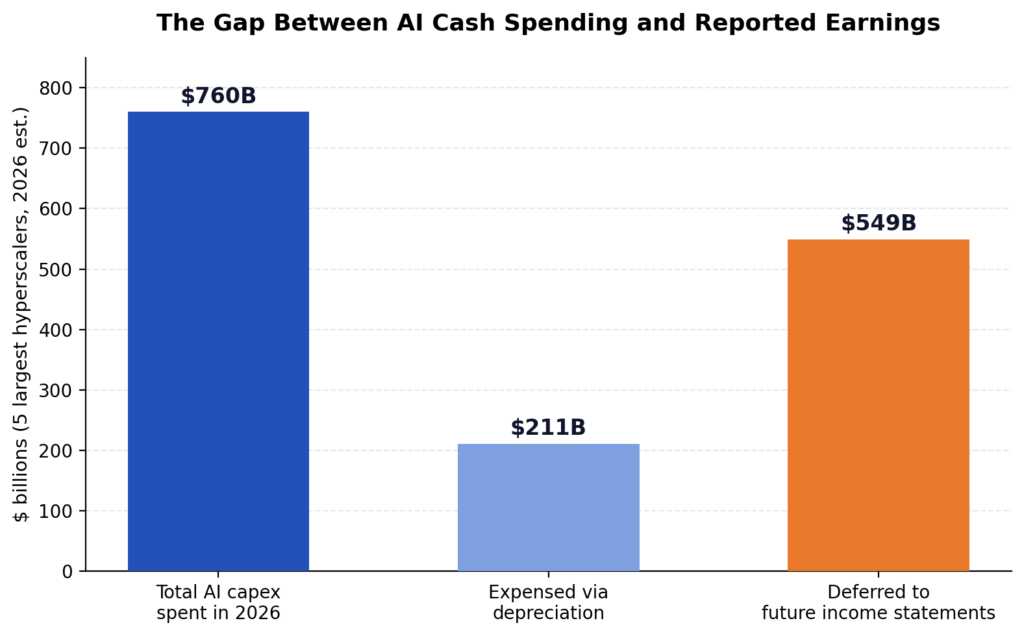
That’s precisely why analysts are looking past this quarter’s EPS number and asking a harder question: when that deferred cost eventually lands on the income statement, will AI revenue have grown enough to absorb it?
The Capex-to-Revenue Gap Is Widening, Not Closing
Capital spending is expanding far faster than the revenue it’s meant to generate. Some analysts now estimate a roughly 46% growth gap between AI investment and AI-related sales — wider than the 32% divergence seen during the telecom overbuild of the early 2000s, right before that bubble burst. That comparison is doing a lot of work in investor conversations right now, not because history has to repeat, but because it sets the bar for how closely this cycle is being watched.
Why this matters more than the headline profit number: A company can report rising earnings while its underlying cash position quietly weakens, simply because of how depreciation accounting spreads capital spending out over time. Wall Street has learned to look past that accounting lag and focus on the cash going out the door today.
Debt Is Doing More of the Heavy Lifting
As spending outpaces cash flow, more of it is being funded with borrowed money. Debt financing across the five largest cloud providers has jumped from roughly $40–50 billion in 2022 to around $190 billion in 2026. Hyperscaler bond issuance and private credit financing have both grown sharply this year as companies look to preserve cash while still funding the buildout at the pace competition demands.
Investors have started drawing a sharp line between companies funding their AI buildout from strong operating cash flow versus those leaning more heavily on debt. Stocks have diverged accordingly — capital raised through debt is being treated as a materially different, riskier bet than capex funded organically.
How the Market Is Reacting
| Signal | What it shows |
|---|---|
| Philadelphia Semiconductor Index | Pulled back more than 20% from its recent peak |
| EV/EBITDA multiples for U.S. tech and AI equities | Near 25x, close to historical extremes and above pre-2000 telecom peak valuations |
| “Magnificent Seven” index performance | Declined even as combined hyperscaler capex rose roughly 77% year over year |
| Investor rotation | Away from AI infrastructure names under margin pressure or funded via debt, toward companies with clearer paths to AI profit |
What Wall Street Is Really Asking Now
The questions dominating hyperscaler earnings calls this quarter aren’t about revenue growth anymore — that part has largely been taken for granted. They’re about capex discipline, cloud backlog conversion, and free cash flow trajectory. Analysts want to know whether management can show a credible path from spending to monetization, not just another quarter of accelerating investment.
Consensus capex estimates have undershot actual spending for two years running — at the start of both 2024 and 2025, Wall Street expected roughly 20% capex growth, and actual spending came in above 50% both years. That track record is part of why investors are no longer taking guidance at face value.
None of this means the AI infrastructure buildout is a mistake. The underlying demand for compute is real, and no single hyperscaler can afford to unilaterally slow down without ceding ground to competitors — which makes the capex cycle largely self-reinforcing regardless of near-term returns. But “real demand” and “priced correctly” are two different questions, and it’s the second one Wall Street is now spending most of its attention on.
What to Watch Going Forward
- Free cash flow trends, not just earnings beats. A company posting rising EPS alongside falling or negative free cash flow is telling two different stories at once.
- Cloud backlog conversion rates. Massive order backlogs only matter if they convert into recognized, profitable revenue on a reasonable timeline.
- How much new capex is funded by debt versus cash. The market is increasingly pricing debt-funded AI spending as a distinct, higher-risk category.
- The eventual depreciation catch-up. As deferred AI infrastructure costs work their way onto future income statements, margins that look strong today could compress even if revenue keeps growing.






Leave a Reply