

Amazon, Microsoft, Alphabet and Meta are on track to spend a combined $725 billion on AI infrastructure in 2026 — up 77% from roughly $410 billion just a year earlier — with total Big Tech capex expected to top $1 trillion in 2027. Numbers that size don’t stay contained to quarterly earnings reports. They’re now visible in stock market structure, energy markets, credit markets, and global growth statistics.
This isn’t a story about one hot sector anymore. It’s a story about how a handful of corporate budgets have grown large enough to move markets that have nothing directly to do with software.
The Stock Market Has Never Been This Concentrated on One Bet
The most visible effect is sitting inside nearly every index fund in the world. The “Magnificent Seven” — Nvidia, Apple, Microsoft, Alphabet, Amazon, Meta and Tesla — now represent roughly 34% to 35% of the entire S&P 500’s market value, with a combined market capitalization exceeding $23 trillion. The top 10 companies in the index, as of July 2026, account for about 38% of its total value, a level that exceeds even the concentration seen at the peak of the dot-com era by roughly 10 percentage points.
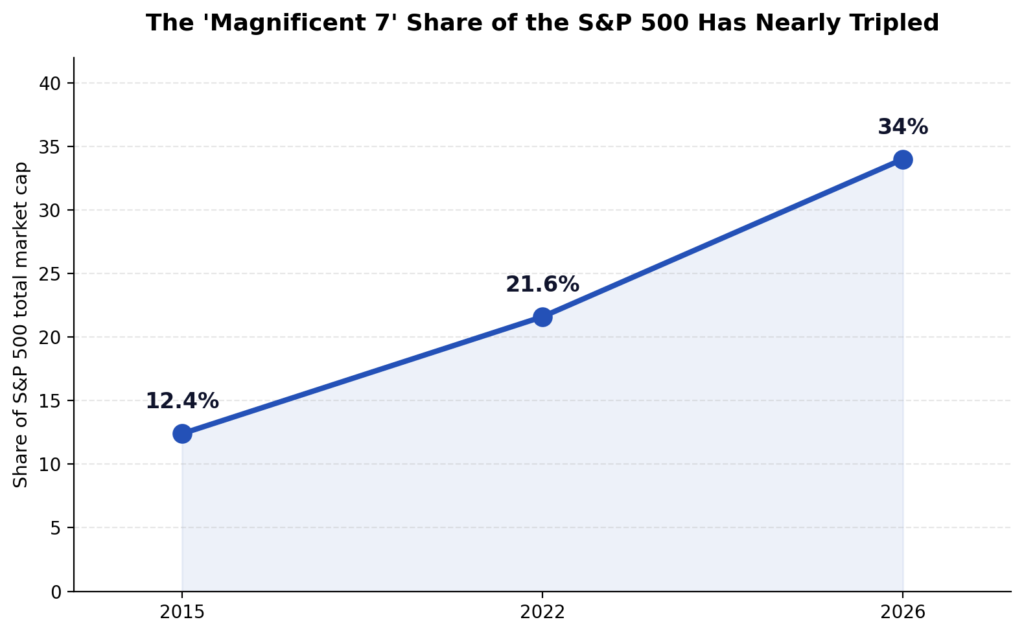
That concentration means a passive investor who assumes they own “the market” through a standard index fund actually has roughly a third of their money riding on seven companies whose fortunes are now tightly tied to a single theme: AI infrastructure spending. Goldman Sachs estimates that group will drive close to half of the S&P 500’s total earnings growth in 2026, even though they represent just 1% of the index’s constituents.
Energy Markets Are Being Redrawn Around Data Centers
AI infrastructure runs on electricity, and the scale of new demand is large enough to reshape power markets on its own. Roughly $300 billion in AI-related capital expenditure is now tied directly to power infrastructure, part of a broader $1.4 trillion grid overhaul effort spanning dozens of utilities. AI data center racks require anywhere from 30 to over 100 kilowatts of power, compared with 5 to 15 kilowatts for traditional infrastructure — a power density that has already overwhelmed local grid capacity in some regions and forced companies to delay projects or contract power directly from generators.
The mismatch in timelines is the real structural story here: a data center can go from groundbreaking to operational in 9 to 12 months, while new power plant capacity typically takes 2 to 5 years to come online. That gap is pulling utilities, independent power producers, and even nuclear and gas generation into the AI investment story in ways that had nothing to do with technology a few years ago.
Credit and Bond Markets Are Absorbing the Overflow
As capital spending outpaces even Big Tech’s substantial cash flow, more of the buildout is being financed with borrowed money rather than paid for outright. Debt financing across the largest cloud providers has climbed from roughly $40 to $50 billion in 2022 to around $190 billion in 2026. Much of that new debt is flowing through private credit funds and structured off-balance-sheet vehicles rather than traditional public bonds, which is starting to draw scrutiny from ratings agencies and bond investors watching coverage ratios soften.
Why this spreads beyond tech investors: As AI infrastructure debt gets packaged into products bought by insurers, pension funds and mutual funds, exposure to the AI capex cycle is showing up in portfolios that were never marketed as AI investments in the first place.
The Global Growth Number Itself Is Being Propped Up
AI-related capital spending has become large enough to move national accounting statistics. Goldman Sachs estimates AI-related spending will boost U.S. capital expenditure growth by roughly 3.3 percentage points in 2026 — a large enough contribution that some economists now describe AI capex as a genuine macroeconomic force rather than a sector-specific trend. Combined capex from the largest hyperscalers already exceeds the GDP of all but the world’s twenty largest national economies.
The buildout is also geographically lopsided. According to the Stanford HAI 2026 AI Index Report, the United States is committing roughly 23 times more private capital to AI than China, with U.S. generative AI investment alone exceeding the combined total from China and Europe. That imbalance is reshaping where semiconductor manufacturing capacity, data center construction, and skilled technical labor are being concentrated globally.
Ripple Effects Across the Supply Chain
| Market | How AI capex is reshaping it |
|---|---|
| Semiconductors | Nvidia’s data center revenue hit $75.2 billion in a single quarter, up 92% year over year, pulling chip supply chains and equipment makers along with it |
| Data center real estate | REITs like Equinix and Digital Realty are being repriced around AI-driven demand for facility space |
| Networking and cooling | Vendors supplying high-density power and cooling equipment are seeing order books stretch years out |
| Enterprise software | Traditional SaaS companies face pressure as hyperscalers build competing AI features directly into cloud platforms |
What This Means for Anyone Holding a Diversified Portfolio
The uncomfortable reality is that “diversification” now means something different than it did a decade ago. A standard S&P 500 index fund, a bond fund holding hyperscaler or private credit debt, and a utility stock benefiting from data center demand can all be exposed to the same underlying bet on AI capital spending — without that overlap being obvious from the fund names alone.
Market concentration has risen before and eventually broadened out again, as it did after the “Nifty Fifty” era of the 1960s. These periods don’t tend to end abruptly, but they do eventually give way as competition increases and leadership spreads across more companies.
What to Watch Next
- Whether earnings growth broadens beyond the Magnificent Seven. Some analysts expect the rest of the S&P 500 to start closing the growth gap in 2026 and 2027, which would ease concentration risk even without the leaders slowing down.
- How power markets absorb data center demand. Grid bottlenecks could become a genuine constraint on how fast the AI buildout can continue, regardless of how much capital is available.
- Where AI infrastructure debt ends up. The more of it flows into retail-facing products, the more ordinary investors carry exposure they may not have chosen deliberately.





Leave a Reply