

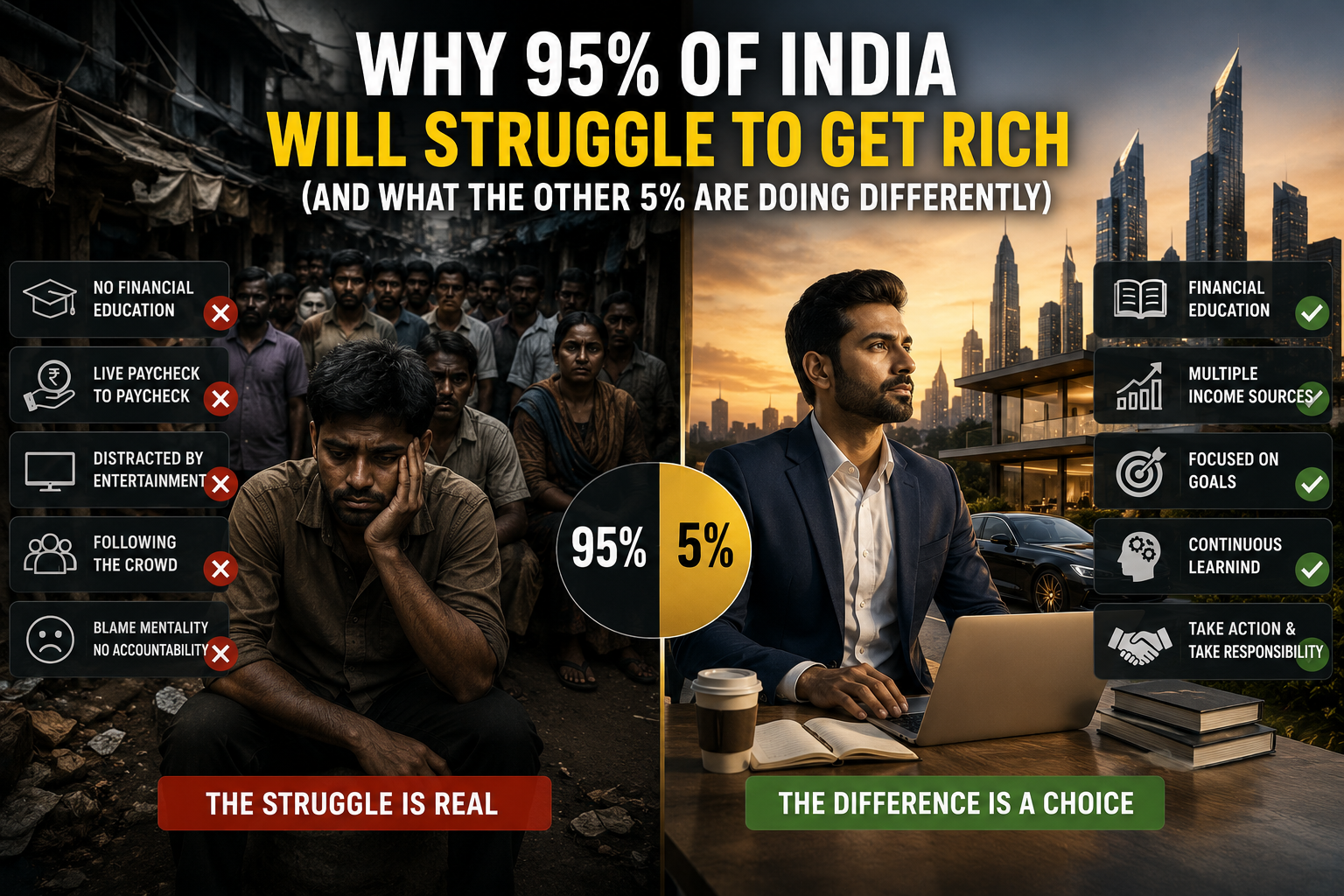
There’s a blunt, slightly uncomfortable idea we kept coming back to while digging into what actually separates fast-growing Indian businesses from the ones stuck standing still. The idea is this: India after 2020 didn’t just change — it split in two.
For roughly 5% of the population, this is a golden age. Opportunities to grow 10x, 50x, even 100x are everywhere, and people are becoming crorepatis, influencers, and spiritual leaders at speeds that would have seemed impossible a decade ago. For the other 95%, it’s the opposite — a kind of modern-day Kalyug, where ambition has quietly gone missing. Even the children of families worth ₹500 crore-plus are opting out of the family business, choosing to “play investor” from their phones instead of doing the hard work that built the wealth in the first place.
The gap between these two Indias is going to keep widening. And whether you land on the winning side of it comes down to a handful of principles that have almost nothing to do with luck.
Where This Framework Comes From
This isn’t theory borrowed from a Western business school textbook. It’s pattern recognition pulled from two decades of on-ground work with Indian entrepreneurs — everyone from small shopkeepers to the country’s biggest business families — including consulting engagements that have touched tens of thousands of businesses since 2013, after an earlier career spanning global finance (including a stint at Lehman Brothers before its 2008 collapse) and a string of early failures in real estate and e-waste recycling before anything clicked.
The SUCCESS Framework
The central thesis is that entrepreneurial success rests on seven pillars, and a weakness in even one of them is enough to sink you. It’s packaged as the acronym SUCCESS:
- Self-discipline
- Understanding of market and strategy
- Culture
- Cash flow
- Emotional storytelling
- Systems, data, and AI
- Sales and scale
Notice what’s missing from the top of that list: money. The advice for anyone starting out, even a teenager, is to stop obsessing over capital and start working on the two things fully within their control — physical health and mental clarity. Fitness and meditation aren’t wellness add-ons; they’re the foundation everything else is built on.
The Krishna Formula: Seven Habits of the ₹100-Crore Club
After looking at thousands of entrepreneurs who crossed the ₹100-crore mark, the same seven habits kept showing up again and again. It’s called the KRISHNA formula:
- Knowledge — Read or consume good content for at least an hour a day. Anything less than 20 minutes daily, he says, keeps you below average.
- Relationships — Build a circle of at least 30 genuinely powerful people who mentor and support you, without ever asking them for money or a job upfront.
- Investment — Understand loans, funding, and basic financial literacy — something Indian schools largely fail to teach.
- Spirituality — Not religion for its own sake, but a mindset of gratitude, humility, and service that keeps ego in check.
- Habits — Waking early, journaling gratitude and goals, sticking to a routine.
- No — Learn to say it. Chasing every opportunity guarantees you’ll master none of them.
- Active pulse — Stay on the ground, travel, meet people, and observe trends firsthand instead of scrolling for insight.
One of his more counterintuitive points: successful entrepreneurs don’t try to remember everything. They deliberately keep their minds “empty” — offloading tasks to calendars and to-do lists — because a cluttered brain has no room left to spot the next big opportunity.
Cash Flow Is the Real Business, Not Valuation
The Shark Tank-era obsession with valuation and funding rounds misses the point. For most Indian businesses, the real game is cash flow — how much money you can pull out of the business every month, and how disciplined you are about payment terms. He points to the textile industry, where six-to-nine-month credit cycles are common, versus factories in China that demand advance payment because they’ve built genuine leverage through unique capability. The lesson: if customers have no real alternative but to work on your terms, you’ve built a moat. If you’re extending endless credit just to keep customers happy, you haven’t.
The SPARK Framework for Building Value
To actually create that leverage, there’s a five-part model called SPARK:
- Systems and operations (like IndiGo’s fast aircraft turnaround times, which let it fly more routes and generate more revenue per plane)
- Product monopoly (a genuinely differentiated product people can’t easily get elsewhere)
- Agility (reacting to trends faster than competitors — he cites a regional snack brand that launched a product nationally within a week of a public figure’s offhand comment)
- Reach and distribution (owning the supply chain, the way large retail chains do)
- Knowledge and experience (the reason people still walk into an electronics showroom instead of buying purely online)
Mastering all five isn’t realistic, he says. Pick one or two and go deep — trying to be everything to everyone is how businesses lose focus and fail.
Nine Industries Worth Betting On
Perhaps the most practical part of this research is an A-to-I framework of nine sectors he believes have genuine long-term potential in India, largely because they’re difficult to fully automate or disrupt:
- Agriculture — especially branding and export of regional specialties (millets, mushrooms, dragon fruit)
- Brands and Digital marketing — low-capital, high-upside work helping small businesses build an online presence
- Care — eldercare, mental health support, and pet care, driven by an aging population and rising loneliness
- Digital creator and AI-enabled businesses
- Entertainment and experiences — events, weddings, travel curation
- Fast fashion and casual consumption — low-ticket, high-volume products that fit India’s price-sensitive middle
- God (spiritual services) — from guided rituals to wellness content, a category he values enormously given the estimated $300 billion global yoga and meditation market
- Hands-on skilled trades — plumbing, electrical work, cooking — the jobs AI genuinely struggles to replace
- Investment and finance literacy — helping people navigate loans, savings, and credit in a country still catching up on financial education
The common thread across all nine, he says, is that none of them require you to already have capital. What they require is getting your hands dirty: a year or two of working for someone else to learn how the industry actually functions, followed by testing your own instincts with real customers before scaling up.
Real Stories, Not Just Theory
The framework holds up against concrete real-world examples: a man born with polio in a Maharashtra village who built a resort empire starting from a small snack stall; a 68-year-old woman who turned her home-cooking skills into a business earning lakhs a month simply by posting videos; a well-known Gujarati snack company that grew from a small theatre canteen stall into a business generating thousands of crores by relentlessly reinvesting profits instead of spending them.
The pattern in every story is the same — hunger, patience, willingness to be corrected, and a refusal to treat failure as the end of the road.
The Takeaway
Strip away the mythology and business jargon, and the message is fairly simple: overnight success is a myth, financial discipline and genuine relationships are your real insurance policy, and in a country as economically layered as India, there is enormous room to build something meaningful if you’re willing to start small, stay on the ground, and actually do the work most people are avoiding.
The opportunities are real. So is the widening gap. Which side you end up on may have less to do with talent than with whether you’re willing to put in the unglamorous hours nobody’s posting about on Instagram.





Leave a Reply