


Every macro signal this year has pointed toward caution. Oil-driven inflation has the Fed weighing its first rate hike in years. A conflict in the Middle East has disrupted shipping and rattled energy markets. Tariff pressure is showing up directly in consumer goods prices. By most conventional readings, this is exactly the environment where corporate boards pull back on spending. Big Tech has done the opposite. The five largest U.S. technology spenders are on track to commit more than $600 billion in capital expenditure in 2026 alone, part of an estimated $2.1 trillion deployment across 2026 through 2028.
The obvious question is why. The less obvious, more uncomfortable answer is that the spending itself has become part of what’s keeping the broader economy from tipping into the very downturn everyone’s bracing for.
The Spending Is Propping Up the Number Everyone’s Watching
Deutsche Bank research has put this starkly: without technology-related spending, the U.S. would likely already be close to a recession this year. Manufacturing has contracted for multiple consecutive months, and non-AI business investment has stayed largely flat while AI-related investment has surged. The primary source of GDP support over the past two years hasn’t been broad-based business confidence — it’s been AI capital expenditure and the employment and supply-chain activity that spending generates around it.
That creates what some analysts have started calling a dependency paradox. The investment that skeptics warn could be a bubble is, at the same time, one of the primary engines keeping headline economic growth positive. If AI capex were to contract sharply for any reason — even a rational, orderly correction — the hit to measured GDP could be immediate and severe. That’s part of why the Federal Reserve itself has started treating AI investment as a macroeconomic stability question, not just a corporate finance one.
This Buildout Is Structurally Different From Past Tech Cycles
The scale of capital intensity here doesn’t have a clean historical precedent. Capex among the largest U.S. tech spenders is running at roughly 34% of revenue in 2026 — more than double the roughly 15% peak capital intensity seen during the 1990s internet buildout, previously the most capital-hungry stretch in modern tech history.
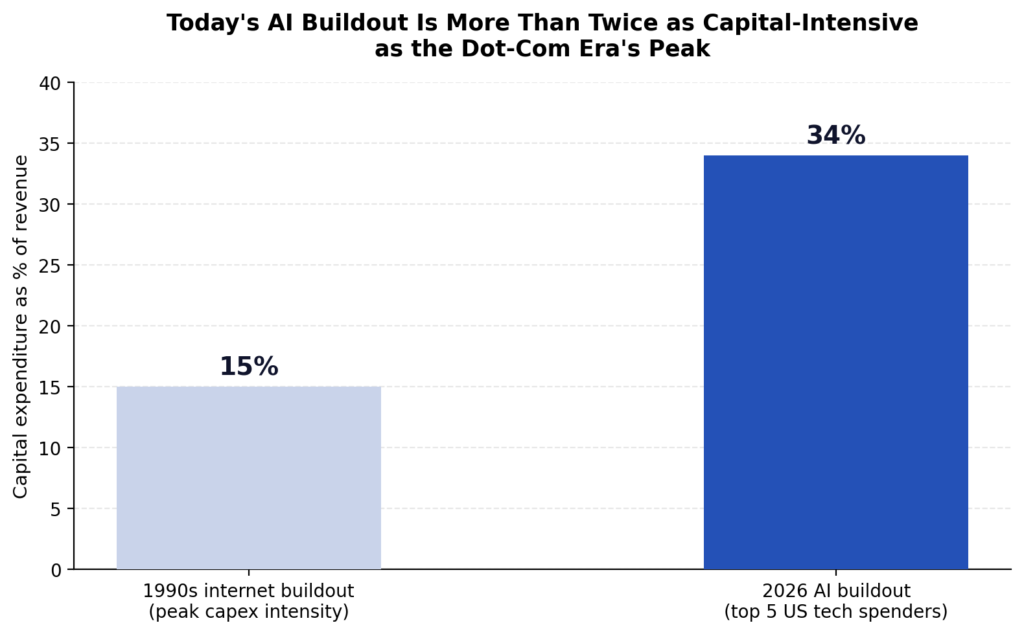
Free cash flow across these companies is turning negative for the first time in 35 years, a genuinely unusual inflection point for firms this large and this consistently profitable. That last distinction matters: unlike the dot-com era, which was substantially funded by pre-revenue startups burning through IPO proceeds, today’s biggest AI spenders are highly profitable, cash-generative businesses choosing to reinvest at a scale that pushes their own free cash flow negative anyway.
Why No Single Company Can Afford to Blink First
Part of the answer is genuinely competitive, not just economic. Google co-founder Larry Page was quoted saying he was willing to go bankrupt rather than lose the AI race — a blunt articulation of the logic driving every major hyperscaler’s spending decisions. If one company slows its infrastructure buildout to preserve near-term margins, it risks ceding compute capacity, model capability, and customer relationships to competitors who don’t blink. That dynamic makes the capex cycle largely self-reinforcing, independent of how any individual quarter’s macro backdrop looks.
Fund managers are now more worried about a slowdown in AI capex than they are about the war in the Middle East, tariff escalation, or a broader recession — a striking reordering of what markets consider the top systemic risk heading into the back half of 2026.
The GDP Math Is More Modest Than the Headlines Suggest
Even as AI capex dominates the growth conversation, its direct contribution to official GDP figures is smaller than the size of the spending might imply. Goldman Sachs estimates AI-related spending will add roughly 0.3 percentage points to “true” GDP growth in 2026, but only about 0.1 percentage points to measured GDP growth — a gap that reflects how much of this spending shows up as investment in equipment and structures rather than immediately measurable economic output.
The circular flow critics point to: AI companies raise capital, spend it on compute from cloud hyperscalers, which counts as revenue for those hyperscalers, which supports their valuations, which in turn supports continued AI investment. None of the money in that loop is fabricated, but critics argue it can make underlying demand look stronger than it actually is.
Where the Risk Is Actually Concentrated
| Risk factor | Why it matters |
|---|---|
| Debt-funded infrastructure | A growing share of this capex is financed through debt and off-balance-sheet vehicles rather than cash, concentrating risk if returns disappoint |
| Power infrastructure lag | Utility capex is rising sharply (up roughly 20% in 2025, 15% in 2026) but still lagging data center demand growth |
| Corporate credit spreads | Spreads remain relatively tight despite recent volatility, suggesting bond investors haven’t yet priced in a material deterioration in AI economics |
| Monetization timelines | Many organizations still report limited measurable return from AI investment so far, even as infrastructure spending accelerates |
What to Watch Next
- Whether corporate spreads start to move. Credit markets, not equity markets, may be the first place real concern about AI capex sustainability shows up.
- How the Fed’s rate decision interacts with debt-funded capex. A rate hike would raise financing costs right as more of this spending shifts toward debt rather than cash.
- Whether GDP growth outside AI-related spending starts to firm up. If broader business investment stays flat while AI capex is the only thing propping up growth, the economy’s dependence on this single spending category becomes more visible, not less.





Leave a Reply