

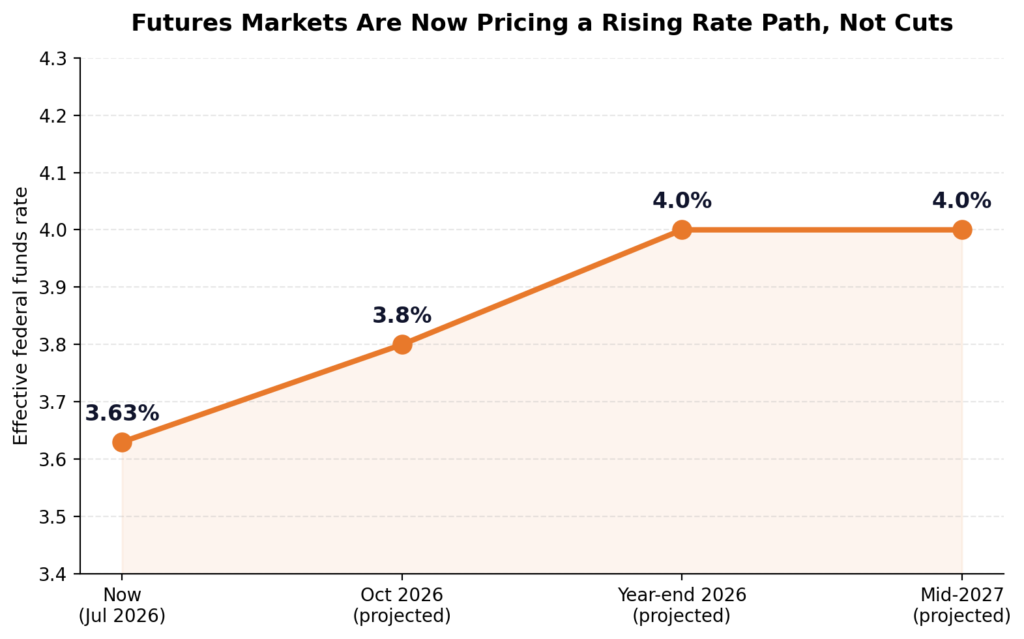
Just a few months ago, the debate around the Federal Reserve was how many rate cuts investors could expect this year. That conversation has flipped. As of late July 2026, futures markets tracked by the CME FedWatch Tool assign a 63% probability that the Fed raises rates by 25 basis points at its September meeting, versus a 37% chance it holds steady. A rate hike wasn’t part of anyone’s base case at the start of the year. Now it’s the market’s leading scenario.
What Changed: Inflation Stopped Cooperating
The reversal comes down to inflation data that’s stalled well above target instead of continuing its descent. Core PCE inflation, the Fed’s preferred gauge, sat at 3.3% in June, while core CPI came in at 2.6%. Both measures have moved further from the Fed’s 2% target over the past several months rather than closer to it — a pattern the Fed’s own July Monetary Policy Report describes as inflation that “moved up notably” through the early part of the year.
Energy prices are doing a lot of the damage. PCE energy prices jumped 24% over the twelve months ending in May, largely because of a military conflict in the Middle East that severely constrained shipping through the Strait of Hormuz and damaged regional energy infrastructure. Oil and gasoline prices spiked in response and have stayed volatile ever since, moving on every headline about negotiations in the region.
Tariffs are adding a second layer of pressure. Core goods price inflation, historically one of the calmer parts of the inflation basket, climbed to a 2.4% annual pace in May, up sharply from just 0.6% a year earlier. The Fed’s own analysis points to tariff increases as a meaningful contributor to that upturn, even though the exact pass-through effect is difficult to isolate in the official data.
A New Fed Chair, and a Fed Rethinking Its Own Playbook
This inflation surprise is landing at an unusually sensitive moment for the institution itself. Kevin Warsh took over as Fed chair in mid-2026 after Jerome Powell’s term expired in May, and he’s used the transition to launch a wide review of how the Fed operates. Fifteen experts drawn from the private and public sectors are now leading task forces covering the Fed’s communications strategy, its balance sheet policy, the quality and timeliness of the economic data it relies on, how AI adoption is reshaping the labor market, and — most consequential for the current debate — how the Fed understands and responds to the drivers of inflation itself. Findings are expected by year-end 2026.
Why the task forces matter beyond process: One idea reportedly on the table is dispensing with the dot plot, the chart the Fed has used for years to signal individual officials’ rate expectations. Changing how the Fed communicates its intentions could itself become a source of market volatility, independent of whatever the actual rate decision turns out to be.
How Financial Conditions Are Already Responding
Markets aren’t waiting for the September meeting to start pricing in tighter policy. Real yields have been rising, the dollar has strengthened, and the Treasury curve has flattened — a combination that typically signals investors are already positioning for tighter financial conditions ahead of any formal Fed action. At the Fed’s July meeting, policymakers left the target range unchanged at 3.50% to 3.75%, but shifted their forward guidance in what analysts widely described as a notably hawkish direction.
Not Everyone Agrees a Hike Is Coming
| Institution | Current view |
|---|---|
| CME FedWatch (market pricing) | 63% probability of a 25bp hike in September; 37% probability of no change |
| Nuveen | Removed all rate cuts from its 2026 outlook; expects the Fed on hold into 2027, with the next move eventually being a cut |
| J.P. Morgan Global Research | Still expects the Fed’s next move to ultimately be a cut, though timing has been pushed out |
| Fed’s own Summary of Economic Projections | Nine of 18 officials penciled in at least one rate hike for this year as of the most recent projections |
That spread of views is itself part of the story. When roughly half the Fed’s own policymakers see room for a hike while major asset managers are still calling for eventual cuts, the range of plausible outcomes for markets to price is unusually wide — and unusually sensitive to whatever the next inflation report shows.
The Labor Market Complication
None of this is happening in a vacuum. The Fed is trying to calibrate policy against a labor market that’s been resilient but not uniformly strong: the unemployment rate has edged down and job openings have increased, even as business hiring expectations, the quits rate and the hiring rate all remain tepid. Layered on top of that is genuine uncertainty about how quickly AI adoption is reshaping hiring and job creation — precisely the question one of Warsh’s new task forces has been assigned to study.
The challenge facing the Fed is that persistent, stalled inflation combined with a labor market that’s resilient on some measures and soft on others leaves very little clean signal to act on — which is exactly the kind of environment where forward guidance becomes both more important and more difficult to get right.
What to Watch Next
- The next CPI and PCE prints. Given how close the September odds are, the incoming inflation data before the meeting will likely be the single biggest swing factor in whether a hike actually materializes.
- Oil price trajectory. With energy prices doing much of the work pushing headline inflation higher, any material easing in the Middle East conflict — or further escalation — could move the inflation picture quickly in either direction.
- The Fed’s task force conclusions. Changes to how the Fed communicates policy, including a potential retirement of the dot plot, could reshape how markets interpret Fed signals well beyond this single rate decision.





Leave a Reply