

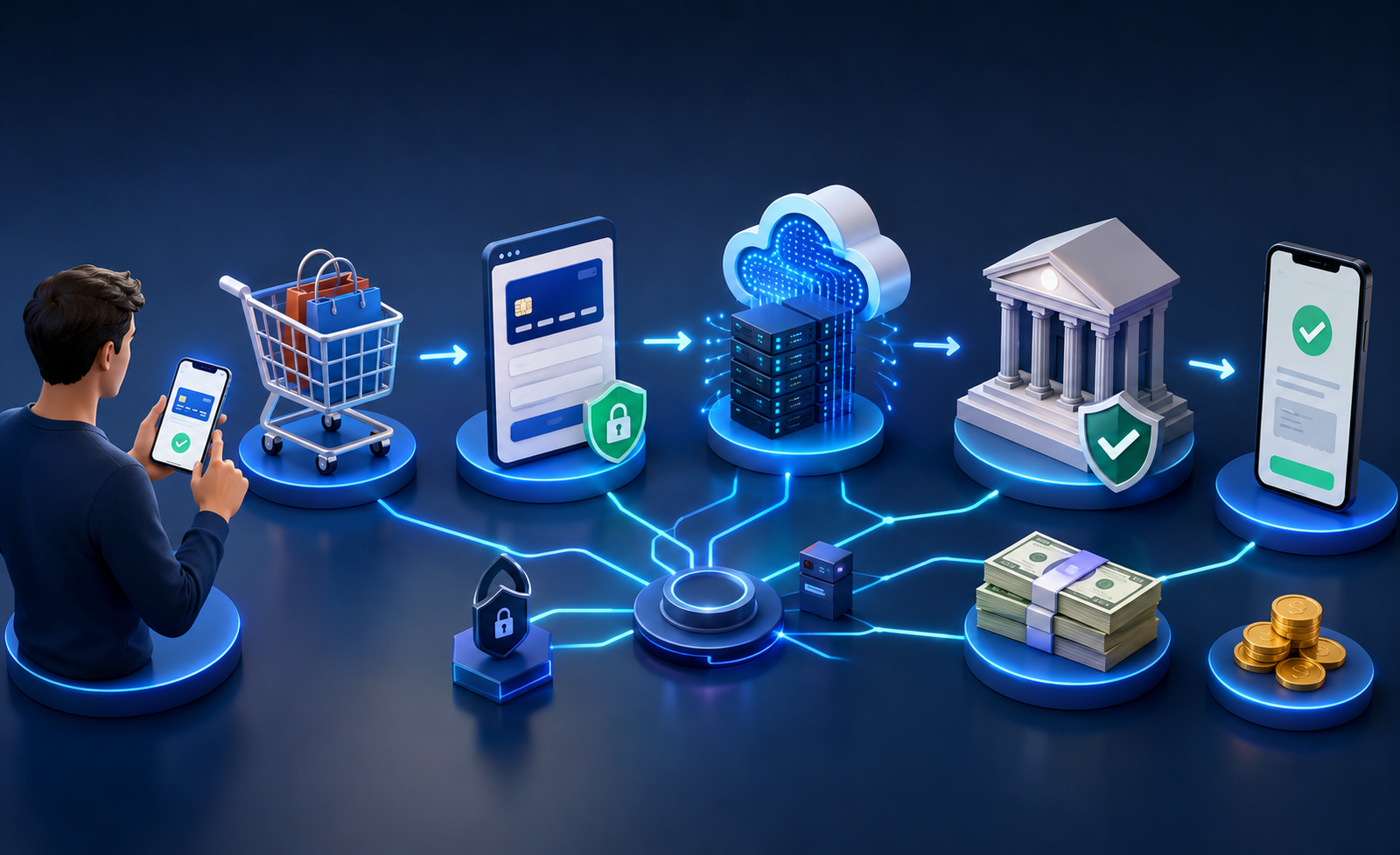
An earlier article in this series looked at the broader technology reshaping money, banking, and digital finance. This one goes deeper into a single, specific moment inside that system: what actually happens, technically and financially, in the few seconds between a customer clicking “Pay Now” and a merchant seeing funds land in their account. It’s a process most people trigger dozens of times a month without ever seeing any of it — which is, in a well-built payment system, exactly the point.
Section 1: Why Digital Payments Changed the Global Economy
Cash requires physical presence. A digital payment doesn’t — and that single difference reshaped commerce more than almost any other technology shift of the past several decades.
Speed changed first. A transaction that once required a trip to a bank or a mailed check now settles, from the customer’s perspective, in seconds. Convenience followed directly: commerce stopped being bound to store hours or geographic proximity, letting a business in one country sell to a customer in another without either party handling physical currency.
Security, done well, actually improved on cash in important ways. Physical cash, once lost or stolen, is simply gone. Digital payments, despite the fraud risks covered later in this article, come with fraud detection, dispute mechanises, and audit trails that cash never had.
Financial inclusion is perhaps the least discussed but most consequential shift. Instant payment networks — UPI in India being one of the clearest global examples — have brought tens of millions of previously unbanked or underbanked people into the formal financial system, using nothing more than a basic smartphone and a bank account, without needing a credit card or a traditional banking relationship built over years.
None of this happened because digital payments are simple. It happened despite them being genuinely complex — a complexity almost entirely hidden from the person clicking “buy,” which is exactly what the rest of this article unpacks.
Section 2: The Journey of an Online Payment
A single online payment, however instantaneous it feels, actually passes through a defined sequence of systems and institutions.
Customer
   |
   v
Merchant Website / App
   |
   v
Payment Gateway
   |
   v
Payment Processor
   |
   v
Acquiring Bank
   |
   v
Card Network / Instant Payment Network
   |
   v
Issuing Bank
   |
   v
Authorization
   |
   v
Settlement
   |
   v
Merchant Account
   |
   v
Confirmation
Walking through each step: the customer initiates payment on the merchant’s website or app, entering card details or selecting a payment method. The payment gateway securely captures that information and passes it forward — think of it as the digital equivalent of a physical card reader. The payment processor handles the actual technical routing of the transaction between the relevant banks and networks. The acquiring bank — the merchant’s bank — submits the transaction into the broader payment system on the merchant’s behalf. The card network (or, for instant payment systems, the equivalent rail) routes the request to the correct issuing bank — the customer’s own bank, which actually holds their funds.
The issuing bank performs authorization — checking that the account has sufficient funds and that the transaction doesn’t look fraudulent — and sends an approval or decline back along the same path. If approved, settlement occurs, the actual movement of funds from the customer’s bank to the merchant’s bank, which frequently happens somewhat later than the authorization itself. Funds then land in the merchant account, and a confirmation is sent back to the customer, closing the loop on what, from the customer’s side, felt like a single instant action.
Section 3: Key Components
| Component | What it does | Why it exists |
|---|---|---|
| Payment gateway | Securely captures and encrypts payment details at the point of transaction | Prevents sensitive payment data from being exposed to the merchant’s own systems directly |
| Payment processor | Routes the transaction between the relevant banks and networks | Merchants and banks don’t communicate directly; processors handle the technical translation |
| Merchant account | A specialized bank account that receives funds from card transactions | Ordinary business accounts aren’t typically structured to receive card network settlements directly |
| Issuing bank | The customer’s bank, which actually holds and authorizes access to their funds | Someone has to actually verify the customer has the money and approve releasing it |
| Acquiring bank | The merchant’s bank, which submits transactions into the payment system | Merchants need a bank relationship that can accept card payments on their behalf |
| Card networks | The rails (like Visa or Mastercard) that connect issuing and acquiring banks | Without a shared network, banks would need direct relationships with every other bank |
| Settlement | The actual transfer of funds between banks | Authorization confirms a transaction is approved; settlement is when money actually moves |
| Reconciliation | Matching transaction records across systems to confirm everything processed correctly | Ensures no transaction is lost, duplicated, or mismatched across the many systems involved |
| Fraud detection | Systems that flag suspicious transactions in real time | Fraud is a direct financial cost, and undetected fraud erodes trust in the entire system |
| Chargebacks | A formal process for reversing a transaction after a customer dispute | Gives customers recourse when a transaction was unauthorized, fraudulent, or undelivered |
Each of these exists because payments involve multiple institutions that don’t inherently trust each other and need a structured, auditable way to move money and resolve disputes reliably, at a scale of billions of transactions.
Section 4: Different Payment Methods
| Method | How it works | Distinguishing characteristic |
|---|---|---|
| Cards (credit/debit) | Routes through the card network path described in Section 2 | Widely accepted, but involves multiple intermediaries and associated fees |
| Bank transfers | Moves funds directly between bank accounts, often via a national payment rail | Typically lower cost, but historically slower, though real-time rails are closing this gap |
| Digital wallets | Store payment credentials and facilitate payment without re-entering card details each time | Adds a convenience and often security layer on top of an underlying payment method |
| UPI (instant payment systems) | Moves funds directly between bank accounts in real time, using a simplified identifier instead of full account details | Enables near-instant, low-cost transactions directly between banks, a major driver of financial inclusion |
| Buy Now Pay Later (BNPL) | Splits a purchase into installments, often approved via a real-time credit check at checkout | Introduces a lending decision into the payment flow itself, not just a payment method |
| QR payments | Encodes payment details in a scannable code, often used with instant payment systems | Removes the need for physical card terminals, especially valuable for smaller merchants |
A real-world example of scale: India’s UPI system illustrates just how much volume an instant, bank-to-bank payment rail can absorb — and the commercial significance of the wallets and apps built on top of it is visible in how major players in that ecosystem report their financial results, where transaction volume and revenue growth reflect just how central this kind of instant payment infrastructure has become to everyday commerce.
Section 5: Security Behind Payments
Payment security isn’t a single feature — it’s layered, because no single defense is sufficient against the range of threats a payment system faces.
Encryption protects payment data as it travels between systems, ensuring that even if traffic is intercepted, the underlying data isn’t readable.
Tokenization replaces sensitive card details with a non-sensitive substitute value (a “token”) used for processing, meaning even systems handling the transaction never need to see or store the actual card number.
PCI DSS (Payment Card Industry Data Security Standard) is the security standard nearly every organization handling card data must comply with, covering everything from network security to access controls — a baseline requirement, not an optional best practice.
Multi-factor authentication adds a second verification step beyond a password or card details alone, significantly reducing the risk of unauthorized transactions even if credentials are compromised.
Fraud detection, risk scoring, device fingerprinting, and transaction monitoring work together as a real-time defense layer: analyzing patterns (unusual location, unusual amount, unusual device) to flag or block suspicious transactions before they complete, often within milliseconds.
Why this matters this much: payment systems are a constant, high-value target, and the broader threat landscape they operate in is exactly the kind of environment covered in depth in this guide to cyber crime and digital security — financial systems specifically are targeted precisely because successful fraud converts directly into money, unlike many other categories of cyberattack. The scale of this threat has pushed even traditional banks to invest heavily in modern defenses, as seen in recent moves by major banks to strengthen defenses against AI-powered cyber threats, reflecting how payment security has become an arms race that continuously escalates on both sides.
Section 6: How FinTech Companies Build Payment Products
Payment infrastructure demands a level of engineering discipline beyond most typical software products, because the cost of failure is direct and immediate — lost money, not just a degraded user experience.
Architecture and APIs need to be designed for both reliability and auditability from the start; every transaction needs a clear, traceable path through the system, since disputes and reconciliation depend on it.
Compliance isn’t a feature bolted on later — regulatory requirements (PCI DSS, regional banking regulations, anti-money-laundering rules) shape core architectural decisions from day one.
Scalability matters enormously, since payment volume is often unpredictable and spiky — a flash sale or a viral product launch can multiply transaction volume in minutes, and a payment system that can’t absorb that spike directly costs the business real revenue.
Monitoring and logging need to be exhaustive, given how critical accurate transaction records are for reconciliation, dispute resolution, and regulatory audits — this level of engineering discipline echoes the broader production architecture principles covered in how real software systems are actually designed and built for production, applied here with an even lower tolerance for error given the direct financial stakes.
Disaster recovery, cloud infrastructure, and high availability requirements are typically stricter for payment systems than for most other software categories, since downtime doesn’t just inconvenience users — it directly blocks revenue and erodes merchant trust. These architectural decisions connect closely to the broader technology stack choices discussed in how engineering teams choose the right technology stack for their specific product, where payment-specific reliability and compliance requirements often push teams toward more conservative, thoroughly proven technology choices than a typical consumer application might need.
Section 7: Common Payment Problems
| Problem | Why it happens | How systems minimize it |
|---|---|---|
| Failed transactions | Insufficient funds, expired cards, network issues, or fraud flags | Clear error messaging and retry logic, without exposing sensitive failure reasons unnecessarily |
| Duplicate payments | Network retries or user double-clicks submitting the same request twice | Idempotency mechanisms ensure a repeated request doesn’t result in a repeated charge |
| Refunds | Customer returns, order cancellations, or merchant errors | A defined, auditable reversal process distinct from the original transaction flow |
| Chargebacks | Disputed, unauthorized, or undelivered transactions | A formal dispute process involving the issuing bank, card network, and merchant evidence submission |
| Fraud | Stolen card details, account takeover, or synthetic identity fraud | Layered detection combining real-time scoring, device fingerprinting, and behavioral analysis |
| Downtime | Infrastructure failures, third-party outages, or deployment issues | Redundant infrastructure and rigorous testing, given how directly downtime affects revenue |
Each of these problems is manageable, not eliminable — well-run payment systems are judged less by achieving zero failures and more by how gracefully and transparently they handle failures when they inevitably occur.
Section 8: AI in Payment Systems
AI has become deeply embedded in modern payment infrastructure, largely because the problems payment systems face — detecting subtle patterns across enormous transaction volumes in real time — are exactly the kind of problem AI is well suited to.
Fraud detection benefits enormously from AI’s ability to spot subtle, evolving patterns across massive transaction volumes far faster than manually maintained rule sets could keep up with.
Risk analysis uses AI to assess the likelihood a given transaction or customer relationship carries elevated risk, informing decisions from transaction approval to lending eligibility for products like BNPL.
Customer support increasingly uses AI to handle common, well-defined payment inquiries quickly, freeing human agents for complex or sensitive disputes.
Transaction monitoring applies AI continuously, not just at the moment of a transaction, to detect patterns suggesting account compromise or emerging fraud rings.
Compliance benefits from AI’s ability to process and flag activity relevant to anti-money-laundering and regulatory requirements at a scale manual review alone couldn’t match. This mirrors a broader shift already underway across finance functions generally, discussed in more depth in how AI and workflow automation are transforming financial operations, where the same underlying pattern — AI handling volume and pattern detection, humans handling judgment and exceptions — shows up repeatedly.
Personalized financial insights use transaction data to surface relevant, useful information to customers, like spending patterns or budgeting suggestions.
Where human oversight remains necessary: high-stakes fraud decisions, ambiguous dispute resolutions, and regulatory judgment calls still require human review — AI accelerates detection and flags patterns at a scale humans can’t match manually, but final accountability for many of these decisions, particularly ones with significant financial or legal consequences, remains a human responsibility.
Section 9: Real Case Study
Consider a fictional e-commerce company, and follow one customer’s payment from the moment they click “Pay Now.”
The customer selects a product and enters their card details at checkout. The payment gateway immediately encrypts this data and tokenizes the card number, meaning the merchant’s own systems never see or store the raw card details. The payment processor receives this tokenized request and routes it toward the customer’s issuing bank through the appropriate card network, while simultaneously running it through real-time fraud scoring.
Within roughly a second, the issuing bank checks the account’s available balance and evaluates the transaction against its own fraud models, then sends back an authorization approval. The customer sees an immediate “Payment Successful” confirmation — but at this point, only authorization has occurred; the actual movement of funds hasn’t happened yet.
Later — often within one to a few business days, depending on the specific payment method and network — settlement occurs: funds actually move from the customer’s issuing bank, through the card network, to the merchant’s acquiring bank, landing in the merchant’s dedicated merchant account. The merchant’s internal systems reconcile this settled amount against the original order, confirming everything matches. If the customer later disputes the charge, the chargeback process would kick in separately, involving evidence submission and a formal resolution process between the bank, network, and merchant.
The entire authorization sequence — encryption, tokenization, fraud scoring, and bank approval — happens in roughly a second. The full settlement, reconciliation, and funds availability process happens over a longer, less visible timeline entirely behind the scenes.
Section 10: Future of Digital Payments
Real-time payments are expanding well beyond instant payment leaders like India’s UPI, with more countries building their own real-time settlement rails, gradually closing the gap between authorization and actual fund availability.
Embedded finance — payment and financial services built directly into non-financial products, like a ride-sharing app handling driver payouts natively — continues to blur the line between “financial company” and “any company with a payment need.”
Open banking enables (with customer consent) third-party applications to securely access banking data and initiate payments directly, expanding the range of products that can be built on top of traditional banking infrastructure.
AI, as discussed in Section 8, will likely continue expanding its role, particularly in fraud detection and personalized financial products, while human oversight remains essential for high-stakes decisions.
Cross-border payments, historically slow and expensive due to the number of intermediary institutions involved, are gradually improving as new infrastructure reduces the number of hops a cross-border transaction requires.
Digital identity is becoming increasingly intertwined with payments, as stronger identity verification reduces fraud while, done well, also reducing friction for legitimate users.
Programmable money — payments with built-in logic, such as funds that only release when a specific condition is met — represents an emerging category with real potential for specific use cases like escrow or automated business payments, though its broader adoption remains an open question worth watching rather than a settled certainty.
The opportunities and challenges are intertwined: each of these trends promises real improvements in speed, access, and convenience, but each also introduces new complexity around security, regulation, and the sheer number of systems that now need to work together reliably — the same fundamental challenge payment systems have faced since the very first card network was built, simply operating at a larger and faster scale.
Glossary
| Term | Definition |
|---|---|
| Authorization | The real-time approval step confirming a transaction can proceed, before funds actually move |
| Settlement | The actual transfer of funds between banks, which often occurs after authorization |
| Tokenization | Replacing sensitive payment data with a non-sensitive substitute used for processing |
| Chargeback | A formal process reversing a transaction following a customer dispute |
| Reconciliation | Matching transaction records across systems to confirm accuracy and completeness |
| Merchant account | A specialized bank account designed to receive settled funds from card transactions |
Frequently Asked Questions
Why does “Payment Successful” appear instantly if settlement takes days? Because authorization — confirming the transaction is approved — happens in real time, while settlement, the actual movement of funds between banks, is a separate, typically slower process that happens behind the scenes afterward.
What’s the difference between a payment gateway and a payment processor? The gateway securely captures and encrypts payment details at the point of transaction; the processor handles the technical routing of that transaction between the relevant banks and networks. They’re often provided together but serve distinct roles.
Why do some payments fail even with sufficient funds? Fraud detection systems can decline a transaction that looks suspicious based on location, spending pattern, or device signals, even when the underlying account has sufficient funds — a deliberate trade-off favoring caution.
Is UPI-style instant payment likely to replace card payments globally? It’s expanding rapidly in markets where it’s been adopted, particularly for financial inclusion, but card networks remain deeply embedded in global commerce, especially for cross-border transactions; the two are likely to coexist rather than one fully replacing the other in the near term.
How does tokenization actually improve security? Because the token itself is useless outside the specific system that issued it, even if it were intercepted or leaked, it can’t be used to make fraudulent charges the way a raw card number could.
What happens during a chargeback, from the merchant’s perspective? The merchant is notified of the dispute and given an opportunity to submit evidence (proof of delivery, service terms, communication records) supporting the transaction’s legitimacy, which the issuing bank and card network then use to resolve the dispute.
Why do payment systems need such strict compliance requirements? Because they handle sensitive financial data and directly enable the movement of real money, making them a high-value target for fraud and a subject of significant regulatory oversight, both of which shape their engineering requirements from the ground up.
Key Takeaways
- A digital payment that feels instantaneous to a customer actually passes through several distinct institutions and steps, each existing to solve a specific trust, security, or routing problem.
- Authorization and settlement are separate processes — a payment can show as “successful” well before funds have actually moved between banks.
- Payment security is layered by necessity, combining encryption, tokenization, compliance standards, and real-time fraud detection, because no single defense is sufficient on its own.
- Building payment infrastructure demands a higher bar for reliability, compliance, and auditability than most software categories, given the direct financial stakes of failure.
- AI has become deeply embedded in fraud detection and risk analysis, though human oversight remains essential for high-stakes and ambiguous decisions.
- The future of payments points toward faster settlement, deeper integration into non-financial products, and expanding AI use — alongside correspondingly greater security and regulatory complexity.




Leave a Reply