

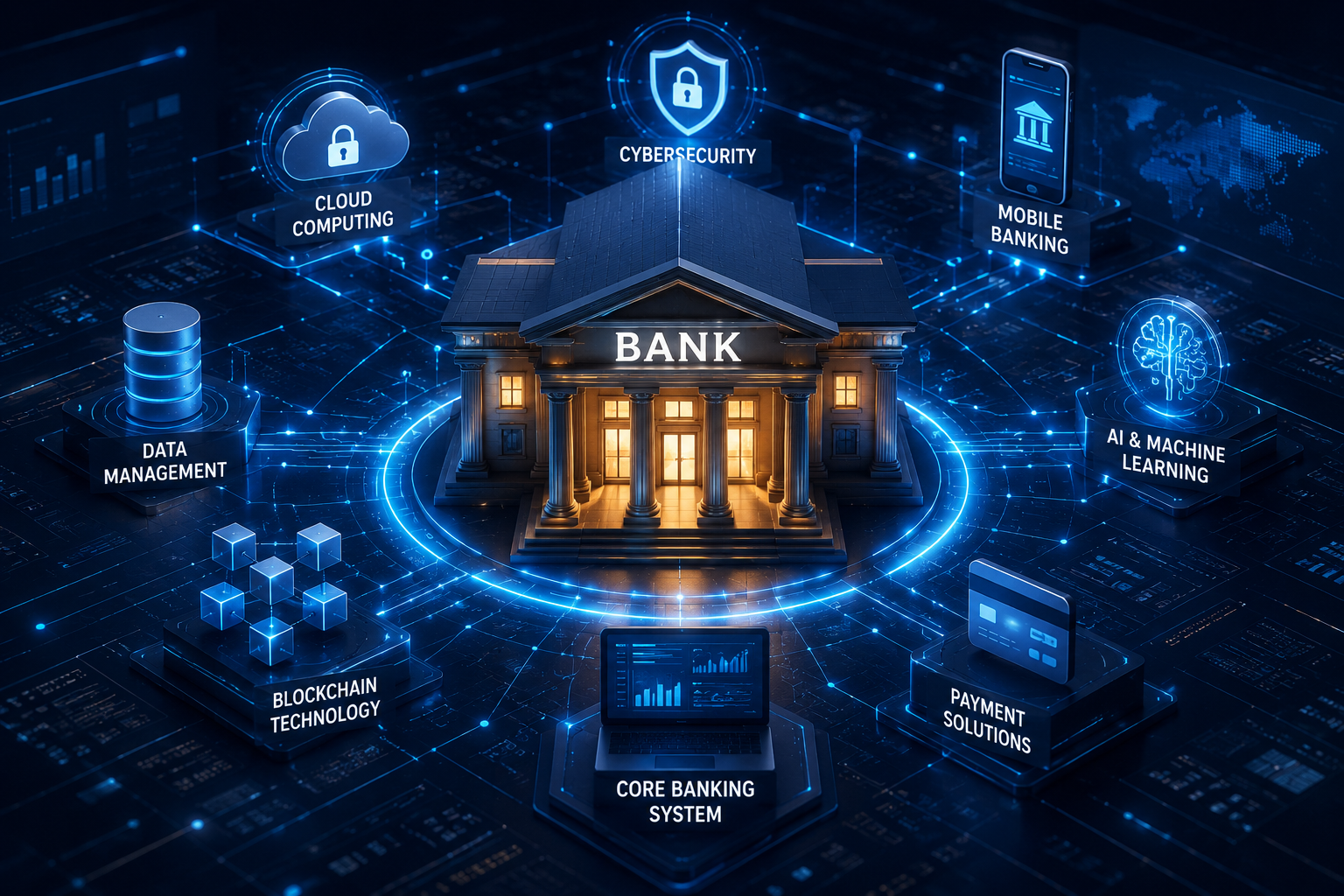
Two earlier articles in this series covered the broader technology reshaping money and banking and the journey of a single digital payment. This one goes one layer deeper, into the system sitting behind every one of those transactions: the Core Banking System — the software that actually makes a bank a bank, rather than just a building with vaults and tellers.
Most people never think about core banking directly. It’s the infrastructure equivalent of plumbing: invisible when it works, catastrophic when it doesn’t. Understanding how it actually functions explains a lot about why banks move the way they do — sometimes remarkably fast, sometimes frustratingly slow.
Section 1: What Is a Core Banking System?
Definition: A Core Banking System (CBS) is the centralized software platform that processes and records a bank’s daily transactions — deposits, withdrawals, transfers, loans, interest calculations — and maintains a single, authoritative record of every account and balance across the institution.
Before core banking existed, individual bank branches operated largely independently, each maintaining its own ledgers. A customer’s balance at one branch wasn’t necessarily visible or updated in real time at another. Core banking systems, which became widespread from the 1980s and 1990s onward, changed this by centralizing account data so that any branch, ATM, or digital channel could access and update the same underlying record.
Why every modern bank depends on it: the CBS is the single source of truth for account balances, transaction history, and customer data. Every other system — mobile banking apps, ATM networks, card processing, internal reporting — ultimately reads from or writes to the core banking platform in some way. If the core banking system goes down, the bank doesn’t just lose a feature; it loses the ability to reliably process money at all.
The branch vs. the platform: a bank branch is a physical (or digital) point of interaction — where a customer opens an account, deposits a check, or asks a question. The core banking platform is the underlying system of record that makes that interaction meaningful and consistent, regardless of which branch, app, or channel the customer used to interact with the bank.
Section 2: How a Core Banking System Works
Following a single customer transaction end-to-end shows how these pieces fit together:
Customer
   |
   v
Mobile Banking App
   |
   v
API Gateway
   |
   v
Authentication
   |
   v
Core Banking System
   |
   v
Customer Database
   |
   v
Transaction Engine
   |
   v
Ledger
   |
   v
Fraud Detection
   |
   v
Notification Service
   |
   v
Customer Confirmation
Walking through each step: the customer initiates an action — say, a funds transfer — through the mobile banking app. The API gateway receives this request and routes it toward the appropriate internal service, while also handling cross-cutting concerns like rate limiting. Authentication verifies the customer’s identity before anything else proceeds. The request then reaches the core banking system itself, which retrieves the relevant account details from the customer database and hands the actual transaction logic to the transaction engine — the component responsible for validating and executing the transfer according to the bank’s business rules.
The ledger records the movement of funds as a permanent, auditable entry — the definitive record that everything else in the bank ultimately reconciles against. Before or alongside this, fraud detection systems evaluate the transaction for suspicious patterns in real time. Once everything clears, a notification service informs the customer, and the app displays a confirmation — the part of this entire chain the customer actually sees.
This entire sequence typically completes in a second or two, even though it touches half a dozen distinct systems, each responsible for a different part of ensuring the transaction is accurate, authorized, and recorded correctly.
Section 3: Major Components of a CBS
| Component | What It Does | Why It Exists |
|---|---|---|
| Customer Information Management | Maintains a unified record of customer identity and relationship data | Every account, product, and interaction needs to tie back to a verified, consistent customer identity |
| Accounts | Manages account creation, status, and account-level rules | The foundational structure everything else — deposits, transactions, statements — is built around |
| Deposits | Handles savings, checking, and term deposit products | Deposits are the core liability side of a bank’s balance sheet and need precise, reliable tracking |
| Loans | Manages loan origination, disbursement, repayment schedules, and interest accrual | Lending is a primary revenue source for most banks and involves complex, long-running obligations |
| Payments | Processes transfers, bill payments, and other movement of funds | The most frequent and time-sensitive category of banking activity |
| General Ledger | The authoritative financial record of the entire institution | Every transaction must ultimately reconcile against a single, accurate financial record |
| Interest Calculation | Computes interest owed or earned across accounts and loans | Interest calculations must be precise, auditable, and consistent with regulatory and contractual terms |
| Branch Operations | Supports in-branch transaction processing and cash management | Physical branches still need to interact with the same core system as digital channels |
| Reporting | Generates operational, financial, and regulatory reports | Banks are required to report extensively to regulators and need internal visibility into performance |
| Audit Logs | Records a detailed history of system actions and changes | Necessary for security investigations, dispute resolution, and regulatory compliance |
| Compliance | Enforces regulatory rules like KYC and AML directly within transaction processing | Compliance failures carry serious legal and financial consequences, so checks are built into the platform itself |
| Notifications | Alerts customers to account activity across channels | Keeps customers informed and adds a layer of fraud awareness through visibility |
Each module exists because banking, unlike most software domains, combines extremely high transaction volume with an unusually low tolerance for error — a lost row in a typical e-commerce database is an inconvenience; a lost row in a bank’s ledger is a genuine financial and legal problem.
Section 4: Technology Behind Modern Banks
Core banking technology has undergone a significant architectural shift over the past decade, moving away from large, tightly coupled monolithic systems toward more modular, cloud-capable architectures.
Microservices break the core banking platform into smaller, independently deployable services — one for payments, one for deposits, one for customer data — rather than one massive, interdependent codebase. This mirrors the same architectural reasoning covered in how real software architecture actually gets designed for production systems, applied here with an even lower tolerance for downtime.
APIs allow different services, both internal and external, to communicate through well-defined interfaces — this is what makes it possible for a bank to integrate with fintech partners, open banking initiatives, and third-party apps without exposing its internal systems directly.
Cloud computing has become increasingly common even in an industry historically cautious about it, offering scalability and resilience that’s difficult to replicate with on-premises infrastructure alone — though banks typically adopt cloud infrastructure more conservatively than most industries, given regulatory and data residency requirements.
Databases, caching, and load balancers function much the same way they do in any high-scale production system — caching reduces load on expensive database operations, while load balancing distributes transaction volume across multiple servers reliably — but in banking, the tolerance for a cache serving even briefly stale balance data is essentially zero, which shapes how aggressively these techniques can be applied to core account data versus, say, less time-sensitive reporting queries.
Disaster recovery and high availability are non-negotiable requirements, given that banking downtime has direct, immediate financial consequences for both the institution and its customers.
Encryption and identity management protect data both in transit and at rest, and control precisely who — human or system — can access or modify sensitive financial records.
Monitoring provides continuous visibility into system health, transaction volumes, and anomalies, since undetected issues in a banking system can compound quickly at scale.
Why banks are moving away from legacy monolithic systems: older core banking platforms, some running on technology decades old, are difficult to update, slow to integrate with modern digital channels, and increasingly expensive to maintain as the pool of engineers familiar with legacy systems shrinks. Modern, modular architectures — informed by the same technology stack decision-making that shapes any large-scale software platform — allow banks to update individual components, integrate with fintech partners faster, and scale more flexibly, without the risk of a single change affecting the entire system at once.
Section 5: Security & Compliance
Security in core banking isn’t a feature layered on top — it’s embedded directly into how transactions are processed, because the cost of failure is immediate and financial.
KYC (Know Your Customer) verifies a customer’s identity before an account is opened or certain transactions are permitted, forming the foundation of a bank’s ability to prevent fraud and comply with regulation.
AML (Anti-Money Laundering) systems monitor transaction patterns for signs of illicit financial activity, a requirement banks take seriously given both the regulatory stakes and the broader societal harm money laundering enables.
Encryption, access control, and audit trails work together to ensure that sensitive data is protected, that only authorized systems and personnel can access or modify it, and that every action is traceable after the fact.
Fraud detection operates continuously, evaluating transactions in real time against patterns associated with unauthorized activity — a discipline covered in more depth in how digital scams and cyber fraud actually work, since understanding attacker tactics directly informs how banks build their detection systems.
Multi-factor authentication adds a verification layer beyond a password alone, significantly reducing the risk of unauthorized account access even when credentials are compromised.
Disaster recovery, regulatory compliance, and business continuity ensure that a bank can keep operating, or recover quickly, in the face of both technical failures and broader disruptions — a requirement regulators actively audit banks against, not just a best practice.
The scale of investment banks are making in this area reflects how seriously the threat is treated: recent moves by major banks partnering with device manufacturers to defend against AI-powered cyber threats show security extending beyond the core banking system itself into the broader ecosystem of devices customers use to access their accounts.
Section 6: Real Banking Scenarios
| Scenario | What Happens Behind the Scenes |
|---|---|
| Opening an account | KYC verification, customer record creation, account setup with applicable product rules, initial compliance checks |
| Money transfer | Authentication, balance verification, transaction engine execution, ledger update, fraud screening, notification |
| Loan approval | Credit assessment, compliance checks, loan account creation, disbursement scheduling, interest accrual setup |
| ATM withdrawal | Card and PIN verification, real-time balance check against the core system, transaction authorization, ledger update |
| Debit card purchase | Merchant authorization request, real-time balance and fraud check, approval or decline, settlement processing |
| Interest calculation | Scheduled batch or real-time processing applying interest rates to account balances according to product terms |
| Monthly statement | Aggregation of all transaction and balance data for the period, formatted and delivered through the customer’s preferred channel |
Each of these everyday actions triggers a coordinated sequence across multiple core banking components — the apparent simplicity a customer experiences is the direct result of a great deal of underlying engineering working correctly, consistently, every time.
Section 7: How AI Is Transforming Core Banking
Fraud detection benefits significantly from AI’s ability to identify subtle, evolving patterns across enormous transaction volumes, far faster than static rule-based systems could adapt on their own.
Risk analysis uses AI to assess creditworthiness and transaction risk more dynamically, incorporating a broader range of signals than traditional scoring models.
Document processing — verifying identity documents, processing loan paperwork — increasingly uses AI to extract and validate information faster than manual review.
Customer support applies AI to handle common banking inquiries at scale, freeing human agents for complex or sensitive cases.
Compliance monitoring benefits from AI’s ability to flag activity relevant to AML and regulatory requirements across volumes that would be impractical to review manually.
Predictive maintenance applies AI to infrastructure monitoring itself, helping identify potential system issues before they cause outages.
Personalized banking uses transaction data and AI to surface relevant products, insights, or alerts tailored to individual customer behavior.
Where human oversight remains essential: final decisions on loan approvals, fraud escalations, and compliance judgment calls typically still require human review, particularly where the financial or legal stakes are significant. AI accelerates detection and analysis at a scale humans can’t match manually, but accountability for high-stakes financial decisions remains, appropriately, a human responsibility.
Section 8: Challenges of Core Banking Systems
| Challenge | Why It’s Difficult | How Banks Address It |
|---|---|---|
| Legacy software | Decades-old systems are hard to modify and increasingly costly to maintain | Gradual modernization, often through phased migration rather than a single risky cutover |
| Downtime | Any outage has immediate financial and reputational consequences | Redundant infrastructure, rigorous testing, and disaster recovery planning |
| Scalability | Transaction volume can spike unpredictably, especially during high-demand periods | Modern, horizontally scalable architecture and capacity planning |
| Cybersecurity | Banks are a constant, high-value target for attackers | Layered security, continuous monitoring, and significant ongoing investment |
| Regulatory changes | Rules evolve, sometimes with tight compliance deadlines | Compliance built into core system design, rather than bolted on afterward |
| Cloud migration | Moving sensitive financial systems to the cloud carries real operational and regulatory risk | Careful, often hybrid approaches that balance modernization against risk tolerance |
| Customer expectations | Customers expect instant, always-on digital experiences | Investment in modern digital channels layered on top of the core system |
| Technical debt | Years of incremental changes accumulate complexity | Deliberate refactoring and architectural investment, treated as an ongoing cost of doing business |
None of these challenges are unique to any single bank — they reflect the genuine difficulty of modernizing systems that can never simply be taken offline for a rewrite, because they’re actively responsible for real customers’ real money every second of every day.
Section 9: Future of Core Banking
Cloud-native banking — platforms built for the cloud from the ground up, rather than legacy systems migrated onto it — is likely to keep growing as trust in cloud infrastructure for sensitive financial workloads continues to mature.
Composable banking breaks core banking functionality into independent, interchangeable components that institutions can mix and match, rather than committing to a single monolithic vendor platform.
Open banking enables, with customer consent, secure data sharing between banks and third-party providers, expanding the range of products and services that can be built on top of traditional banking infrastructure.
Embedded finance continues blurring the line between “bank” and “any company offering a financial feature,” as banking capabilities get built directly into non-financial products.
Real-time processing is becoming the expectation rather than the exception, as instant payment rails expand globally and customers increasingly expect immediate settlement, not next-business-day processing.
AI and automation, as discussed in Section 7, will likely continue expanding their role across fraud detection, compliance, and personalization, while human oversight remains essential for high-stakes decisions.
API-first platforms treat integration as a first-class design principle rather than an afterthought, making it dramatically easier for banks to partner with fintechs and build new products faster.
CBDCs (Central Bank Digital Currencies) represent an emerging and still-evolving area, with various central banks exploring digital forms of national currency — a genuinely significant potential shift for core banking infrastructure, though one whose ultimate shape and adoption timeline remains an open question worth watching rather than a settled certainty.
Between 2026 and 2035, the most likely trajectory is continued, gradual modernization — banks moving from monolithic, legacy cores toward modular, API-first, increasingly cloud-native architectures, without the kind of overnight transformation that’s neither realistic nor prudent for systems this critical.
Section 10: Career Opportunities
| Role | Focus | Skills in Demand |
|---|---|---|
| Core Banking Developer | Building and maintaining core banking modules | Backend development, financial domain knowledge, system reliability practices |
| Backend Engineer | General backend systems supporting banking platforms | API design, database systems, distributed systems fundamentals |
| Solutions Architect | Designing how banking systems and integrations fit together | System design, enterprise architecture, cross-team technical communication |
| Business Analyst | Bridging banking requirements and technical implementation | Domain expertise in banking processes, requirements gathering, stakeholder communication |
| DevOps Engineer | Managing deployment, infrastructure, and reliability | CI/CD, infrastructure automation, monitoring and incident response |
| Cloud Engineer | Managing cloud infrastructure and migration strategy | Cloud platform expertise, security-conscious infrastructure design |
| Cybersecurity Engineer | Protecting banking systems and data | Threat modeling, security architecture, compliance frameworks |
| FinTech Product Manager | Defining product direction for banking technology | Domain knowledge, cross-functional leadership, regulatory awareness |
Demand across these roles remains strong and is likely to stay that way, given how many banks are mid-journey through long-term modernization efforts — a trend also reflected in the broader growth of technology and AI-adjacent career paths, where domain expertise in a specific, high-stakes industry like banking meaningfully differentiates a candidate from a generalist.
Glossary
| Term | Definition |
|---|---|
| Core Banking System (CBS) | The centralized platform processing and recording a bank’s transactions and account data |
| Ledger | The authoritative, permanent record of all financial transactions within a bank |
| KYC | Know Your Customer — the process of verifying a customer’s identity |
| AML | Anti-Money Laundering — regulatory and technical measures to detect and prevent illicit financial activity |
| Composable banking | An architectural approach using independent, interchangeable components instead of one monolithic platform |
| CBDC | Central Bank Digital Currency — a digital form of a country’s official currency issued by its central bank |
Frequently Asked Questions
What’s the difference between core banking and online banking? Core banking is the underlying system that processes and records all banking transactions; online banking is a customer-facing channel that connects to the core system, one of several ways customers can interact with it.
Why do some banks still use decades-old core banking technology? Because migrating a system responsible for real customer funds carries genuine operational risk, banks typically modernize gradually and cautiously rather than replacing core systems all at once.
Is core banking moving to the cloud? Increasingly, yes, though adoption tends to be more conservative and gradual than in other industries, given regulatory, security, and data residency considerations specific to financial institutions.
How does a core banking system prevent fraud? Through layered defenses including real-time transaction monitoring, AI-assisted pattern detection, authentication controls, and compliance checks embedded directly into transaction processing.
What is composable banking, and why does it matter? It’s an architectural approach that breaks banking functionality into independent components banks can mix, match, and replace individually, offering more flexibility than committing to one large, monolithic platform.
Do core banking systems process transactions instantly? Many core processes now happen in real time or near-real time, though some operations, like certain interest calculations or batch reporting, still run on scheduled cycles depending on the specific bank’s architecture.
What skills are most valuable for a career in core banking technology? A combination of solid backend engineering fundamentals and genuine domain knowledge of how banking actually works tends to be more valuable than either skill set alone.
How does open banking relate to core banking systems? Open banking depends on a bank’s core system exposing secure APIs that let third-party providers access account data or initiate transactions with customer consent, extending the core system’s reach beyond the bank’s own channels.
Key Takeaways
- A Core Banking System is the centralized platform that makes a bank function as a single, coherent institution rather than a collection of disconnected branches.
- Every customer-facing interaction — a transfer, a withdrawal, a loan application — ultimately depends on a coordinated sequence of core banking components working correctly together.
- Modern core banking architecture is shifting from monolithic legacy systems toward modular, API-first, increasingly cloud-native platforms.
- Security and compliance aren’t add-ons in banking technology — they’re built directly into how transactions are processed, given the direct financial and regulatory stakes.
- AI is meaningfully transforming fraud detection, compliance, and personalization, while human oversight remains essential for high-stakes financial decisions.
- The future of core banking points toward composability, real-time processing, and deeper API integration, with careers in this space benefiting from a genuine combination of technical and banking domain expertise.





Leave a Reply