

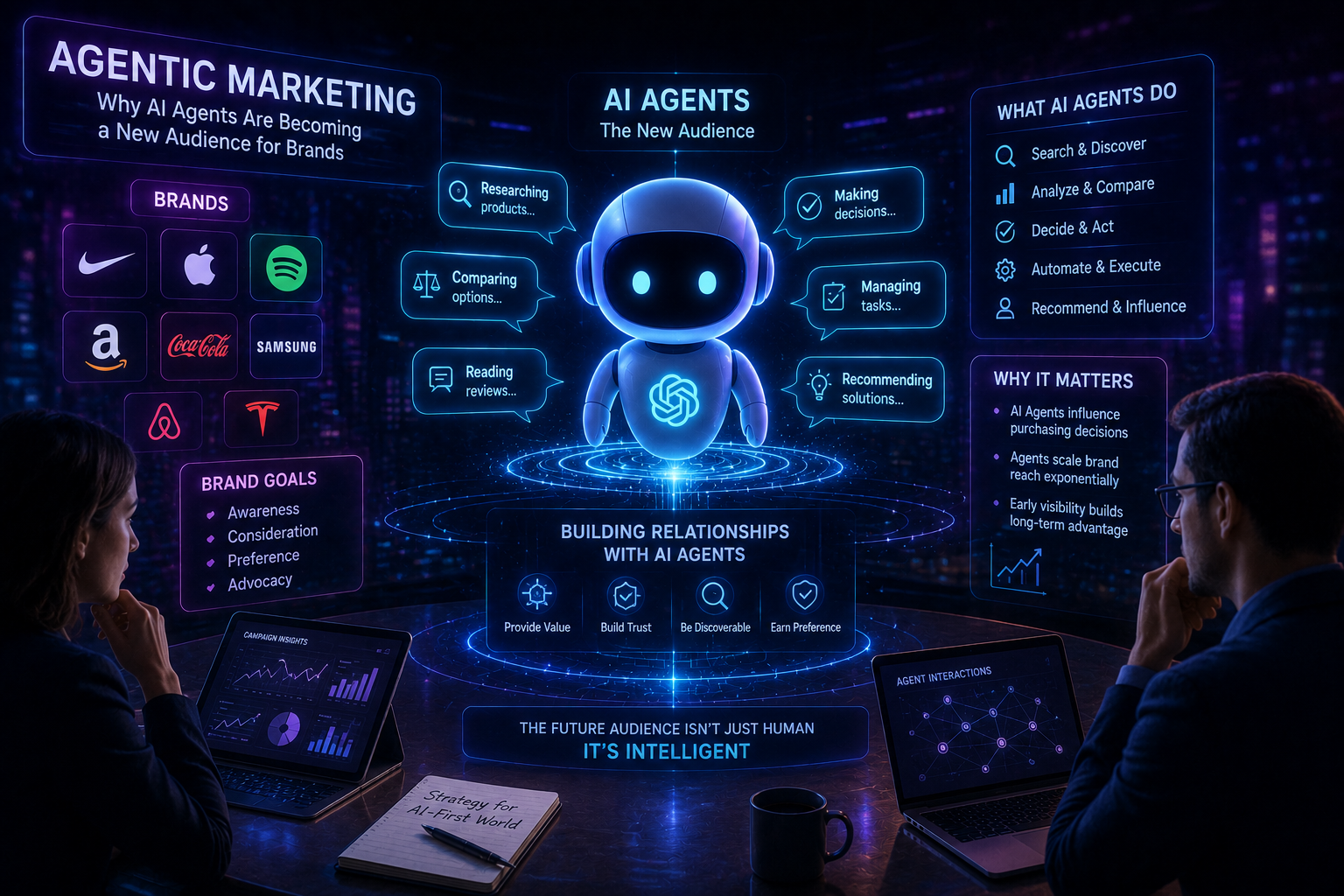
Marketing has always been built around one core assumption: a human being reads, watches, or scrolls past your message and decides whether to act on it. That assumption no longer fully holds. AI agents — software that researches, compares, and increasingly acts on behalf of a person — are starting to sit between brands and the customers they’re trying to reach. That shift doesn’t replace human-focused marketing. It adds an entirely new audience that behaves nothing like a human one.
This guide breaks down what agentic marketing actually means, how it differs from marketing to people, and why the ability to orchestrate experiences at scale is becoming the real differentiator for brands navigating this shift.
Two Audiences, Two Very Different Rules
Marketing to humans and marketing to agents are governed by fundamentally different logic, and treating them the same way is a mistake brands are already starting to make.
Marketing to humans is a battle for seconds. Attention spans in digital channels are famously short, and the pressure on brands to be immediately relevant hasn’t eased — it’s intensified. Getting a promotional message right in the first few seconds now determines whether it lands at all. But relevance alone isn’t enough. Customers reliably disengage when they feel over-marketed to, even when the content itself is technically well-targeted. Timing, restraint, and authenticity matter as much as personalization itself.
Marketing to agents is a battle for structure. An agent processing information on a customer’s behalf isn’t swayed by emotional storytelling, clever copy, or a well-timed offer. It needs accurate, structured, easily parsed information about a product or brand to complete whatever task it’s been asked to do. Persuasion isn’t the goal — clarity and accuracy are.
This is the core insight brands need to internalize: agentic marketing isn’t a new flavor of the same playbook. It requires a genuinely different approach, built around different content, different success metrics, and a different relationship with the audience entirely.
What Makes Human-Facing Marketing Harder Right Now
Even before agents entered the picture, marketing to people had become a tighter balancing act. A few dynamics stand out:
- Attention windows are shrinking. Most customers give a brand only a few seconds to earn engagement in an ad, email, or social post before they move on.
- Over-promotion drives disengagement. A meaningful share of customers will stop engaging with a brand entirely if they feel bombarded with promotions, even relevant ones.
- Poor timing undoes good personalization. Personalized content that arrives at the wrong moment in a customer’s journey — before they’re ready to buy, or after they’ve already decided — often does more harm than generic messaging would have.
- Customers want participation, not just impressions. Interactive, co-created, and experiential brand moments consistently outperform passive advertising in building genuine engagement. Fan-driven content in professional sports and culturally resonant brand collaborations are examples of this dynamic playing out in real time.
The throughline across all of these is that relevance now has to be earned continuously, not established once through a single well-crafted campaign.
How Agents Actually Engage With Brands
Autonomous agents that independently shop, compare, and complete purchases on a customer’s behalf are still an emerging capability rather than the norm. What’s already happening at scale is narrower but no less important: agents assessing information and delivering aggregated answers to real customers, often without the brand ever directly engaging the human in that moment.
This changes what marketing content needs to accomplish. When an agent is retrieving and summarizing information about a product or brand, the content needs to be structured clearly enough for that agent to extract accurate answers — not written primarily to persuade a human reader scrolling past it.
Customer comfort with agent involvement varies significantly by task type. People tend to be far more comfortable letting their personal agent interact with a brand’s human representative than with a brand’s AI agent directly. Comfort also rises sharply for low-risk, routine tasks — things like customer service interactions, receiving personalized promotions, or automating repetitive processes — and drops substantially for higher-stakes actions like booking travel, sharing personal information, or finalizing a purchase.
This points to a practical starting place for brands experimenting with agentic marketing: begin with low-risk, transactional touchpoints where agent involvement is already welcomed, rather than trying to hand agents control over high-stakes decisions customers still want to make themselves.
From Capturing Attention to Supporting Intent
One of the more important mental shifts brands need to make is recognizing that marketing to an agent isn’t about capturing its attention the way you’d capture a human’s. An agent doesn’t get bored, distracted, or swayed by creative flair. It’s executing a task on behalf of a person, which means the brand’s real job is supporting that underlying human intent as accurately and efficiently as possible.
In practice, this means brands need to think about discoverability and structured accuracy as marketing priorities in their own right — not just as technical SEO or data hygiene tasks handled separately from brand strategy. If an agent can’t accurately retrieve or understand information about a product, no amount of creative brand storytelling reaches the human it’s acting for.
Why Experience Orchestration Is the Real Differentiator
None of this changes what actually makes marketing effective at its core: a strong creative idea, a clear message, and genuine customer understanding still start with human insight. What’s changed is the operational complexity required to deliver that idea consistently across formats, channels, languages, and now audience types that include both humans and agents.
A single campaign today can require dozens of asset variations, multiple language versions, and constant optimization across channels — an operational load that pulls marketing teams away from the strategic and creative work that actually drives results.
Customer experience orchestration (CXO) addresses this by connecting customer insight, decisioning, and action into one continuous system rather than a series of disconnected campaigns. Instead of managing isolated moments — an email here, an ad there — orchestration designs and optimizes the entire customer journey as a connected whole, using AI to operate at the scale and speed that manual campaign management can’t match.
Where AI genuinely adds value in this system:
- Translating and deploying content across markets and languages at scale
- Building and refining audience segments based on real behavioral data
- Optimizing performance in response to real-time engagement signals
- Freeing marketing teams to focus on strategy, message clarity, and experience design rather than manual production and distribution
The brands getting the most value from AI in marketing aren’t the ones deploying it everywhere indiscriminately — they’re the ones using it specifically to scale a strong core idea across audiences and formats without diluting it.
Practical Steps for Brands Adapting to This Shift
- Audit your content for structured accuracy, not just persuasive quality. Agents need clean, accurate, well-organized information to represent your brand correctly — this is now as important as compelling copy.
- Identify low-risk touchpoints as your agentic marketing starting point. Customer service, routine promotions, and repetitive processes are where agent involvement is already comfortable for most customers.
- Invest in orchestration infrastructure before scaling AI content production. Producing more content faster only helps if it’s connected to a coherent system of customer insight and journey design — otherwise it just adds noise.
- Keep a human at the center of the creative idea. AI scales execution; it doesn’t replace the strategic spark that makes a campaign resonate in the first place.
- Build governance around agent-facing content and data. As agents increasingly mediate customer interactions, protecting the accuracy and trustworthiness of what they retrieve becomes a brand-protection issue, not just a technical one.
Best Practices for the Agentic Marketing Era
- Treat agents and humans as genuinely separate audiences with separate content strategies, not variations of the same message.
- Prioritize clarity and structured data for anything likely to be retrieved by an agent on a customer’s behalf.
- Respect customer comfort boundaries — push agent involvement into low-risk, routine interactions before attempting higher-stakes ones.
- Use AI to scale a strong idea across formats and markets, not to generate the idea itself.
- Build orchestration systems that connect insight, decisioning, and action, rather than running AI-powered campaigns in isolation from each other.
Common Mistakes to Avoid
- Marketing to agents the same way you market to humans. Persuasive, emotionally driven content doesn’t serve an audience that’s evaluating structured accuracy, not sentiment.
- Over-personalizing without regard to timing. Even relevant content damages engagement when it arrives at the wrong moment in a customer’s journey.
- Treating AI content production as the goal instead of orchestration. More content without a connected system behind it creates fragmentation, not scale.
- Assuming customers want agents making high-stakes decisions for them. Comfort with agent involvement is highest for routine tasks and drops sharply for anything involving money, personal data, or final purchase decisions.
- Letting operational complexity crowd out creative strategy. Orchestration should free marketers to focus on ideas and insight, not just accelerate content output.
Key Takeaways
- Agentic marketing is a distinct discipline from traditional human-focused marketing, built around structured accuracy rather than persuasion.
- Human attention spans are shrinking, and over-personalization or poor timing can disengage customers even when content is relevant.
- Customer comfort with AI agents varies sharply by task — routine, low-risk interactions are the natural starting point for agentic marketing.
- Customer experience orchestration connects insight, decisioning, and action into one system, which is what allows brands to scale personalized experiences without losing coherence.
- The brands succeeding in this shift keep human creativity at the center while using AI specifically to scale execution across audiences, formats, and channels.
Frequently Asked Questions
What is agentic marketing? Agentic marketing refers to marketing strategies designed for AI agents acting on a customer’s behalf, in addition to the customer themselves. It focuses on providing structured, accurate information that agents can retrieve and use, rather than persuasive content aimed purely at human readers.
How is marketing to AI agents different from marketing to humans? Human-facing marketing relies on emotional relevance, timing, and creative storytelling to capture attention within a short window. Agent-facing marketing relies on structured, accurate data that an agent can process and use to complete a task on a customer’s behalf, since agents aren’t persuaded by tone or creative appeal the way people are.
What is customer experience orchestration? Customer experience orchestration is the practice of connecting customer insight, decisioning, and action into one continuous system rather than running isolated, disconnected campaigns. It allows brands to design and optimize entire customer journeys and use AI to execute that vision at scale.
Are customers comfortable letting AI agents interact with brands on their behalf? Comfort levels vary significantly by task. Customers are generally more comfortable with agent involvement in low-risk, routine interactions like customer service or receiving promotions, and far less comfortable letting agents make high-stakes decisions like finalizing purchases or sharing personal information.
Where should a brand start with agentic marketing? Low-risk, transactional touchpoints are the most practical starting point — areas like customer service, routine promotions, and repetitive processes where customers already show comfort with agent involvement. From there, brands can expand into more complex use cases as trust and infrastructure mature.
Conclusion
The rise of AI agents doesn’t replace human-centered marketing — it adds a second, structurally different audience that brands now have to design for simultaneously. Winning in this environment means treating agent-facing content as its own discipline, respecting where customers actually want agent involvement, and building the orchestration infrastructure that lets a strong creative idea scale coherently across both audiences instead of fragmenting into disconnected campaigns.






Leave a Reply