


Nobody sat down and decided to rebuild their company around AI. It happened the way the cloud happened a decade ago: one team needed a coding assistant, another wanted a content tool, HR piloted an AI recruiting platform, finance adopted an AI cost-governance product. Each decision made sense on its own. Looked at together, most companies have quietly built something much bigger than a stack of point solutions — they’ve built the beginnings of a new operating system for the entire business.
That’s not a marketing metaphor. It’s becoming a literal description of what’s happening inside enterprise software architecture.
The Numbers Behind the Shift
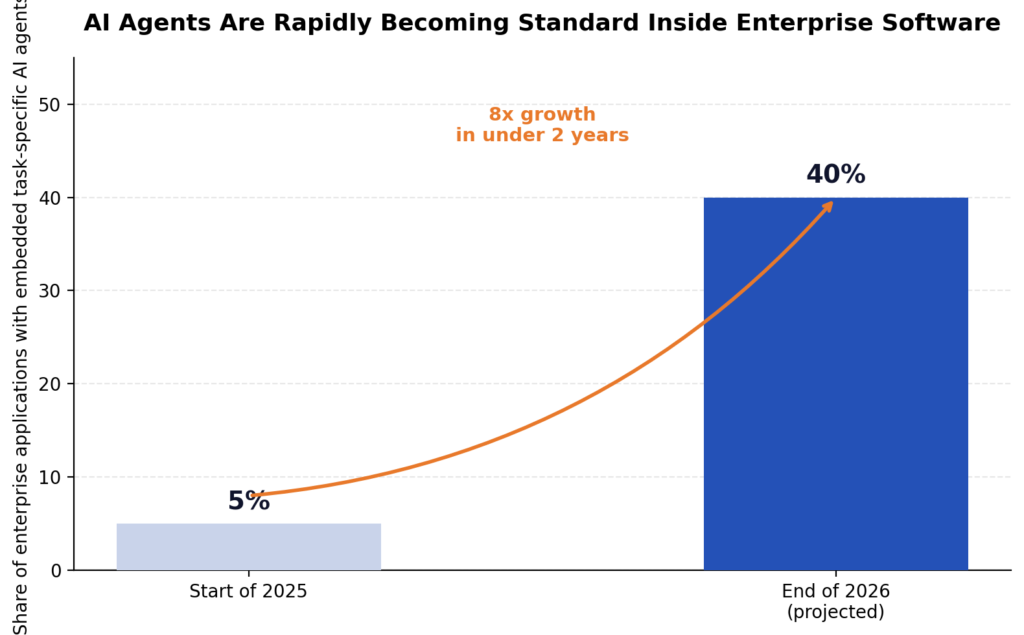
Gartner projects that roughly 40% of enterprise applications will have task-specific AI agents embedded in them by the end of 2026, up from less than 5% at the start of the year — an eightfold jump in under two years. Separately, Gartner has tracked more than 240% growth in agent-based automation across sectors over a similar window.
Executives are moving just as fast as the software itself. In a recent enterprise survey, 97% of executives said their company deployed AI agents in the past year, and 52% of employees reported already using them directly in day-to-day work. McKinsey’s research shows nearly 9 in 10 organizations now use AI in at least one business function — a level of penetration that used to take entire technology categories a decade to reach.
Why “Operating System” Is the Right Word, Not Just a Buzzy One
An operating system doesn’t sit at the edge of a computer as an optional add-on. It’s the foundational layer everything else runs on top of — managing resources, coordinating processes, and providing a consistent interface between applications and infrastructure. That’s precisely the role AI is starting to play inside companies. It’s no longer a chatbot bolted onto a support ticketing system or a writing assistant tucked into a document editor. It’s becoming the layer that orchestrates workflows, routes decisions, and connects tools that were never designed to talk to each other.
The pattern echoes what happened with cloud computing in its early years: individual teams solved individual problems until, almost by accident, an entire company found itself running on infrastructure nobody had explicitly designed. Dependencies formed. Governance gaps opened up. Integrations worked until they didn’t. AI is following the same path, just moving faster.
The Adoption-Value Gap Nobody’s Talking About Enough
Here’s the uncomfortable part: widespread adoption hasn’t translated into widespread value, at least not yet. Despite nearly 90% of organizations using AI somewhere in the business, only 39% report any enterprise-level impact on earnings, and among those that do, most say it contributes less than 5% of total profit. McKinsey has found that only about 1% of companies consider themselves genuinely “mature” in AI deployment — meaning AI is fully integrated into workflows and driving measurable business outcomes rather than sitting in a collection of disconnected pilots.
The core tension: Companies are adopting AI tools faster than they’re building the governance and integration layer needed to actually connect them. That gap between adoption speed and organizational readiness is where most of today’s AI value is quietly leaking out.
What This Looks Like Inside a Real Company
Fragmented by default
The data team picks one platform, engineering adopts an AI coding tool, marketing buys a separate content system, and finance runs its own AI cost-governance product. Every choice is locally rational. Collectively, it creates an estate with no single owner and no shared standards.
Governance built for one model, breaking under fifty
Rules and review processes designed around a single pilot project rarely scale cleanly once five departments are running their own agents against production data and customer-facing systems.
A platform land grab underway
Microsoft, Google and Apple are each racing to become the connective layer businesses standardize on — Copilot woven through Microsoft 365, Gemini tied into Workspace and Android, Apple Intelligence embedded across its device ecosystem. The company that becomes the default “AI operating system” for a business gains enormous influence over which other tools that business can easily use.
Sovereignty Is Becoming Part of the Decision Too
As AI moves from feature to foundation, where that foundation is built and by whom has become a boardroom question, not just a technical one. In a recent enterprise survey, 77% of companies said a vendor’s country of origin now factors into AI vendor selection, 58% said they’re prioritizing local vendors in their stack decisions, and 83% of multinational board members said sovereign AI considerations are at least moderately important to overall strategy.
If the past decade of enterprise software was defined by cloud adoption, the current one is being defined by which company controls the intelligence layer sitting on top of that cloud — and increasingly, where that intelligence layer is legally and physically based.
What Companies Should Do About It
- Treat AI governance as infrastructure, not policy. The organizations handling this well are building the connective tissue between tools now, rather than retrofitting coherence after the estate becomes unmanageable.
- Ask who owns the AI layer, not just which tools it uses. A missing owner is the clearest predictor of the fragmentation problem showing up later.
- Measure business impact, not deployment counts. The gap between “AI is deployed somewhere” and “AI is driving EBIT” is where most companies are currently stuck.
- Plan for platform dependency. Standardizing on one vendor’s AI layer brings real efficiency, but it also concentrates risk and negotiating leverage in ways worth thinking through deliberately, not accidentally.






Leave a Reply