

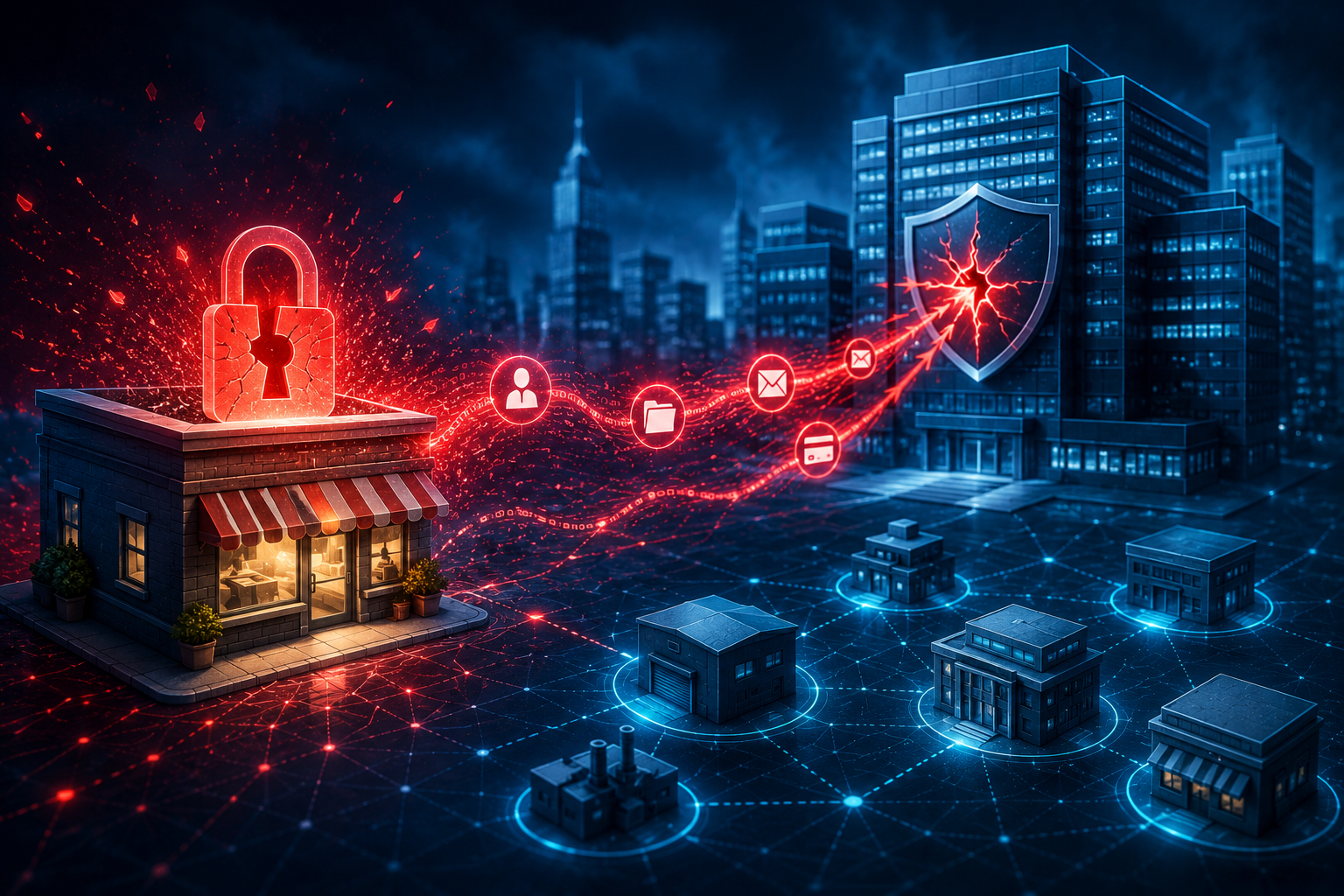
For years, ransomware attacks primarily focused on organizations with the deepest pockets—large enterprises, hospitals, government agencies, and multinational corporations. But cybersecurity experts are now witnessing a strategic shift.
Instead of attacking large organizations directly, cybercriminals are increasingly compromising small and medium-sized businesses (SMBs) first. These smaller companies often serve as suppliers, software vendors, logistics partners, managed service providers (MSPs), or contractors for much larger enterprises. Once attackers gain access to these trusted partners, they use that relationship as a stepping stone to infiltrate bigger, more lucrative targets.
This evolution has transformed ransomware from isolated attacks into sophisticated supply-chain campaigns, making even the smallest organization a valuable target.
Why Small Businesses Have Become Prime Targets
Small businesses typically lack the cybersecurity budgets and dedicated security teams available to larger enterprises. While Fortune 500 companies invest millions in advanced security tools, threat intelligence, and continuous monitoring, many SMBs rely on basic antivirus software and limited IT support.
Common weaknesses include:
- Weak password policies
- Lack of multi-factor authentication (MFA)
- Unpatched systems
- Inadequate employee security awareness
- Limited endpoint detection capabilities
- Poor backup and disaster recovery practices
These vulnerabilities make SMBs significantly easier to compromise than heavily defended enterprises.
For ransomware groups operating like organized businesses, attacking the weakest link often delivers the highest return on investment.
The Supply Chain Effect
Today’s businesses rarely operate in isolation.
A small accounting firm may have access to a client’s financial systems. A software vendor may maintain remote administrative access to customer infrastructure. An MSP may manage hundreds of enterprise endpoints.
If attackers compromise one trusted partner, they may inherit access to dozens—or even hundreds—of larger organizations.
This strategy has become one of the fastest-growing cybersecurity threats because it exploits trust rather than technology.
Instead of breaking through an enterprise’s defenses, attackers simply walk through a trusted digital doorway.
How the Attack Typically Works
A modern ransomware campaign often follows several stages.
1. Initial Compromise
Attackers gain access through:
- Phishing emails
- Stolen credentials
- Remote Desktop Protocol (RDP) exposure
- Vulnerable VPNs
- Unpatched software
- Third-party applications
2. Silent Reconnaissance
Rather than deploying ransomware immediately, attackers quietly explore the network.
They identify:
- Customer information
- Remote management tools
- Cloud credentials
- Administrative accounts
- Backup infrastructure
- Connections to enterprise customers
3. Credential Theft
Cybercriminals harvest credentials using:
- Keyloggers
- Memory scraping
- Token theft
- Password dumping tools
These credentials often provide access beyond the SMB’s own environment.
4. Lateral Movement
Using legitimate administrative tools, attackers move across systems while avoiding detection.
Many ransomware operators deliberately mimic normal administrator behavior to remain unnoticed.
5. Enterprise Pivot
Once valuable enterprise connections are discovered, attackers exploit trusted relationships.
Examples include:
- Software update mechanisms
- Remote support sessions
- Shared cloud platforms
- VPN connections
- Vendor portals
- Active Directory trust relationships
6. Double Extortion
Modern ransomware rarely stops at encryption.
Before locking files, attackers steal sensitive data.
Victims then face two threats:
- Operational disruption
- Public exposure of confidential information
Many organizations end up paying to avoid both.
Why Larger Enterprises Are Vulnerable
Many enterprises invest heavily in cybersecurity while overlooking third-party risks.
Every vendor connected to corporate infrastructure becomes part of the organization’s attack surface.
Common trusted partners include:
- Payroll providers
- IT service companies
- Cloud software vendors
- Manufacturing suppliers
- Marketing agencies
- Financial consultants
- HR platforms
If just one partner is compromised, attackers may gain indirect access to enterprise systems.
Industries Seeing the Highest Risk
Supply-chain ransomware affects nearly every industry, but some sectors are especially vulnerable.
Healthcare
Hospitals rely on numerous technology vendors, laboratories, billing companies, and medical device suppliers.
One compromised partner can affect multiple healthcare providers simultaneously.
Manufacturing
Manufacturers depend on extensive supplier ecosystems.
A compromised engineering contractor or software vendor can disrupt production across multiple facilities.
Financial Services
Banks increasingly outsource software development, compliance, customer support, and cloud infrastructure.
Each external partner introduces potential attack paths.
Retail
Retailers depend on payment processors, logistics providers, inventory platforms, and e-commerce vendors.
Compromising any one of these can expose sensitive customer data.
Why Ransomware Gangs Prefer This Strategy
Cybercriminal organizations have become highly professional.
Instead of spending months attacking heavily protected enterprises, they focus on smaller organizations with weaker defenses.
Benefits for attackers include:
- Lower attack costs
- Higher success rates
- Access to multiple enterprise victims
- Larger ransom demands
- Greater leverage through stolen data
From the attacker’s perspective, compromising one MSP serving 200 clients is far more efficient than attacking 200 companies individually.
The Rise of Ransomware-as-a-Service (RaaS)
The ransomware ecosystem has also evolved into a commercial model known as Ransomware-as-a-Service (RaaS).
Developers create ransomware platforms while affiliates conduct attacks.
Affiliates earn a share of ransom payments, enabling less-skilled criminals to launch sophisticated campaigns.
This model has dramatically increased both the frequency and sophistication of ransomware attacks worldwide.
How Small Businesses Can Protect Themselves
Cybersecurity doesn’t require enterprise-scale budgets to be effective.
Small businesses should prioritize:
- Enable multi-factor authentication across all accounts
- Keep operating systems and applications updated
- Conduct regular employee phishing awareness training
- Maintain offline and immutable backups
- Implement endpoint detection and response (EDR)
- Restrict administrative privileges
- Monitor unusual login activity
- Develop an incident response plan
- Encrypt sensitive business data
- Regularly review third-party access permissions
Even basic cybersecurity hygiene can significantly reduce ransomware risk.
What Larger Enterprises Must Do
Enterprises should recognize that vendor security is now business security.
Key measures include:
- Assess vendor cybersecurity practices before onboarding
- Continuously monitor third-party risk
- Implement Zero Trust access policies
- Limit vendor permissions to only necessary resources
- Require MFA for all external access
- Audit remote connections regularly
- Segment critical networks
- Conduct supply-chain security assessments
- Include cybersecurity requirements in vendor contracts
Protecting the enterprise now means protecting the entire ecosystem.
The Future of Ransomware
As businesses become increasingly interconnected, ransomware operators will continue exploiting trusted relationships rather than attacking organizations head-on.
Artificial intelligence, automation, and stolen credentials are enabling attackers to identify weak links faster than ever before.
The next major ransomware incident may not begin inside a Fortune 500 company—it could start with a small supplier that has fewer than 20 employees.
In today’s digital economy, every connected business is part of a larger cybersecurity ecosystem.
Conclusion
The era when only large enterprises needed to worry about ransomware is over. Small businesses have become attractive targets not because of their own size, but because of the valuable connections they maintain with larger organizations.
A single compromised supplier, contractor, or managed service provider can open the door to widespread disruption across entire industries. As ransomware groups continue refining supply-chain attack strategies, organizations of every size must view cybersecurity as a shared responsibility rather than an isolated IT concern.
Investing in strong authentication, employee awareness, regular patching, and vendor risk management is no longer optional—it’s essential for protecting not only your own business, but the broader network of partners and customers that depend on it.





Leave a Reply