

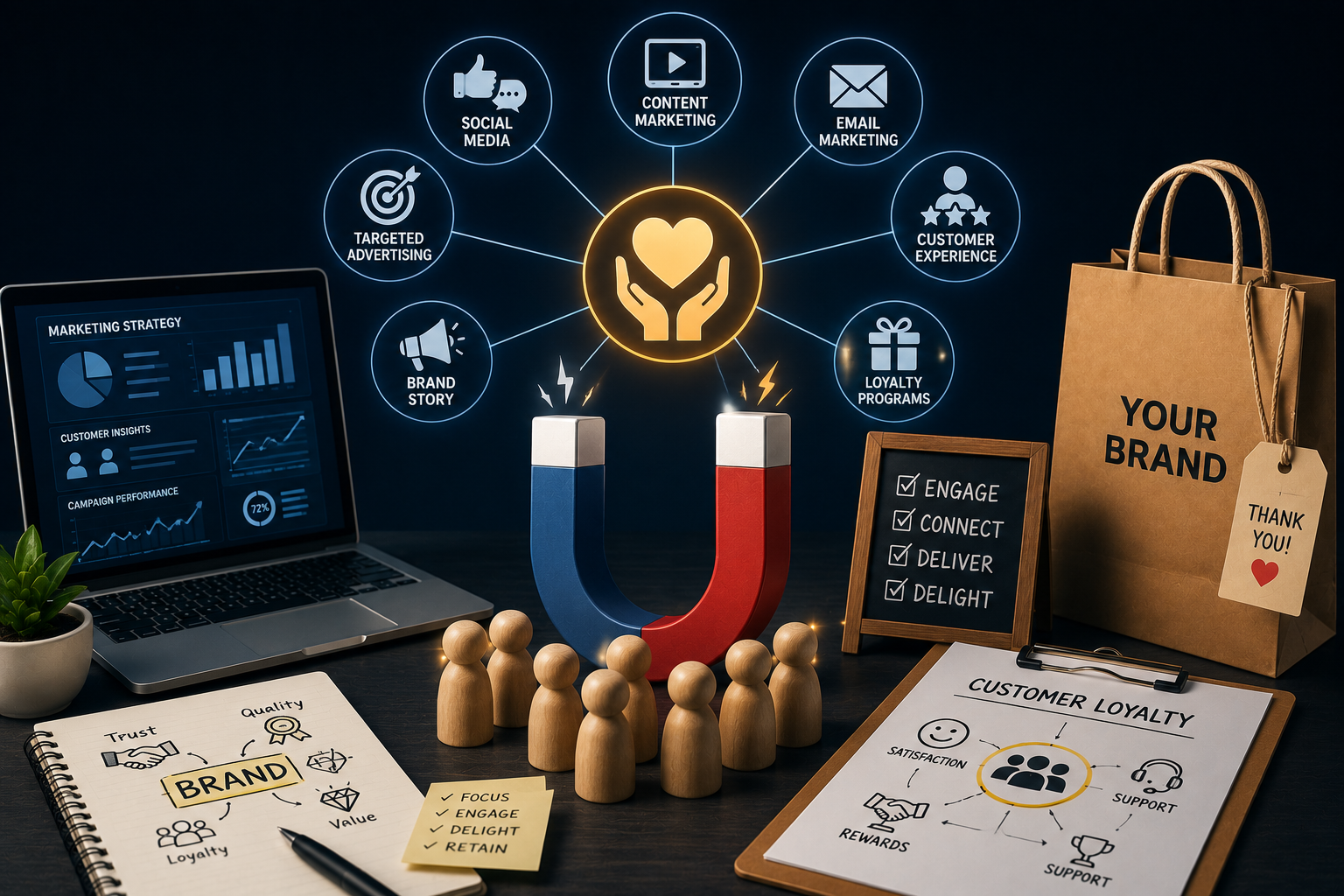
Winning a customer’s first purchase is only half the job. The businesses that grow fastest on limited budgets are the ones that turn that first purchase into a second, a third, and eventually a habit. For small and medium-sized enterprises and startups, brand loyalty isn’t a nice-to-have — it’s often the difference between a business that survives its first few years and one that doesn’t.
Large companies can afford to buy attention repeatedly. Smaller businesses generally can’t compete on ad spend alone, which means every advertising dollar has to work harder. The good news is that loyalty-building advertising tends to reward authenticity and consistency more than budget size — qualities smaller, nimbler businesses are often better positioned to deliver than their larger competitors.
This guide walks through the advertising approaches that consistently produce the best return for resource-constrained businesses, and how to combine them into a system rather than a series of disconnected campaigns.
Why Brand Loyalty Deserves Its Own Strategy
Acquiring a new customer typically costs significantly more than keeping an existing one. A returning customer already trusts your product, needs less convincing, and is more likely to spend more per visit over time. Research on customer lifetime value consistently shows that loyal customers can be worth many times their initial purchase across their full relationship with a brand.
That means an advertising budget split entirely between acquiring new customers is leaving money on the table. A portion of that budget — and a portion of your strategic attention — needs to go toward keeping the customers you’ve already won. Loyalty-focused advertising isn’t a separate discipline from acquisition; it’s what makes acquisition spending pay off over the long run instead of resetting to zero with every new customer.
Digital Ads: Making Every Dollar Accountable
Platforms like Google Ads, Facebook, and Instagram give small businesses something large ad campaigns didn’t have a generation ago: precise targeting and real-time performance data. You don’t need a large budget to use them well — you need a willingness to test, measure, and adjust.
Start small and let data guide you. Run a few small-budget variations of the same ad before committing serious spend to any one version. Track which one performs best, and expand from there.
Use retargeting to recapture interest. Most visitors won’t buy on their first visit to your website or store page. Retargeting ads — shown specifically to people who’ve already engaged with your brand — reintroduce you at the moment they’re more likely to convert, and they typically cost less per result than ads aimed at cold audiences.
Treat every campaign as a learning opportunity. Even a campaign that underperforms teaches you something about your audience’s preferences. Small businesses that review performance data regularly improve their targeting and messaging far faster than those that “set and forget” their ads.
In-Person Connection Still Builds Trust Ads Can’t
Digital advertising is efficient, but it can’t fully replace the trust built through a face-to-face conversation. For SMEs and startups, local events, trade shows, pop-ups, and community meetups offer something scaled advertising doesn’t: the chance to answer a question directly, tell your story in your own words, and let a potential customer see the people behind the brand.
These interactions are also disproportionately effective at generating word-of-mouth referrals, which remain one of the most trusted forms of marketing precisely because they come from someone the buyer already knows rather than from an advertisement. A single strong in-person impression can ripple outward through a customer’s network in ways a digital ad rarely does on its own.
Email: The Loyalty Channel Businesses Underuse
Email marketing tends to get overlooked in favor of flashier channels, but it remains one of the most cost-effective ways to maintain a relationship with existing customers. Unlike social media, where a message competes with dozens of other posts in a feed, an email lands directly in a customer’s inbox with your brand’s name attached.
Build your list deliberately. Collect email addresses through your website, at checkout, on social media, and at in-person events — always with clear consent.
Keep communication genuinely useful. Product updates, exclusive offers, and early access to new releases give subscribers a reason to keep opening your emails rather than unsubscribing.
Don’t underestimate a short, personal message. A brief note that reminds a customer why they chose you in the first place often performs better than a heavily designed promotional email. Personalization and authenticity tend to outperform polish in this channel.
Social Media: Real-Time Relationship Building
Social platforms let small businesses do something large brands often struggle with: respond to individual customers in real time. That responsiveness is a genuine competitive advantage, not just a nice gesture.
- Reply to comments and messages promptly and personally rather than with generic scripted responses.
- Share behind-the-scenes content that shows the people and process behind your product.
- Use targeted ads sparingly to extend the reach of your best-performing organic content rather than replacing organic engagement entirely.
- Offer small, social-only discounts or early access to reward people who follow and engage with your brand directly.
The businesses that build the strongest social media loyalty tend to treat the channel as a two-way conversation rather than a broadcast feed. Customers who feel heard are far more likely to become repeat buyers and vocal advocates.
Structured Loyalty Programs Don’t Need to Be Complicated
Large brands run sophisticated, tiered loyalty programs backed by dedicated software. SMEs and startups don’t need to match that complexity to see results — a simple, clearly communicated reward system is often enough.
Effective low-cost loyalty mechanics include:
- Punch cards or purchase-based rewards — a free or discounted item after a set number of purchases.
- Referral incentives — a discount or credit for both the referring customer and the new customer they bring in.
- Early access programs — letting loyal customers try new products or offers before the general public.
- Milestone discounts — a reward tied to a customer’s fifth, tenth, or twentieth purchase to reinforce the habit of returning.
The specific mechanic matters less than the psychology behind it: customers who can see visible progress toward a reward are measurably more likely to keep purchasing than customers who receive no acknowledgment of their loyalty at all.
Let Existing Customers Do the Advertising
Testimonials, reviews, and case studies are among the most persuasive advertising assets a small business can have, and they cost far less to produce than a professional ad campaign. Potential customers trust the experiences of people who’ve already bought from you more than they trust a brand’s own claims about itself.
Even a handful of specific, detailed reviews can meaningfully shift a hesitant buyer’s decision. Once that buyer becomes a customer and experiences the product firsthand, the cycle reinforces itself — satisfied customers create more of the social proof that attracts the next wave of buyers.
Practical ways to collect this content:
- Ask directly after a positive interaction or purchase, when the experience is still fresh.
- Make leaving a review as frictionless as possible — a direct link goes a long way.
- Feature real customer stories, not just star ratings, wherever your brand has a presence online.
Measuring What’s Actually Working
Loyalty efforts are only useful if you can tell whether they’re moving the numbers that matter. A few core metrics tell most of the story:
| Metric | What it tells you |
|---|---|
| Repeat purchase rate | The percentage of customers who buy more than once |
| Customer lifetime value | The total revenue a typical customer generates over their relationship with your brand |
| Referral rate | How often existing customers bring in new ones |
| Feedback and satisfaction scores | Early warning signs of friction before they show up in sales numbers |
Reviewing these numbers regularly — not just at the end of the year — lets you catch problems early and double down on what’s clearly working. Small, consistent improvements to the customer experience tend to compound into meaningful retention gains over time.
Best Practices for SME Loyalty Advertising
- Prioritize channels where you can have a genuine two-way conversation with customers.
- Reward loyalty visibly so customers can see their progress toward a benefit.
- Combine at least one digital channel with one relationship-based channel (email, in-person, or social) rather than relying on either alone.
- Ask for feedback often, and act visibly on what you learn.
- Keep messaging consistent across channels so your brand feels familiar wherever a customer encounters it.
Common Mistakes to Avoid
- Spending only on new customer acquisition and neglecting the customers already won.
- Running loyalty programs that are too complicated for customers to understand or bother tracking.
- Treating social media as a one-way broadcast channel instead of engaging directly with comments and messages.
- Ignoring email marketing because it feels outdated, despite it remaining one of the most cost-effective retention tools available.
- Collecting reviews passively instead of actively asking satisfied customers to share their experience.
Key Takeaways
- Loyalty-focused advertising delivers a stronger long-term return than acquisition-only spending because repeat customers are worth significantly more over time.
- Digital ads and retargeting let SMEs compete effectively even on modest budgets, provided campaigns are tested and measured consistently.
- In-person connection and genuine social media engagement build trust that scaled advertising alone can’t replicate.
- Simple loyalty mechanics — punch cards, referral discounts, early access — are enough to meaningfully increase repeat purchases.
- Tracking core metrics like repeat purchase rate and customer lifetime value keeps loyalty efforts grounded in real results rather than guesswork.
Frequently Asked Questions
What’s the most cost-effective advertising channel for a small business building loyalty? Email marketing is consistently one of the most cost-effective channels for retention, since it reaches existing customers directly without ongoing ad spend. It works best when paired with a genuine reason to stay subscribed, such as exclusive offers or early product access.
Do small businesses need a formal loyalty program to build brand loyalty? No. A simple, clearly communicated reward — like a punch card or a discount after a set number of purchases — is often enough. What matters most is that customers can see visible progress toward a benefit, not the sophistication of the system tracking it.
How much of an advertising budget should go toward retention versus new customer acquisition? There’s no universal ratio, but many growing SMEs find value in dedicating a meaningful share of their budget to retention once they have an established customer base, since returning customers typically generate more value per dollar spent than a single new acquisition.
Why does word-of-mouth still matter in a digital advertising world? Recommendations from people a buyer already trusts carry more weight than most paid advertising, because they come without the assumed bias of a brand promoting itself. In-person events and strong customer experiences are two of the most reliable ways to generate this kind of organic referral.
What metrics best indicate whether a loyalty strategy is working? Repeat purchase rate and customer lifetime value are the clearest indicators, since they measure actual behavior rather than intent. Referral rates and customer feedback scores add useful early signals before those numbers fully show up in revenue.
Conclusion
Building brand loyalty as an SME or startup doesn’t require matching the budgets of larger competitors — it requires consistency, genuine engagement, and a willingness to treat existing customers as seriously as new ones. Digital ads bring people in, but email, social interaction, simple rewards, and authentic customer stories are what keep them coming back. Businesses that combine these approaches into one connected strategy, rather than treating them as separate tactics, tend to build the kind of loyalty that compounds over years, not just campaigns.






Leave a Reply