

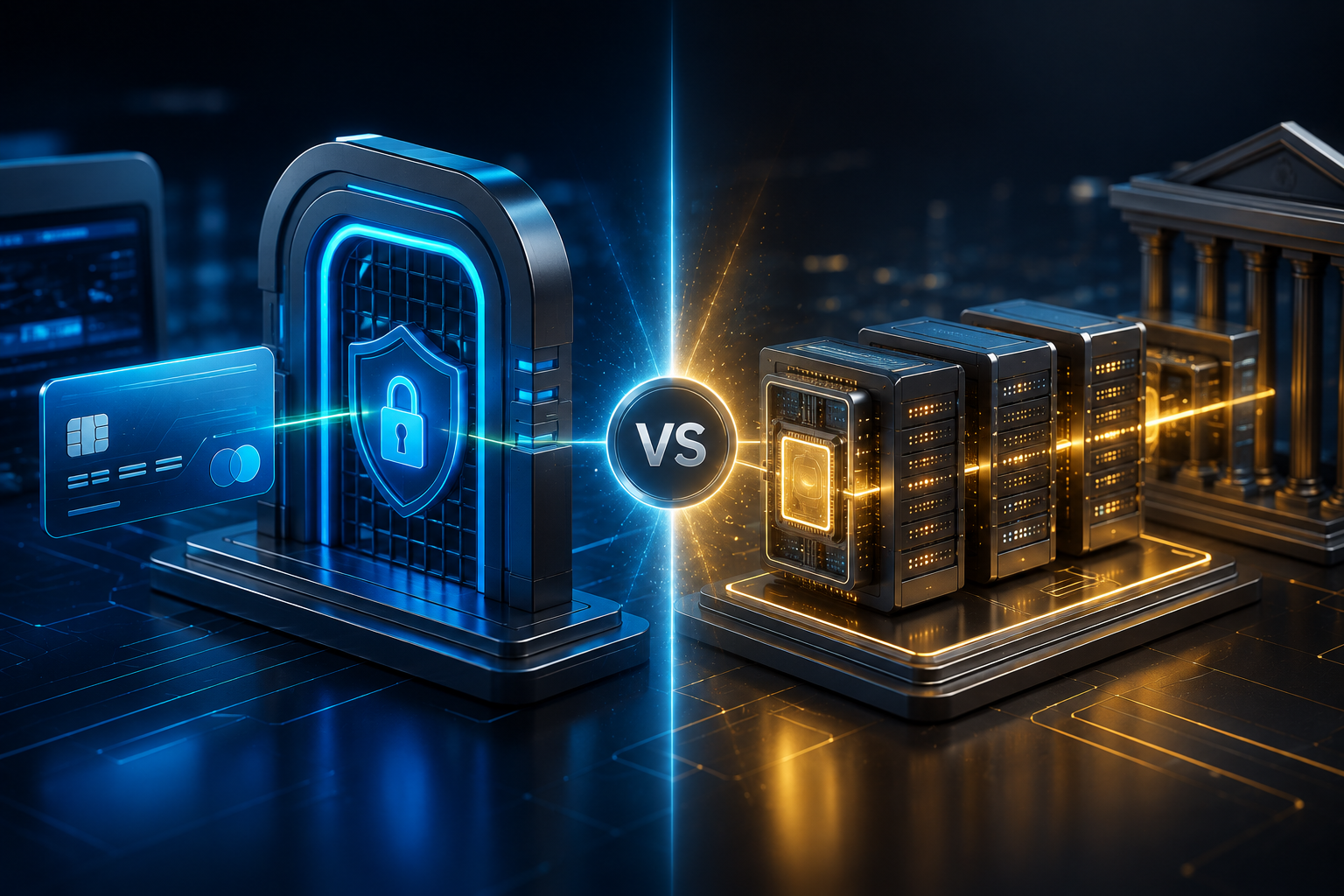
Ask most people to explain the difference between a payment gateway and a payment processor, and you’ll usually get a blank look, or an answer that conflates the two entirely. That confusion is understandable — from a merchant’s dashboard, both often feel like the same black box that “handles payments.” But they’re distinct systems, doing distinct jobs, and understanding the difference matters enormously if you’re building, integrating with, or simply trying to understand modern payment infrastructure.
An earlier article in this series already walked through the complete journey of a single online payment, from click to confirmation. This one zooms in specifically on two of the most misunderstood components in that journey — the gateway and the processor — and explains, in real technical depth, what each one actually does, where their responsibilities begin and end, and how they work together.
Section 1: Why Online Payments Need Multiple Companies
No single company handles an online payment from start to finish, and that’s by design, not accident. Payments require specialized trust relationships — with card networks, with banks, with regulators — that took decades to build, and no new entrant realistically replicates all of them from scratch. Instead, the ecosystem splits responsibility across several specialized players:
- Customer — initiates the payment
- Merchant — the business receiving payment
- Payment gateway — securely captures and transmits payment details
- Payment processor — routes the transaction and coordinates settlement
- Acquiring bank — the merchant’s bank, submitting the transaction into the network
- Card network — the rails (like Visa or Mastercard) connecting banks
- Issuing bank — the customer’s bank, holding and authorizing access to their funds
- Settlement — the actual movement of funds between banks
This full flow, and what happens at each stage, is covered in detail in our complete breakdown of the online payment journey. This article focuses specifically on two of these players — the gateway and the processor — since they’re the ones most frequently confused, and the ones a business actually integrates with directly.
Section 2: What Is a Payment Gateway?
Definition: A payment gateway is the technology layer that securely captures a customer’s payment details at the point of transaction and transmits them, encrypted, toward the payment processor for further handling.
Think of the gateway as the digital equivalent of a physical card reader at a checkout counter — its job is capturing payment information safely and passing it along, not deciding whether the transaction should be approved.
Core responsibilities:
- Encryption — payment details are encrypted the moment they’re entered, protecting them in transit
- Tokenization — sensitive card data is replaced with a non-sensitive substitute token, meaning the merchant’s own systems never need to handle raw card numbers directly
- Authorization request — the gateway packages the transaction details and forwards them toward the processor, initiating the authorization sequence
- Merchant integration — gateways provide the actual technical interface (APIs, hosted checkout pages, or embedded elements) that a merchant’s website or app integrates with
Hosted vs. embedded checkout:
| Approach | How It Works | Trade-off |
|---|---|---|
| Hosted checkout | The customer is redirected to a page hosted by the gateway to enter payment details | Simpler integration and reduced compliance burden, at the cost of a less seamless brand experience |
| Embedded checkout | Payment fields appear directly within the merchant’s own site or app, often via secure embedded components | More seamless customer experience, but typically more integration and compliance responsibility for the merchant |
The gateway’s real-world role: it’s the first point of contact for payment data, and its entire job is making sure that data reaches the next stage of the process securely and accurately, without ever exposing raw sensitive information to systems that don’t need it.
Section 3: What Is a Payment Processor?
Definition: A payment processor is the system that handles the actual technical routing of a transaction between the acquiring bank, the card network, and the issuing bank — executing the behind-the-scenes work of getting a transaction authorized and eventually settled.
If the gateway is the card reader, the processor is closer to the entire back-office operation that decides whether a transaction is approved, communicates with the relevant banks, and eventually makes sure money actually moves.
Core responsibilities:
- Transaction routing — directing the authorization request to the correct acquiring bank and, from there, into the card network
- Bank communication — handling the technical exchange between acquiring and issuing banks required to approve or decline a transaction
- Settlement — coordinating the actual transfer of funds from the customer’s bank to the merchant’s bank, which typically happens after authorization, not at the same moment
- Clearing — the process of reconciling and finalizing transaction details between banks before settlement completes
- Risk checks — evaluating transactions for fraud risk as part of the authorization process
- Merchant payouts — ensuring settled funds actually reach the merchant’s account on the expected schedule
Why processors operate behind the scenes: unlike the gateway, which a customer indirectly interacts with (even if just through a checkout page), the processor is almost entirely invisible to the end customer. Its work happens entirely between institutions — banks, card networks, and clearing systems — well outside anything a customer or even most merchants ever see directly.
Section 4: Complete Payment Flow
To see exactly where the gateway’s job ends and the processor’s begins, it helps to walk through the full sequence:
Customer
   |
   v
Merchant Website
   |
   v
Payment Gateway        <- captures, encrypts, tokenizes payment details
   |
   v
Payment Processor       <- routes the transaction, coordinates with banks
   |
   v
Acquiring Bank
   |
   v
Card Network
   |
   v
Issuing Bank
   |
   v
Authorization           <- approval or decline, sent back through the same path
   |
   v
Settlement               <- actual movement of funds, typically after authorization
   |
   v
Merchant Account
   |
   v
Confirmation
The key handoff to understand: the gateway’s responsibility ends once it has securely captured and transmitted the transaction details. From that point forward, the processor takes over — routing the request through the acquiring bank, card network, and issuing bank, and eventually coordinating settlement. Many providers today bundle both gateway and processing functionality into a single product, which is a major reason the distinction has become blurry to merchants, even though the two remain functionally separate stages of the process.
Section 5: Payment Gateway vs Payment Processor
| Dimension | Payment Gateway | Payment Processor |
|---|---|---|
| Purpose | Securely capture and transmit payment data | Route transactions and coordinate settlement between banks |
| Primary responsibility | Encryption, tokenization, data capture | Authorization routing, clearing, settlement |
| Security focus | Protecting data at the point of capture | Fraud and risk checks during authorization |
| Communication | Merchant-facing (integrates with checkout) | Bank-facing (communicates with acquiring/issuing banks and card networks) |
| Settlement involvement | None directly | Central to coordinating fund movement |
| Merchant interaction | Direct — merchants integrate with gateway APIs or checkout pages | Indirect — merchants rarely interact with the processor directly |
| Customer visibility | Sometimes visible (hosted checkout pages) | Essentially invisible to the customer |
| Revenue model | Often per-transaction fee, sometimes a flat platform fee | Often a percentage of transaction value plus per-transaction fees |
| Technical complexity | Moderate — focused on secure data capture and API integration | High — involves complex bank and network-level coordination |
A useful mental model: the gateway is about capturing a transaction safely; the processor is about executing it — actually getting the transaction approved and the money moved between the right institutions. A business can, in principle, use a gateway and processor from different providers, though many modern payment platforms bundle both into a single integrated product for simplicity.
Section 6: Security Behind Every Transaction
Security spans both the gateway and processor, layered because no single defense is sufficient on its own.
Encryption protects payment data in transit, ensuring intercepted traffic remains unreadable. Tokenization, handled primarily at the gateway level, replaces sensitive card data with a non-sensitive substitute, so downstream systems never need to handle raw card numbers.
PCI DSS (Payment Card Industry Data Security Standard) compliance is required across the entire chain — gateway, processor, and merchant — covering everything from network security to access controls.
Fraud detection and risk engines, largely operated at the processor level, evaluate transactions in real time against patterns associated with fraudulent activity, drawing on the kind of pattern recognition covered in how digital scams and cyber fraud actually work — understanding attacker tactics directly informs how these detection systems are built.
3D Secure adds an additional authentication step (often involving the issuing bank directly) for card-not-present transactions, shifting liability and reducing fraud risk for higher-risk online purchases.
Multi-factor authentication adds a verification layer beyond payment details alone, particularly relevant for digital wallets and account-based payment methods.
Device fingerprinting analyzes device and behavioral signals to help distinguish legitimate customers from fraudulent actors, even when stolen payment details are technically valid.
Chargeback prevention combines fraud detection, clear transaction records, and dispute-response tooling to reduce both the frequency and cost of disputed transactions.
Why this matters this much: every layer in this chain represents a potential point of failure, and payment fraud converts directly into financial loss — unlike many other categories of security risk, there’s no ambiguity about the stakes.
Section 7: How Modern FinTech Companies Build Payment Infrastructure
Payment systems demand engineering discipline beyond most software categories, because the cost of failure is immediate, financial, and highly visible.
API-first architecture treats integration as a core design principle, letting merchants, partners, and internal teams build on top of a well-defined, stable interface rather than tightly coupled internal systems.
Microservices break payment platforms into independently deployable components — authorization, fraud detection, settlement — following the same architectural reasoning covered in how real production software systems are actually designed, applied here with an especially low tolerance for downtime.
High availability and load balancers ensure the system can absorb unpredictable transaction volume without failure — the same principles explored in how load balancing keeps high-traffic systems reliable apply directly to payment infrastructure, where a dropped transaction has real financial consequences, not just a degraded user experience.
Caching, applied carefully, speeds up non-critical lookups without compromising the accuracy of live balance or authorization data — the same trade-offs discussed in why modern applications rely on multiple layers of caching apply here, with an even lower tolerance for serving stale financial data.
Message queues handle asynchronous work — notifications, reconciliation, reporting — without blocking the time-sensitive authorization path itself.
Database replication ensures transaction records remain available and consistent even in the event of a hardware failure, critical given how strict the accuracy requirements are for financial records.
Monitoring, cloud infrastructure, and disaster recovery round out the picture: continuous visibility into system health, scalable infrastructure to absorb demand, and a tested plan for recovering quickly from serious failures.
Why near-zero downtime is the standard, not the aspiration: every minute a payment system is unavailable directly blocks revenue for every merchant relying on it simultaneously — a fundamentally different risk profile than most consumer software, where downtime is an inconvenience rather than a direct, compounding financial loss across an entire customer base at once.
Section 8: Common Payment Failures
| Failure | Why It Happens | How Modern Systems Reduce It |
|---|---|---|
| Timeouts | Network issues or slow upstream responses from banks or networks | Redundant infrastructure and sensible timeout/retry logic |
| Duplicate payments | Network retries or user double-submission | Idempotency mechanisms ensuring repeated requests don’t double-charge |
| Failed authorization | Fraud flags, insufficient funds, or expired cards | Clear, actionable error messaging without exposing sensitive detail |
| Insufficient funds | Customer’s account balance is genuinely too low | Real-time balance checks at the issuing bank during authorization |
| Gateway downtime | Infrastructure failure at the gateway level | Redundant, highly available gateway infrastructure |
| Processor issues | Failures in bank or network communication | Failover routing and monitoring across processor infrastructure |
| Chargebacks | Disputed, unauthorized, or undelivered transactions | Strong fraud prevention and clear transaction documentation |
| Settlement delays | Batch processing schedules or bank-side delays | Increasing adoption of real-time settlement rails where available |
Well-engineered payment systems aren’t judged by achieving zero failures — that’s not realistic given how many external institutions are involved — but by how gracefully and transparently they handle failures when they occur.
Section 9: AI in Payment Infrastructure
Fraud detection benefits enormously from AI’s ability to identify subtle, evolving patterns across massive transaction volumes, far faster than static, manually maintained rule sets.
Risk scoring uses AI to assess transaction and customer risk more dynamically, incorporating a broader range of signals than traditional models.
Transaction monitoring applies AI continuously, spotting patterns that suggest account compromise or emerging fraud rings across large volumes of activity.
Customer support increasingly uses AI to resolve common payment-related inquiries quickly, freeing human agents for complex disputes.
Compliance benefits from AI’s ability to flag activity relevant to regulatory requirements at a scale manual review can’t match.
Predictive analytics help anticipate infrastructure issues or unusual transaction volume patterns before they become operational problems.
Where human oversight remains essential: high-stakes fraud decisions, complex disputes, and regulatory judgment calls still require human review. AI dramatically improves detection speed and scale, but accountability for consequential financial decisions remains, appropriately, a human responsibility.
Section 10: Real Architecture Case Study
Consider a fictional e-commerce company and its complete payment architecture:
Customer's Browser
        |
        v
   Merchant Checkout Page
        |
        v
   Payment Gateway (hosted/embedded checkout, tokenization)
        |
        v
   Payment Processor (routing, risk checks)
        |
        v
   Acquiring Bank  --->  Card Network  --->  Issuing Bank
        |
        v
   Authorization Response
        |
        v
   Merchant's Order System (order confirmed)
        |
        v
   Settlement (batch or real-time, days later or same-day)
        |
        v
   Merchant's Bank Account
        |
        v
   Reconciliation System (matches settled funds to orders)
Why each component exists: the checkout page and gateway handle secure data capture without exposing the merchant’s systems to raw card data. The processor handles the actual authorization logic and bank communication. The order system reacts to authorization, not settlement, which is why order confirmation happens almost instantly while the underlying funds movement completes separately, often days later. Reconciliation exists because authorization and settlement are separate events, and someone — automated or human — needs to confirm every settled transaction matches an actual order.
Section 11: Future of Payment Infrastructure (2026–2035)
Real-time payments continue expanding globally, gradually closing the gap between authorization and actual fund availability that has historically defined card-based payments.
Open banking enables, with customer consent, secure account-to-account payments and data sharing that bypass some traditional card network steps entirely.
Embedded finance continues blurring boundaries, with payment capabilities built directly into non-financial products and platforms.
AI, as discussed in Section 9, will likely keep expanding its role in fraud detection and risk analysis, with human oversight remaining essential for high-stakes decisions.
Cloud-native payment platforms, built for elasticity and resilience from the ground up, are increasingly replacing older, more rigid processing infrastructure.
Digital identity is becoming more tightly integrated with payment security, as stronger identity verification reduces fraud while, done well, also reducing friction for legitimate customers.
Cross-border payments continue improving as new infrastructure reduces the number of intermediary institutions a cross-border transaction must pass through.
Programmable money and CBDCs represent genuinely emerging areas, with real potential to reshape settlement and conditional payment logic — though their ultimate adoption timeline remains an open question rather than a settled certainty.
The engineering challenge underlying all of this: every one of these trends promises real improvements in speed and access, but each also multiplies the number of systems, institutions, and standards that need to interoperate reliably — the same fundamental challenge payment infrastructure has faced since its earliest days, now simply operating at greater speed and scale.
Section 12: Career Opportunities
| Role | Focus | Skills in Demand |
|---|---|---|
| Payments Engineer | Building and maintaining gateway and processor integrations | API design, security-conscious development, financial domain knowledge |
| FinTech Backend Developer | General backend systems supporting payment platforms | Distributed systems, database design, high-availability architecture |
| Solutions Architect | Designing how payment systems and integrations fit together | System design, cross-team technical communication |
| Risk Analyst | Assessing transaction and portfolio-level risk | Statistical analysis, fraud pattern recognition, regulatory awareness |
| Fraud Analyst | Investigating and responding to suspicious transaction activity | Pattern analysis, investigative reasoning, familiarity with fraud detection tooling |
| Cloud Engineer | Managing scalable, resilient infrastructure | Cloud platform expertise, security-focused infrastructure design |
| Product Manager | Defining payment product direction and merchant experience | Domain knowledge, cross-functional leadership |
| Compliance Specialist | Ensuring adherence to PCI DSS and financial regulations | Regulatory expertise, audit and documentation discipline |
This field rewards a genuine combination of technical skill and financial domain knowledge — a pattern that shows up consistently across technology and AI-adjacent career paths more broadly, where deep, specific expertise in a high-stakes industry differentiates a candidate far more than general technical skill alone.
Glossary
| Term | Definition |
|---|---|
| Tokenization | Replacing sensitive payment data with a non-sensitive substitute used for processing |
| Authorization | The real-time approval step confirming a transaction can proceed, before funds actually move |
| Settlement | The actual transfer of funds between banks, typically occurring after authorization |
| Acquiring bank | The merchant’s bank, which submits transactions into the payment system |
| Issuing bank | The customer’s bank, which holds funds and approves or declines transactions |
| 3D Secure | An additional authentication step for card-not-present transactions, shifting fraud liability |
Frequently Asked Questions
Can a business use a payment gateway without a separate payment processor? In practice, most modern payment platforms bundle both functions into a single product, but they remain functionally distinct — the gateway captures data, the processor routes and settles the transaction.
Is a payment gateway the same as a merchant account? No. A merchant account is a specialized bank account that receives settled funds; the gateway is the technology that captures payment data at the point of transaction. They’re related but serve entirely different functions.
Why does authorization happen instantly but settlement takes longer? Authorization is a real-time approval check; settlement is the actual movement of funds between banks, which involves clearing and batch processes that typically take longer to complete.
What’s the difference between tokenization and encryption? Encryption scrambles data so it’s unreadable without the right key; tokenization replaces the data entirely with a substitute value that’s meaningless outside the specific system that issued it. Both are commonly used together.
Do payment processors ever interact directly with customers? Rarely. Processors operate almost entirely between institutions — banks and card networks — making their work essentially invisible to the end customer, unlike the gateway, which customers sometimes see through hosted checkout pages.
Why do some payments fail even when a card has sufficient funds? Fraud detection systems can decline a transaction that looks suspicious based on location, spending pattern, or device signals, even when the underlying account has enough funds — a deliberate trade-off favoring caution.
What is 3D Secure, and why does it matter? It’s an additional authentication step, often involving the issuing bank directly, used for card-not-present transactions to reduce fraud and shift liability away from the merchant when properly implemented.
How do payment processors make money? Typically through a combination of a percentage of transaction value and per-transaction fees, though exact fee structures vary significantly by provider and merchant agreement.
Is real-time settlement widely available today? It’s expanding steadily but isn’t yet universal — availability depends heavily on region and the specific payment rails involved, with card-based settlement generally still slower than newer instant payment systems.
What skills matter most for a career in payments engineering? A strong foundation in backend and distributed systems engineering, combined with genuine understanding of financial and regulatory domain requirements, tends to matter more than expertise in any single specific technology.
Key Takeaways
- A payment gateway captures and securely transmits payment data; a payment processor routes the transaction and coordinates settlement between banks — related but functionally distinct roles.
- Authorization and settlement are separate events, which explains why a payment can show as “successful” well before the underlying funds have actually moved.
- Security is layered across both gateway and processor, combining encryption, tokenization, fraud detection, and compliance requirements like PCI DSS.
- Building payment infrastructure demands a higher bar for reliability and near-zero downtime than most software categories, given the direct, immediate financial stakes of failure.
- AI has become deeply embedded in fraud detection and risk analysis, though human oversight remains essential for high-stakes decisions.
- The future of payment infrastructure points toward faster settlement, deeper integration through open banking and embedded finance, and expanding AI use, alongside correspondingly greater engineering and security complexity.





Leave a Reply