

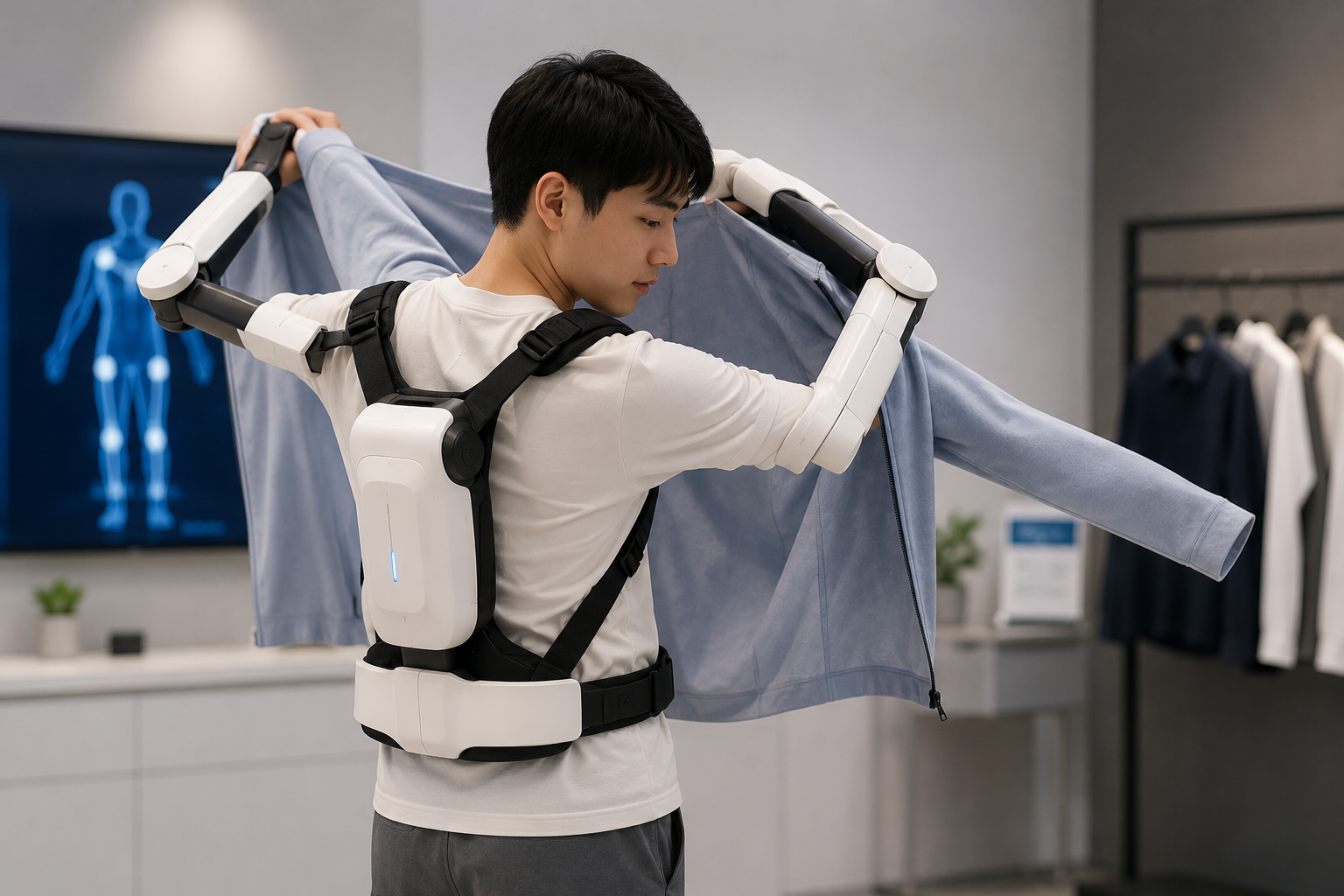
Assistive robotics has taken another significant step forward as researchers in South Korea have developed a wearable robotic system designed to help people put on clothing independently. The innovation combines robotics, artificial intelligence (AI), computer vision, and force-control technology to make one of the most challenging daily activities easier for individuals with limited mobility.
Unlike traditional rehabilitation robots that focus on walking or lifting objects, this wearable system is specifically engineered to assist with dressing—a task that requires delicate movements, precise force control, and continuous interaction with the human body. The breakthrough could improve the quality of life for elderly individuals, people with disabilities, and patients recovering from injuries.
Why Dressing Assistance Is Technically Challenging
Helping someone wear clothes is far more complex than it appears.
Clothing is a flexible object that constantly changes shape, folds, stretches, and wrinkles during movement. A robot must continuously understand the garment’s position while adapting its actions in real time.
The system must also ensure user safety by applying just enough force to move the clothing without causing discomfort or injury. These requirements make dressing assistance one of the most difficult problems in assistive robotics.
How the Wearable Robot Works
The wearable robot integrates multiple advanced technologies into a compact assistive system.
Smart Sensor Network
The robot is equipped with various sensors that continuously monitor:
- Arm position
- Shoulder movement
- Joint angles
- Contact pressure
- User motion
These sensors provide real-time feedback, allowing the robot to respond instantly if the user’s posture changes during the dressing process.
Artificial Intelligence-Based Motion Planning
Instead of following a fixed sequence of movements, the robot uses AI algorithms to determine the safest path for guiding clothing over the user’s arms and shoulders.
Machine learning models analyze body posture and predict movement, enabling the robot to adjust its trajectory dynamically rather than relying on pre-programmed motions.
Computer Vision
Integrated cameras and vision algorithms help identify:
- Sleeve openings
- Garment orientation
- User position
- Arm location
Computer vision ensures the robot aligns clothing correctly before beginning the dressing process.
Force and Torque Control
One of the most important technical features is force control.
Unlike industrial robots that prioritize speed and precision, assistive robots must prioritize safety and comfort. Force sensors continuously measure the pressure exerted on the user’s body and automatically reduce or stop movement if excessive resistance is detected.
This compliance allows the robot to interact safely with people while minimizing the risk of accidental injury.
Engineering Challenges Behind the System
Developing a dressing-assistance robot involves solving several complex engineering problems.
Soft Material Manipulation
Unlike rigid objects, clothes deform unpredictably. The robot must compensate for wrinkles, stretching, twisting, and shifting fabric throughout the dressing process.
Advanced control algorithms estimate how the garment moves and continuously update the robot’s actions.
Human-Robot Collaboration
The user is not completely passive during dressing. Small body movements can change the robot’s operating conditions.
To address this, the system uses closed-loop feedback, constantly monitoring both the user’s movements and the garment’s position to maintain smooth and coordinated interaction.
Real-Time Processing
The robot simultaneously processes information from cameras, motion sensors, and force sensors.
This requires high-speed embedded processors capable of executing perception, motion planning, and control algorithms within milliseconds to ensure natural and responsive assistance.
Potential Applications
Although the current prototype focuses on dressing assistance, the underlying technologies could support a wide range of assistive tasks.
Potential applications include:
- Elderly care
- Rehabilitation centers
- Hospitals
- Home healthcare
- Assisted living facilities
- Smart healthcare robotics
Future versions may also assist users with wearing jackets, shirts, gloves, or other garments independently.
Why This Research Matters
Global populations are aging rapidly, increasing the demand for technologies that enable independent living.
Wearable assistive robots can reduce dependence on caregivers while allowing individuals with reduced mobility to perform daily activities with greater dignity and confidence.
The research also demonstrates how AI, robotics, and human-centered engineering are converging to solve practical healthcare challenges beyond manufacturing and industrial automation.
Future Improvements
Researchers are expected to further enhance the system by incorporating:
- More compact and lightweight actuators
- Higher-resolution depth cameras
- Improved AI models for garment recognition
- Personalized motion planning based on individual body dimensions
- Voice-controlled operation
- Cloud-based learning for continuous performance improvements
These advancements could make wearable dressing-assistance robots suitable for everyday home use rather than limited research environments.
Conclusion
The wearable robot developed by South Korean researchers showcases how advances in artificial intelligence, computer vision, sensor fusion, and force-control robotics are transforming assistive healthcare technologies. By tackling the technically demanding task of helping users dress independently, the research highlights the growing potential of human-centric robotics to improve daily life.
As hardware becomes lighter, AI algorithms become more intelligent, and wearable systems become more affordable, assistive robots are likely to play an increasingly important role in healthcare, rehabilitation, and elderly support. What is currently a research prototype could eventually become a practical household companion, empowering millions of people to maintain greater independence in their daily routines.






Leave a Reply