

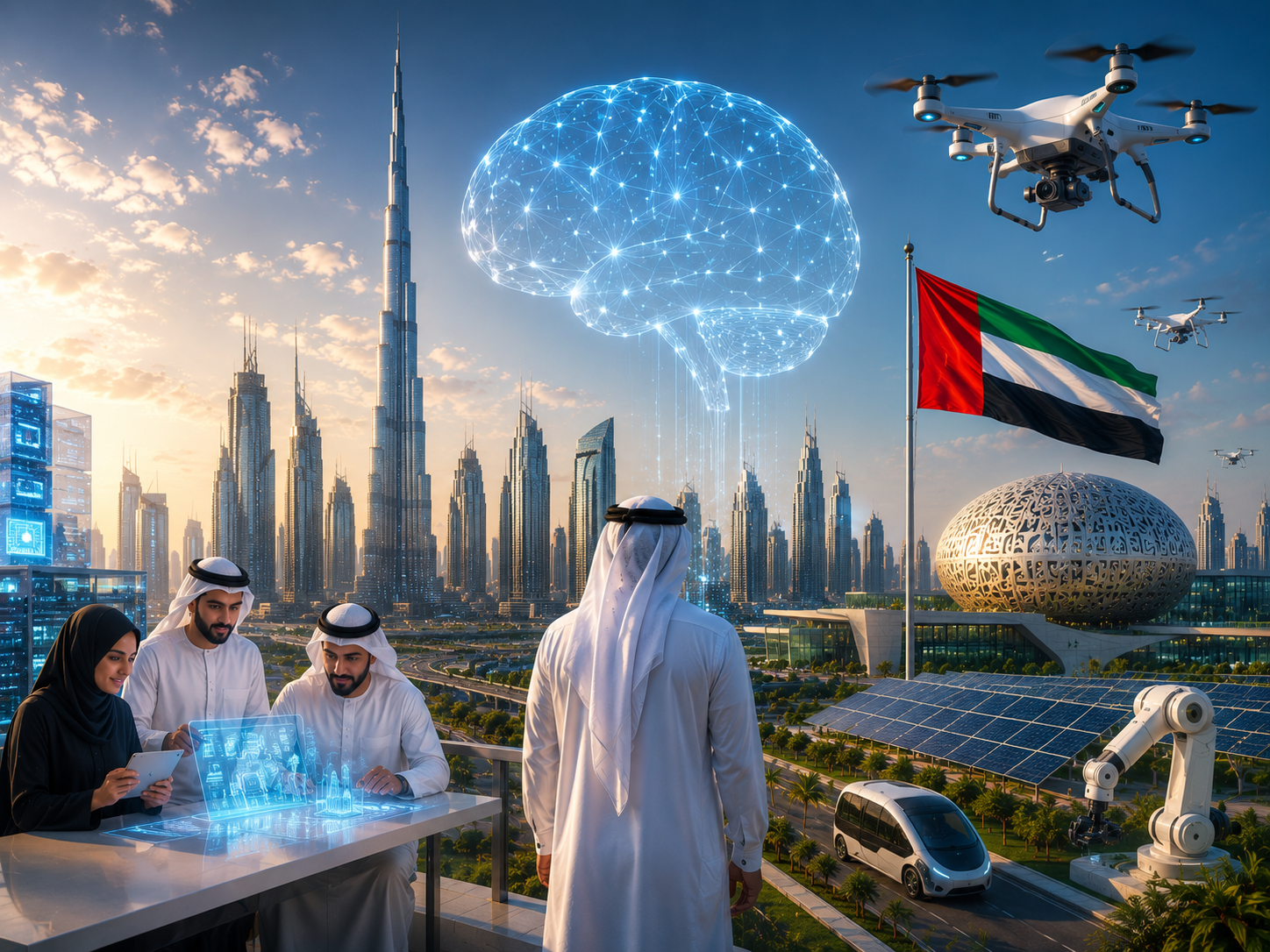
Three years ago, the United Arab Emirates was best known internationally as an oil-wealthy business and tourism hub. Today, it’s being described by analysts as one of the most significant — and least understood — strategic pivots in global technology: a nation moving from simply buying artificial intelligence to becoming a foundational node in the world’s AI infrastructure.
The numbers behind that shift are striking. Microsoft’s own AI Diffusion Report ranked the UAE first globally in AI adoption for the third consecutive quarter. A one-gigawatt supercomputing campus is rising in Abu Dhabi in partnership with OpenAI, Oracle, and Nvidia. And the government itself is restructuring around AI, with a target of transforming half of all government sectors within two years. Here’s how a country of roughly 10 million people is positioning itself as a genuine AI power — and what’s complicating that ambition.
The Adoption Numbers Behind the Hype
The clearest evidence of the UAE’s AI push shows up in adoption data rather than announcements. Microsoft’s AI Diffusion Report for the first quarter of 2026 ranked the UAE first globally for the third consecutive time, with an adoption rate of 70.1% — growth running at nearly four times the global average. A separate Boston Consulting Group study classified 42% of UAE institutions as “AI leaders,” reflecting how deeply the technology has been integrated across both government and private sectors.
Stanford University research adds another data point: more than 80% of UAE employees now regularly use AI technologies in their work, and the concentration of specialized AI talent in the country has more than doubled between 2019 and 2025. Separately, some estimates suggest AI could reduce manual workloads by as much as 30% across government ministries as adoption matures further.
Stargate UAE: The Infrastructure Bet
The centerpiece of the UAE’s physical AI buildout is Stargate UAE, a one-gigawatt supercomputing complex based in Masdar City, Abu Dhabi — part of a planned five-gigawatt UAE-U.S. AI Campus. For context, one gigawatt is roughly the power consumption of a small American city, and few countries can assemble that much dedicated power for a single digital installation, let alone deploy it quickly.
The project is being built by Khazna Data Centers, a subsidiary of Emirati AI group G42, in partnership with OpenAI, Oracle, Nvidia, Cisco, and SoftBank. Its first 200-megawatt phase is expected to come online this year, with the site now recognized as the largest AI infrastructure campus outside the United States.
G42 and the $100 Billion War Chest
At the center of the UAE’s AI ambitions sits G42, the Abu Dhabi-based AI group backed by state investment vehicle Mubadala and chaired by Sheikh Tahnoon bin Zayed Al Nahyan. Microsoft invested $1.5 billion into G42 in 2024, a relationship that has since helped clear the way for exports of Nvidia’s most advanced AI chips to the company — a significant development given how tightly the U.S. has historically controlled access to its most capable chip technology.
Backing much of this buildout financially is MGX, an AI investment platform launched by Mubadala and G42 that’s building toward $100 billion dedicated specifically to AI infrastructure and applications. Combined with G42’s own frontier research work — including its Falcon open-weight AI models — analysts describe Abu Dhabi as now holding a genuinely “full stack” AI capability: sovereign compute, in-house research, open models, and the capital to deploy all of it at scale.
Rebuilding Government Around AI
The UAE’s AI strategy isn’t confined to infrastructure and private investment — it extends directly into how the government itself operates. In June, the UAE announced the creation of a dedicated Artificial Intelligence and Data Authority, headed by Omar Sultan Al Olama, tasked with consolidating public data, AI capabilities, and digital government functions into a single national body.
That authority sits on top of an already-announced framework for implementing agentic AI models across government operations — AI systems capable of taking a series of actions on their own rather than simply answering questions — with a stated goal of transforming 50% of government sectors, services, and processes within two years. A concrete example already in public use is TAMM (Arabic for “Consider it done”), a government services app that lets residents photograph a problem — a broken streetlight, for instance — and have AI analyze the image, route it to the correct government entity, and track it through to resolution.
Why the UAE Has an Energy Advantage Few Others Do
A significant part of the UAE’s pitch to AI companies and hyperscalers comes down to something more basic than software: energy. Training and running frontier AI models consumes enormous amounts of electricity, and both the U.S. and European power grids are increasingly strained — in Europe’s case, further slowed by environmental litigation and local opposition that can delay major energy projects for years.
The UAE, by contrast, has positioned itself around genuine energy abundance and a regulatory environment able to move new power and compute capacity into place quickly. That combination — abundant low-cost energy plus fast execution — is central to why the UAE, alongside neighbors Saudi Arabia and Qatar, has been able to attract hyperscale data center investment at a pace few other regions can currently match.
The Economic Bet: Diversifying Beyond Oil
Underlying all of this is a deliberate economic reinvention. The UAE’s digital economy currently contributes close to 12% of national GDP, with authorities targeting more than 20% by 2031. That target reflects a broader ambition to shift the country from a hydrocarbon-powered economy toward one built around AI, advanced computing, robotics, and digital finance — positioning the UAE not just as a regional hub, but as what officials increasingly describe as a strategic bridge between the Global South and the West.
Local officials frame this as more than a branding exercise. As one digital strategy leader put it in recent public remarks, the AI push is treated as rooted in the country’s leadership vision and described as having become part of its institutional DNA — an approach meant to position the UAE as a place where entrepreneurs anywhere can test and build with AI.
The Geopolitical Risk Testing This Strategy
The UAE’s AI ambitions are not unfolding in a vacuum. The country’s data center buildout has been directly affected by the broader conflict between the U.S., Israel, and Iran — Iran’s Islamic Revolutionary Guard Corps has claimed responsibility for strikes targeting Emirati data centers built in partnership with American technology companies, including a claimed hit on an Oracle-based facility in Dubai, forcing government planners to adapt their build-out plans in response.
At the same time, the same conflict has, according to reporting from The Wall Street Journal, factored into the U.S. decision to expand the UAE’s access to advanced AI chips — described as a reward for the UAE’s assistance during the Iran war, and the culmination of a yearslong push by the Gulf state to secure that level of American technology access. Analysts covering the region note that the UAE’s entire AI strategy was built on an assumption of regional stability and cheap, reliable energy — an assumption now being genuinely tested by rising geopolitical risk rather than a purely theoretical concern.
Conclusion
The UAE’s transformation into a serious AI power isn’t a single announcement or a marketing campaign — it’s a combination of top-tier adoption numbers, a genuinely massive infrastructure buildout backed by both sovereign wealth and Silicon Valley partners, and a government actively rebuilding its own operations around AI systems. That combination has real staying power. But it’s also unfolding inside one of the world’s more volatile regions, where the same geopolitical tensions shaping the UAE’s chip access are also putting its physical infrastructure directly at risk. Whether the country can sustain this pace of growth likely depends as much on regional stability in the months ahead as it does on any further technology investment.






Leave a Reply