

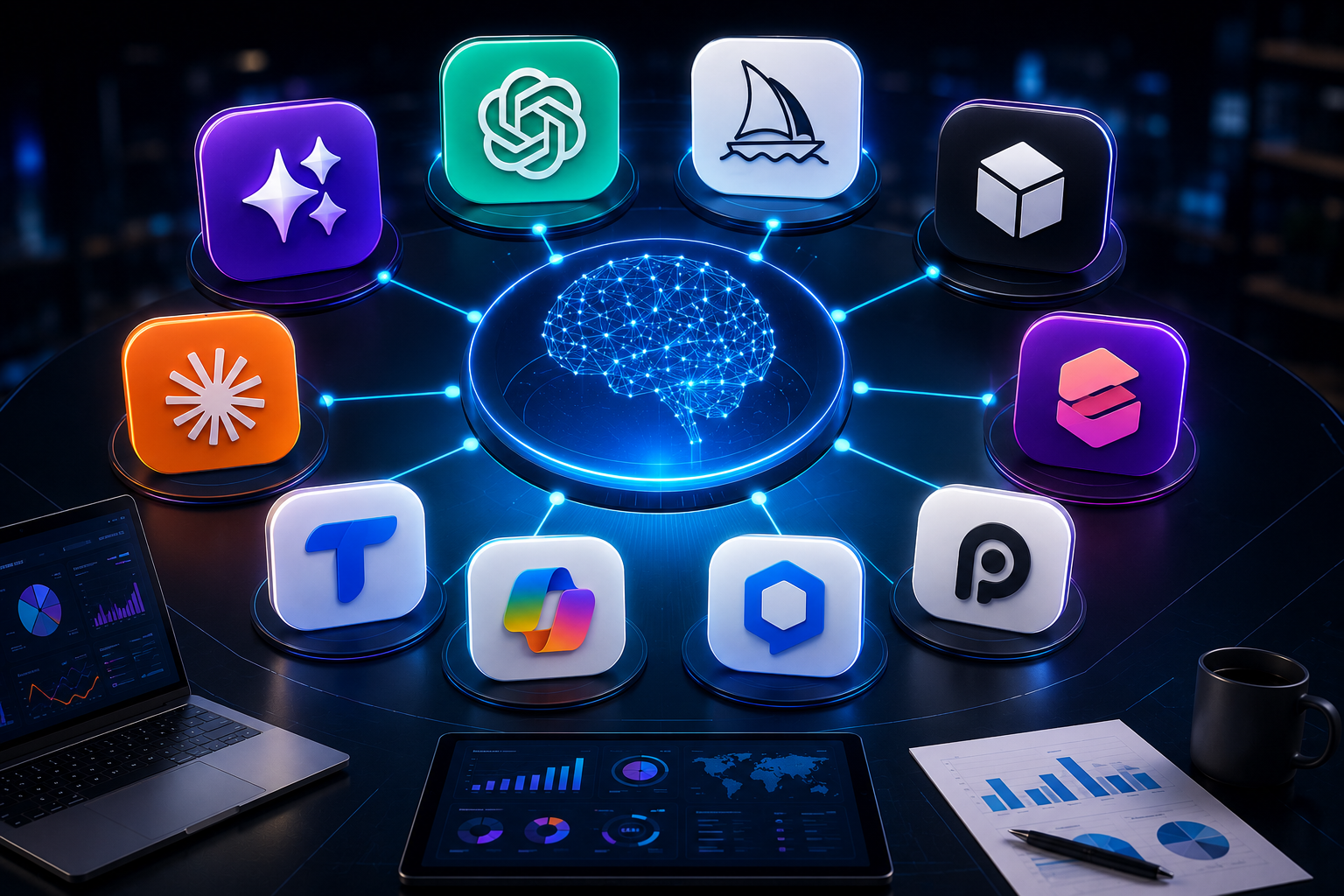
Every business eventually asks the same question after deciding AI is worth investing in: which tool actually solves our problem? The market doesn’t make this easy. Dozens of AI products claim to do everything, and most businesses don’t need “everything” — they need the right tool for one specific function, done well.
This guide breaks down the top 10 AI tools for business by category, so you can match your actual problem to the right kind of solution instead of sorting through an overwhelming general-purpose list.
How to Use This List
Rather than ranking ten tools against each other head-to-head, this list covers the ten functional categories where AI delivers the clearest business value — one entry per category. Pick the category that matches your actual bottleneck first; the specific tool matters less than choosing the right type of tool for the job.
1. Best AI Chatbot for Personal Productivity
Tool: ChatGPT
General-purpose AI chatbots are strong at drafting content, generating ideas, writing code snippets, and answering broad questions. They’re widely accessible, often free at a basic tier, and require no setup to start using — making them the natural starting point for individual employees experimenting with AI.
Best for: Solo use, quick drafts, brainstorming, and personal productivity. Watch for: Data handling. Consumer-grade chatbots don’t necessarily keep company information contained within your organization’s environment, which matters the moment usage moves beyond individual experimentation.
2. Best AI Chatbot for Business Deployment
Tool: Microsoft Copilot
Once a chatbot moves from personal use to company-wide rollout, data protection becomes the deciding factor. Enterprise-focused alternatives — commonly built directly into existing productivity ecosystems like Microsoft 365 — are designed specifically to generate insights from internal data without that data leaving your organization’s environment.
Core capabilities:
- Summarizing meeting transcripts, chat threads, and email conversations into concise overviews
- Drafting communications based on internal context and prior data
- Analyzing internal documents and surfacing insights
- Converting content between formats (a document into a presentation, for example)
- Surfacing internal documentation employees might not know exists or how to find
Best for: Company-wide AI adoption where proprietary data protection matters. Watch for: Rollouts that skip training tend to underdeliver — the tool only pays off if employees actually know how to use it well.
3. Best AI Agent for Complex Task Execution
Tool: Manus
A newer category of tools goes beyond answering questions and into completing multi-step tasks autonomously — researching, comparing, and producing a finished output rather than just a conversational response.
Core capabilities:
- Researching and comparing options against defined criteria (property listings, suppliers, vendors)
- Producing detailed recommendations for improving specific business functions like SEO
- Analyzing complex datasets and generating interactive visualizations
- Monitoring brand sentiment and reputation across public channels
Best for: Research-heavy, multi-step tasks that would otherwise consume significant staff time. Watch for: Agent-based tools typically carry a higher price point than simpler chatbot tools, reflecting the more complex work involved.
4. Best AI for Video Generation
Tool: HeyGen
AI video tools let businesses generate polished video content — often using a lifelike digital avatar — directly from written text, with no filming required. Options typically include using your own likeness, a stock avatar, or a fully AI-generated character.
Core capabilities:
- Marketing and promotional videos
- Internal or client-facing presentations
- Training tutorials and educational content
- Interactive, conversational video experiences
Best for: Producing polished video content quickly without a production team. Watch for: These tools tend to be more specialized than general-purpose AI, but that focus is exactly what makes them outperform general chatbots for serious video production needs.
5. Best AI Search Tool for Research
Tool: Perplexity
AI search tools are increasingly used alongside — and sometimes instead of — traditional search engines for research-heavy tasks. Rather than returning a list of links, these tools pull information from a wide range of sources, synthesize it into a coherent answer, and cite exactly where each piece of information came from.
Core capabilities:
- Detailed, highly specific research queries
- Generating ideas for solving defined business problems
- In-depth analysis across multiple sources
- Summarizing a topic from several sources at once
- Fact-checking existing content before publication
Best for: Research tasks where verifiable, source-backed answers matter. Watch for: Citation transparency is the key differentiator in this category — always confirm a tool shows its sources before trusting its synthesis.
6. Best Financial AI Tool
Tool: FP&A Genius by Datarails
General-purpose AI tools can handle basic financial questions, but purpose-built financial AI tools are designed specifically around the needs of finance teams and executives, with far deeper domain-specific capability.
Core capabilities:
- Automated insight generation based on defined parameters, routed directly to relevant stakeholders
- Data visualization and storyboarding that communicates financial performance clearly to non-finance audiences
- Conversational access to budgets, expenditures, and forecasts without manually building a report
Best for: CFOs and finance teams managing complex, recurring reporting needs. Watch for: A specialized tool generally outperforms adapting a general-purpose AI assistant to serious financial analysis.
7. Best Supply Chain AI Tool
Tool: Blue Yonder Orchestrator
Supply chain management has grown more complex as global disruption has become a recurring rather than occasional challenge. AI tools built specifically for this domain let teams query complex logistics and inventory data in plain language and receive analysis, recommendations, and — in more advanced tools — direct execution handoff.
Core capabilities:
- Natural-language querying against real operational data
- Clear, actionable output formatting
- Deep integration with existing systems and microservices
Best for: Organizations managing complex, multi-node supply chains under ongoing disruption risk. Watch for: Integration depth matters more than raw features here — a tool that can’t connect to your existing systems adds friction instead of removing it.
8. Best AI Coding Assistant
Tool: Qodo
For development teams, agentic coding tools have moved well beyond simple autocomplete, offering context-aware generation, testing, and even direct implementation.
Core capabilities:
- Context-aware code generation with iterative refinement and collaborative chat-based development
- Automated regression testing with awareness of the broader codebase
- The ability to review, merge, and implement code changes directly into live environments
Best for: Development teams looking to reduce time spent on routine coding and review work. Watch for: Tools in this category can meaningfully cut development time — often in the 20 to 30 percent range — while also catching bugs earlier through automated, context-aware review.
9. Best AI Tool for Marketing and Website Engagement
Tool: Warmly
A growing category of marketing-focused AI tools sits directly on business websites, detecting visitor intent and matching it against an ideal customer profile in real time.
Core capabilities:
- Proactively engaging high-intent visitors from target accounts
- Personalizing interactions based on what’s known about the visiting account
- Escalating to a human representative at the right moment in the conversation
Best for: B2B companies with longer sales cycles where identifying a high-value visitor early can shorten the path to a qualified lead. Watch for: These tools work best layered on top of existing marketing infrastructure, not as a standalone replacement for a full marketing stack.
10. Best AI Tool for Customer Service
Tool: Salesforce Agentforce
Dedicated customer service AI platforms go beyond simple support chatbots, handling a wider range of customer relationship functions end to end.
Core capabilities:
- Proactively working leads and engaging prospective customers
- Scheduling meetings directly with prospects or existing customers
- Answering detailed account-specific questions, including order history
- Directing customers to the most relevant documentation automatically
Best for: Businesses with high support volume looking to reduce response times without losing personalization. Watch for: The best tools in this category maintain a level of personalization generic chatbots typically can’t match — verify this with a real trial before committing.
How to Choose the Right Tool From This List
- Start with your highest-friction problem, not the most talked-about tool. The best AI investment addresses a real bottleneck, not a trend.
- Weigh data protection carefully for anything beyond individual use. Company-wide deployment requires tools built to keep proprietary data inside your own environment.
- Favor specialization for complex domains. Financial analysis, supply chain management, and coding all benefit more from purpose-built tools than from general-purpose AI stretched to cover them.
- Budget for training, not just the tool itself. Even the most capable AI tool underperforms if the team using it hasn’t been properly onboarded.
- Pilot before committing company-wide. A focused trial with a specific team or use case reveals real-world friction that a demo or sales pitch won’t.
Best Practices for AI Tool Adoption
- Run a readiness assessment before selecting tools, so you understand your data, processes, and team capacity going in.
- Choose tools by function first, brand recognition second.
- Prioritize tools that integrate cleanly with your existing systems over ones that require building entirely new workflows.
- Set clear success metrics before rollout so you can objectively evaluate whether a tool is delivering value.
- Revisit your AI tool stack periodically — this space moves quickly, and this year’s best option in a category may not hold that position for long.
Common Mistakes to Avoid
- Deploying a consumer-grade chatbot company-wide without considering how proprietary data is handled.
- Choosing a general-purpose tool for a specialized problem like financial forecasting or supply chain optimization, where purpose-built tools consistently outperform generalist ones.
- Skipping training and onboarding, which is often the actual reason AI tools go underused after a promising pilot.
- Chasing every new tool instead of building depth with a focused, well-integrated stack.
- Failing to define success metrics upfront, making it impossible to tell later whether a tool investment actually paid off.
Key Takeaways
- The right AI tool depends on the specific business problem, not general popularity — start with the problem, then narrow by category.
- Data protection is the key differentiator between AI tools suited for individual use and those appropriate for company-wide deployment.
- Specialized tools consistently outperform general-purpose AI for complex domains like finance, supply chain, and coding.
- Agent-based tools that complete multi-step tasks autonomously carry a higher cost but can deliver strong returns for research-heavy work.
- Successful AI adoption depends as much on training and clear success metrics as it does on the tool itself.
Frequently Asked Questions
Should a business use the same AI chatbot employees use personally? Not necessarily. Consumer chatbots are fine for individual experimentation, but company-wide deployment generally calls for an enterprise-grade alternative built to keep proprietary data within your own environment rather than a third party’s.
What’s the difference between a chatbot and an AI agent? A chatbot primarily responds to questions and prompts within a conversation. An AI agent can complete multi-step tasks with greater autonomy — researching, comparing, and producing a finished output — rather than simply generating a conversational reply.
Are specialized AI tools worth the extra cost compared to general-purpose tools? For complex, high-stakes domains like financial analysis, supply chain management, or software development, specialized tools generally deliver stronger, more reliable results because they’re built specifically around the nuances of that function, which often justifies the added cost.
How should a business start choosing from this list? Begin with an honest assessment of your organization’s biggest operational bottleneck, then jump to the matching category above rather than trying to evaluate all ten at once.
Why do AI tool rollouts sometimes fail to deliver value? Underinvestment in training and unclear success metrics are common causes. Even a highly capable tool underperforms if the team using it isn’t properly onboarded or if there’s no clear definition of what success looks like.
Conclusion
The strongest AI strategy isn’t about adopting the single “best” tool on the market — it’s about matching each real business problem to the category built to solve it: chatbots for productivity, agents for complex research, specialized tools for finance and supply chain, and dedicated platforms for coding, marketing, and support. Prioritize data protection wherever proprietary information is involved, and invest as much in training and clear success metrics as in the tool selection itself. That combination is what turns AI adoption from a hype-driven purchase into a measurable business advantage.






Leave a Reply