

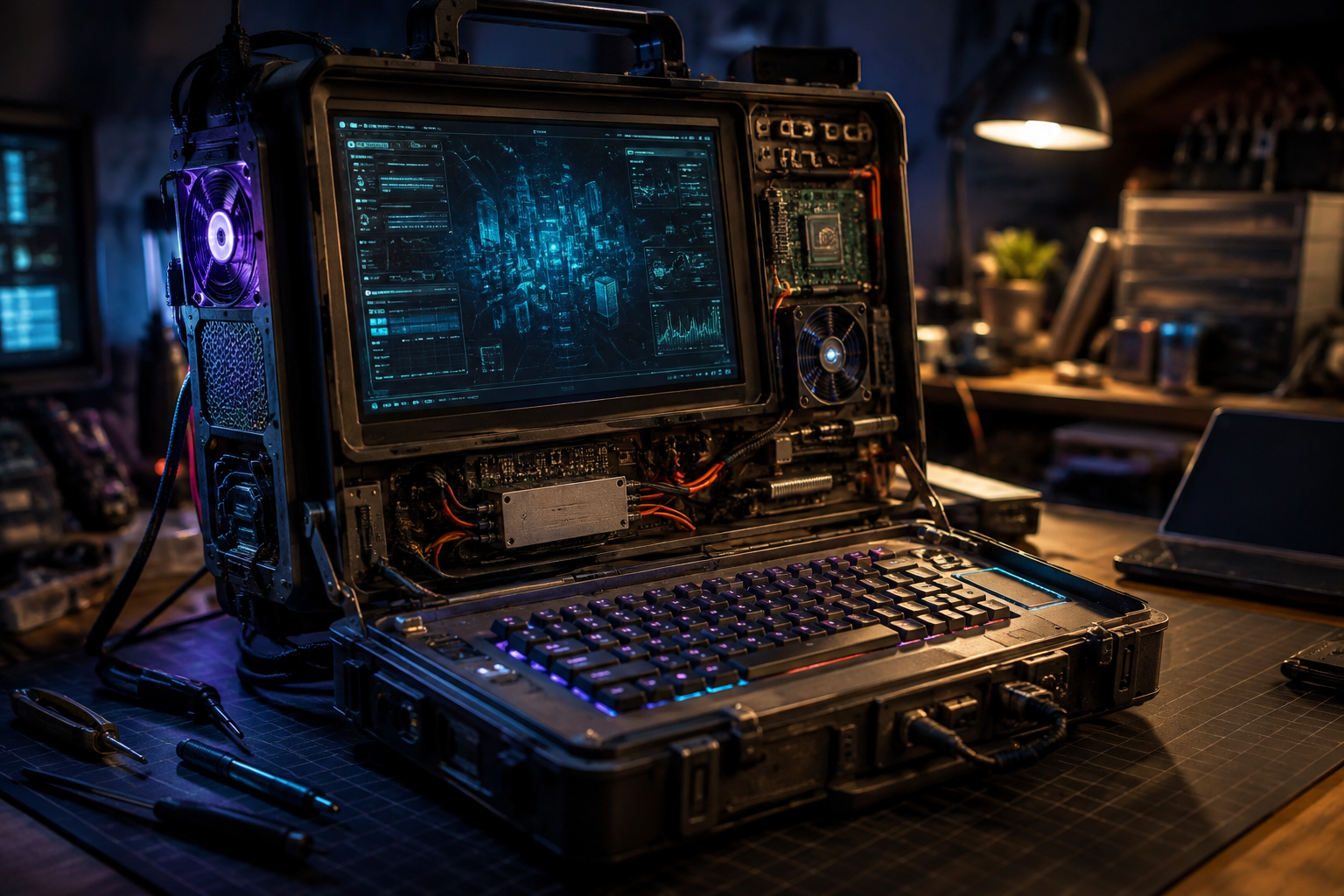
Not long ago, every laptop looked more or less the same: a slim black rectangle, a glowing logo, nothing to distinguish one machine from the next. That uniformity is exactly what a growing community of builders is now rejecting — by making their own computers from scratch. They’re called cyberdecks, and they’ve quietly become one of the most talked-about trends in DIY tech.
What Exactly Is a Cyberdeck?
A cyberdeck is a custom-built, portable computer assembled from mismatched parts rather than bought off a shelf. <cite index=”1-1″>The devices are typically built around single-board systems like Raspberry Pi, paired with small screens, keyboards, and custom enclosures.</cite> The term itself borrows from cyberpunk fiction — most notably William Gibson’s 1984 novel Neuromancer, which imagined portable hacking devices decades before the technology to build them was cheap and accessible.
No two cyberdecks look alike. Builders source parts from thrift stores, old electronics, and salvage bins, then assemble them into cases made of wood, aluminum, carbon fiber, or whatever material fits the aesthetic they’re chasing. Some lean into retro-futurism, styled after 1970s and ’80s computer terminals. Others go for something closer to a post-apocalyptic field radio. The point isn’t to copy a template — it’s to build something that doesn’t exist anywhere else.
Why the Sudden Surge in Interest
A few forces are converging to push cyberdecks from niche hobbyist project to genuine cultural moment.
Fatigue with mass-produced tech. A lot of the appeal comes down to a simple frustration: modern devices are polished, closed-off, and interchangeable. Building a cyberdeck flips that entirely — one creator described the philosophy as making something built specifically for its owner, resistant to the sameness of commercial products.
A response to closed ecosystems. Beyond aesthetics, there’s a growing open-hardware movement behind the trend. <cite index=”3-1″>Builders are turning Raspberry Pi-based cyberdecks into custom computing projects that rely on self-hosted systems and locally run AI, as a deliberate alternative to the closed platforms run by major tech companies.</cite> For many in this community, owning every layer of a device — hardware and software — is the actual point, not just the look.
Social media and maker culture. Platforms like TikTok and YouTube have turned individual builds into shareable content, and build guides get passed around almost as freely as the finished projects get shown off. Competitions have accelerated this further — Hackaday’s cyberdeck contests alone have drawn well over a hundred submissions, ranging from satellite-communication terminals to elaborate sci-fi-inspired field computers.
A cyberpunk aesthetic having a moment. The look and feel of the genre — worn terminals, exposed wiring, glowing screens — has found new relevance as more people express skepticism toward surveillance-heavy, AI-saturated tech culture. Building a cyberdeck becomes a small, tactile way of pushing back.
Who’s Actually Building These
What’s notable about the current wave isn’t just the aesthetic — it’s who’s driving it. A significant part of the community, particularly on social platforms, is made up of builders with no formal background in computer science or software engineering, learning hardware and software skills project by project and documenting the process for others to follow. That’s a meaningful shift from the traditionally male-dominated maker and hacker scenes cyberdecks originally grew out of.
How Someone Actually Builds One
Cyberdeck builds vary wildly, but most follow a similar backbone:
- Choose the brain — a Raspberry Pi, a repurposed laptop board, or another small computing unit.
- Pick a display — often a small LCD, LED screen, or HDMI touchscreen.
- Add an input method — a compact keyboard, sometimes paired with a trackpad or joystick.
- Power it — usually a lithium-ion battery pack, chosen for portability.
- Build the case — the most personal step, using anything from plywood to salvaged metal enclosures.
There’s no fixed formula, which is part of the appeal. A build can take a weekend or stretch over months, depending on how ambitious the design gets.
Is This a Passing Trend or Something More Durable?
Cyberdecks aren’t going to replace laptops or phones, and nobody building one is trying to make that case. Their value isn’t in convenience — it’s in the opposite of convenience: a device shaped entirely by its owner’s choices, quirks, and constraints. That’s precisely what’s kept the trend growing rather than fading.
It’s also arriving at an interesting moment for the wider DIY tech world. Building your own standard PC has gotten noticeably more expensive recently, with memory and GPU prices climbing as demand for AI hardware eats into consumer supply. Against that backdrop, the appeal of a cyberdeck — often built from cheap, secondhand, or repurposed parts rather than the latest high-end components — makes even more sense. It’s less about performance, and more about ownership, creativity, and building something that’s actually yours.
Whether cyberdecks stay a niche subculture or grow into a broader movement, they’ve already made their point: in an industry built on sameness, there’s real appetite for machines that look, feel, and function like nothing else on the market.








Leave a Reply