


In a year when nearly every venture dollar has been chasing AI that keeps people online longer, a smaller and stranger category of startup has been quietly raising money to do the opposite: get people to put their phones down. It sounds like a bad business model — why would anyone fund a product designed to reduce engagement? — but the money is real, and so is the reasoning behind it.
The Numbers Behind the “Slowtech” Bet
Americans now unlock their phones roughly 186 times a day and spend an average of five hours and sixteen minutes on them, a figure that’s climbed 14% in a single year. Attention spans have been shrinking alongside that rise: research out of MIT Media Lab and Stanford’s Center for Mind, Brain, and Computation puts the average attention span at 7.6 seconds today, down more than a third since 2000.
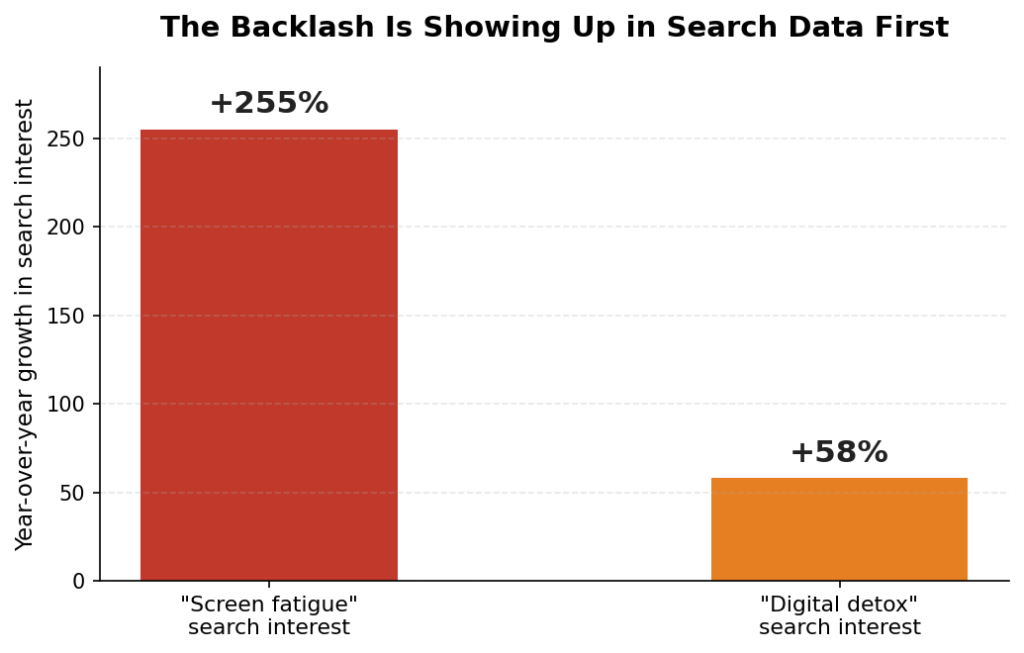
What’s changed recently isn’t the usage — it’s the appetite to fight it. More than half of American adults now say they actively want to cut their screen time, and that sentiment is showing up clearly in search behavior. Interest in “screen fatigue” as a search term has jumped 255% over the past year, and searches for “digital detox” are up 58% over the same period. Investors have started calling this broader shift “slowtech,” a term that moved from lifestyle commentary into venture conversation earlier this year.
Who’s Actually Getting Funded
A handful of companies illustrate where the money is going, and why.
- Opal makes an app that builds in scrolling breaks, and has raised funding from Adjacent and Speedinvest. Its traction has come largely from teenagers: roughly 70% of its users are students, split about evenly between high school and college.
- Light sells a stripped-down phone that deliberately leaves out email, social apps, and anything else built to keep you scrolling, keeping only basics like notes and GPS. Its founder, Kaiwei Tang, has said the hardest part of the business has always been convincing users to exercise self-control in the first place — not building the product itself.
- MOQA, a screen-time app from Austin Murray, comes from a founder with an unusual résumé for this category: he co-founded JAMDAT, an early mobile gaming company that sold to Electronic Arts for $680 million in 2006. Murray has argued that excess screen time “is not a willpower problem, it’s a product design problem,” which is effectively the founding thesis of the entire slowtech category.
- Onward, backed by Founders Fund, Compound Ventures, and Gaingels on a $3.2 million raise, was built by Gabe Zichermann, who spent years designing the gamification techniques that make apps addictive before turning to the opposite problem. Company-run research on more than 1,400 users has reported meaningful drops in screen time and related compulsive behaviors among participants.
- Oura is the clearest public-market signal in the category. The wearable-ring maker, which has sold 5.5 million rings and pulled in $500 million in 2024 revenue, confidentially filed for an IPO in May 2026 at a valuation building on its $11 billion October 2025 round.
Why Investors Are Willing to Bet on Friction
Funding a product that intentionally frustrates the user is a harder pitch than funding one built to maximize engagement, and investors in this space acknowledge as much. But a few things make the bet make sense on paper.
- The demand signal is unusually clean. A majority-preference stat with almost no commercial infrastructure behind it — investors have compared today’s 53% who want less screen time to the early organic-food surveys of the 1990s, before that preference had anywhere to spend money.
- It’s not just software. The category spans hardware (Light’s phone, Oura’s ring), software (Opal, MOQA, Onward), and even in-person experiences — Timeleft, which organizes stranger dinners, raised a $7M Series A, while Joiner App has raised over €2.2 million positioning itself as a real-world alternative to dating apps.
- Founders with credibility in “addictive design” are switching sides. Several of the most closely watched founders in this space, including Murray and Zichermann, spent earlier careers building the exact engagement mechanics they’re now trying to counteract, which gives them an unusually specific understanding of what actually works.
The Skepticism That Remains
None of this makes the category an easy bet. Products that add friction are fighting the same behavioral pull that made the original apps so effective, and getting users to pay for less convenience is a fundamentally harder sell than getting them to pay for more. Several founders in the space have pointed out that the real product challenge isn’t engineering — it’s getting someone to choose friction for themselves in the moment they’re least equipped to. Whether “slowtech” becomes a durable category or stays a niche alongside wellness fads will likely depend on whether products like Oura, Opal, and Light can turn a broad stated preference into something people will actually pay to keep using.








Leave a Reply