


Ask someone to picture a tech founder, and the image that comes to mind is almost always the same: a 20-something coding in a dorm room, hoodie on, ready to disrupt an industry before turning 25. That image has quietly shaped who gets funded, who gets taken seriously in a pitch meeting, and who founders believe they’re up against. The trouble is, it was never really true — and Silicon Valley still hasn’t fully let go of it.
The Myth vs. the Data
The “young genius founder” story has deep roots in Silicon Valley’s culture. It’s been reinforced from the top: Mark Zuckerberg has publicly suggested that younger people simply think better, and Peter Thiel’s well-known fellowship program pays young entrepreneurs to skip college entirely, so long as they’re under 23. Messaging like that doesn’t stay confined to interviews and press releases — it filters into how investors evaluate pitches and how founders size up their own competition.
The actual research points the other way. Large-scale analysis of startup founders has found that a 50-year-old is nearly twice as likely to build a top-performing company as someone founding in their 30s — and that founders in their 20s post the weakest odds of the bunch. When researchers zeroed in specifically on the country’s fastest-growing startups, the average founder wasn’t a fresh-faced 20-something at all. The average age came out to 45, a figure that reportedly caught even the researcher who ran the numbers off guard. Separate research into Silicon Valley’s actual successful exits — companies that got acquired or went public — found an average founding age of 47.
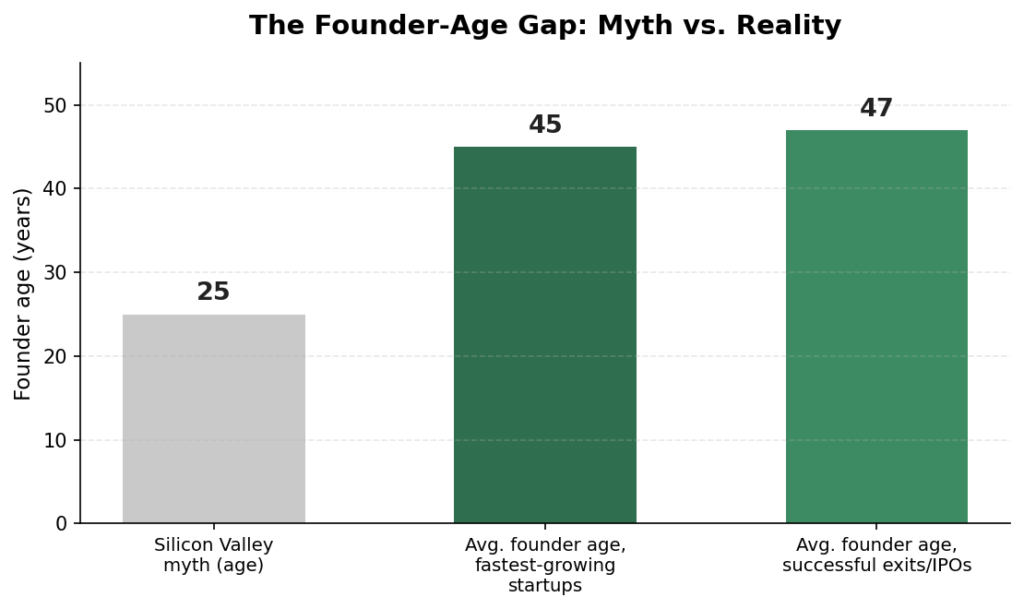
Put simply: the startups that actually make it tend to have been built by people well past the age the industry loves to celebrate.
Why the Bias Persists Anyway
If the numbers don’t support the young-founder story, why does it stick around? A few reinforcing dynamics keep it alive.
- Investor pattern-matching. Venture capital has long rewarded founders who resemble previous successful founders — which, for decades, has meant young, and often narrow along other dimensions too. That creates a self-reinforcing loop: young founders get funded partly because young founders have historically gotten funded.
- Perception, not ability. One founder who launched his company at 48, following two decades in enterprise tech, has described the hesitation he ran into — not doubts about his skill, but concern over how backing someone past 40 would look. He’s pointed out that when someone takes a career risk after 40, it tends to get read as a midlife crisis rather than a calculated, informed bet, even though that founder often brings exactly the deep domain knowledge younger founders haven’t had time to build.
- Compounding bias for underrepresented founders. Age bias rarely shows up alone. Immigrant and women founders in particular describe it stacking on top of other obstacles they already face. One founder-network leader has noted that women, who statistically tend to start companies later in life, end up facing age bias layered directly on top of an already higher bar.
The pattern doesn’t stop at the founder level, either. Experienced tech professionals report being screened out of senior roles in favor of younger hires, even where deep, hard-won experience should be the clear asset. One entrepreneur who’d already been through a successful exit observed that younger startup leadership can be just as quick to write off mid-career hires with families as investors are to write off older founders — and pointed to Europe’s startup scene, home to companies like Sweden’s Lovable and Germany’s Kaia Health, as proof that fast growth doesn’t require Silicon Valley’s particular fixation on youth.
The Cost of Getting This Wrong
Age bias isn’t only unfair to the individual founders it sidelines — it carries a real opportunity cost for the industry. Passing over experienced operators means passing over people who already understand where an industry actually breaks, who’ve built real networks over decades, and who bring judgment that’s difficult to shortcut. It also means venture capital keeps chasing a founder profile that, by its own data, isn’t the one most likely to build a company that lasts.
There are early signs of change: more public attention to the underlying data, more older founders sharing their stories despite the skepticism they faced, and growing scrutiny of how VC firms actually build their portfolios. But a culture built on decades of celebrating the young dropout-turned-billionaire archetype doesn’t shift overnight. Until it does, Silicon Valley is likely to keep underfunding exactly the founder profile its own numbers say it should be backing.
Building something later in your career shouldn’t be a liability — the data suggests it might be your biggest edge. If you’re weighing a founder journey after 40, your experience is the asset the numbers say to bet on.








Leave a Reply