

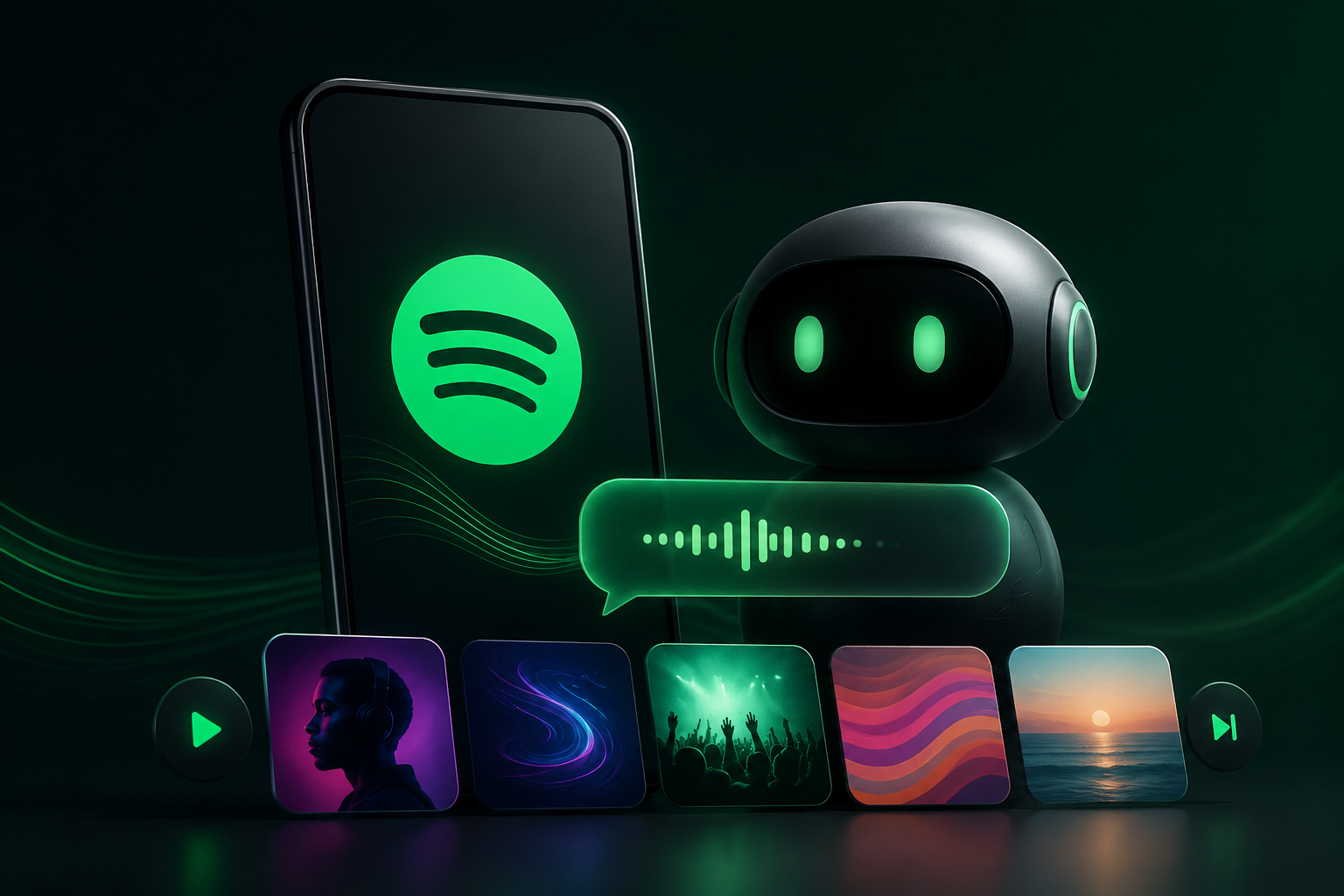
Spotify is taking another step deeper into AI, and this time it’s bringing a conversational assistant directly into the core listening experience. On Tuesday, July 14, 2026, Spotify announced a new feature that lets users chat with the app — typing or speaking — to decide what to play next, extending the kind of back-and-forth interaction people are used to from tools like ChatGPT into the everyday act of choosing music.
How the New Assistant Works
The new feature lets users talk to Spotify directly from the app’s Home and Now Playing views on mobile. Rather than searching for a specific song or scrolling through curated playlists, users can describe what they’re in the mood for and refine it through follow-up messages, the same way they might steer a conversation with an AI chatbot.
Spotify shared a few example interactions to illustrate how it’s meant to work. A user might start by asking the app to play artists they haven’t heard before, then narrow that selection with a follow-up — adding a specific artist by name, filtering to more recent tracks, or asking for something “more upbeat.” From there, users can ask the assistant to save songs, add tracks to their queue, or follow an artist, all without leaving the conversation.
The assistant isn’t limited to picking songs, either. Spotify says it will also be able to talk with users about their own listening history, answer questions about the music, podcasts, or audiobooks they’re into, and go deeper on things like what inspired a particular song or when an album was released. It can also serve up suggestions for other artists based on what someone is currently playing.
The feature is rolling out now on mobile devices.
Not Spotify’s First AI Feature — But Its Most Conversational
This isn’t Spotify’s first attempt at bringing AI into how people find music. The company already offers an AI DJ, which uses an AI-generated voice to introduce tracks and talk directly to listeners, along with AI tools for building playlists from text prompts. What makes the new assistant different is scope: it extends the ability to have an actual back-and-forth conversation with the app beyond the DJ experience, embedding that interactivity into the main parts of the app people already use every day.
Spotify has also been expanding how it connects with AI tools outside its own app. Starting in October 2025, the company partnered with OpenAI to let Free and Premium users link their Spotify accounts directly to ChatGPT. Once connected, users could ask ChatGPT to build playlists or recommend podcasts using natural-language prompts — things like requesting a playlist built around specific artists in heavy rotation, or podcast recommendations on a given topic. That integration rolled out in English across 145 countries and worked on both desktop and mobile.
Spotify has been careful to draw a line around what that kind of partnership does and doesn’t involve. The company has said the ChatGPT integration does not involve sharing its music, lyrics, or other audio content with OpenAI for model training — only metadata related to user behavior and preferences is involved, and the connection is fully opt-in and can be disconnected at any time.
Part of a Bigger AI Strategy
The new in-app assistant fits into a broader pattern of Spotify layering AI throughout its product over the past year. Beyond the AI DJ and the ChatGPT integration, the company has also updated its policies around AI-generated music, aiming to curb spam and artist impersonation while still allowing musicians to use AI production tools responsibly. Spotify’s head of music, Charlie Hellman, has said the company isn’t trying to punish artists for using AI authentically, but is instead focused on stopping bad actors who exploit the system.
Industry analysts see Spotify’s AI investments as more than a novelty feature. Wedbush Securities senior advisor Michael Pachter has pointed out that the more ways Spotify integrates into a listener’s daily habits — car dashboards, voice assistants, and now AI chat — the harder it becomes for users to switch to a competing service, since years of curated playlists and listening history are tied to the platform. Spotify has said it now connects to more than 2,000 device types, underscoring just how deeply embedded the app has become across people’s routines.
Why This Matters for Music Discovery
Music discovery has traditionally leaned on algorithms working quietly in the background — think Discover Weekly or Release Radar, which generate recommendations without any direct input from the user in the moment. A chat-based assistant flips that model: instead of waiting for the algorithm to guess right, users can actively steer their recommendations in real time, refining requests the same way they’d clarify a search with a search engine or a chatbot.
For casual listeners, that could mean an easier way to find something new without digging through menus. For power users, it opens the door to much more specific requests than a simple genre or mood filter would allow — combining artist names, tempo, recency, and personal listening history into a single, evolving conversation.
Final Thoughts
Spotify’s new chat assistant is a natural next step for a company that’s been steadily building toward more conversational, AI-driven music discovery for over a year. By bringing chat-style interaction into the Home and Now Playing screens — rather than keeping it confined to a separate DJ feature or an external chatbot — Spotify is betting that talking to an app will start to feel as natural as typing a search or hitting shuffle. Whether that reshapes how people actually find music, or simply adds another way to do what Discover Weekly already does, will become clearer as the rollout expands.






Leave a Reply