

Introduction
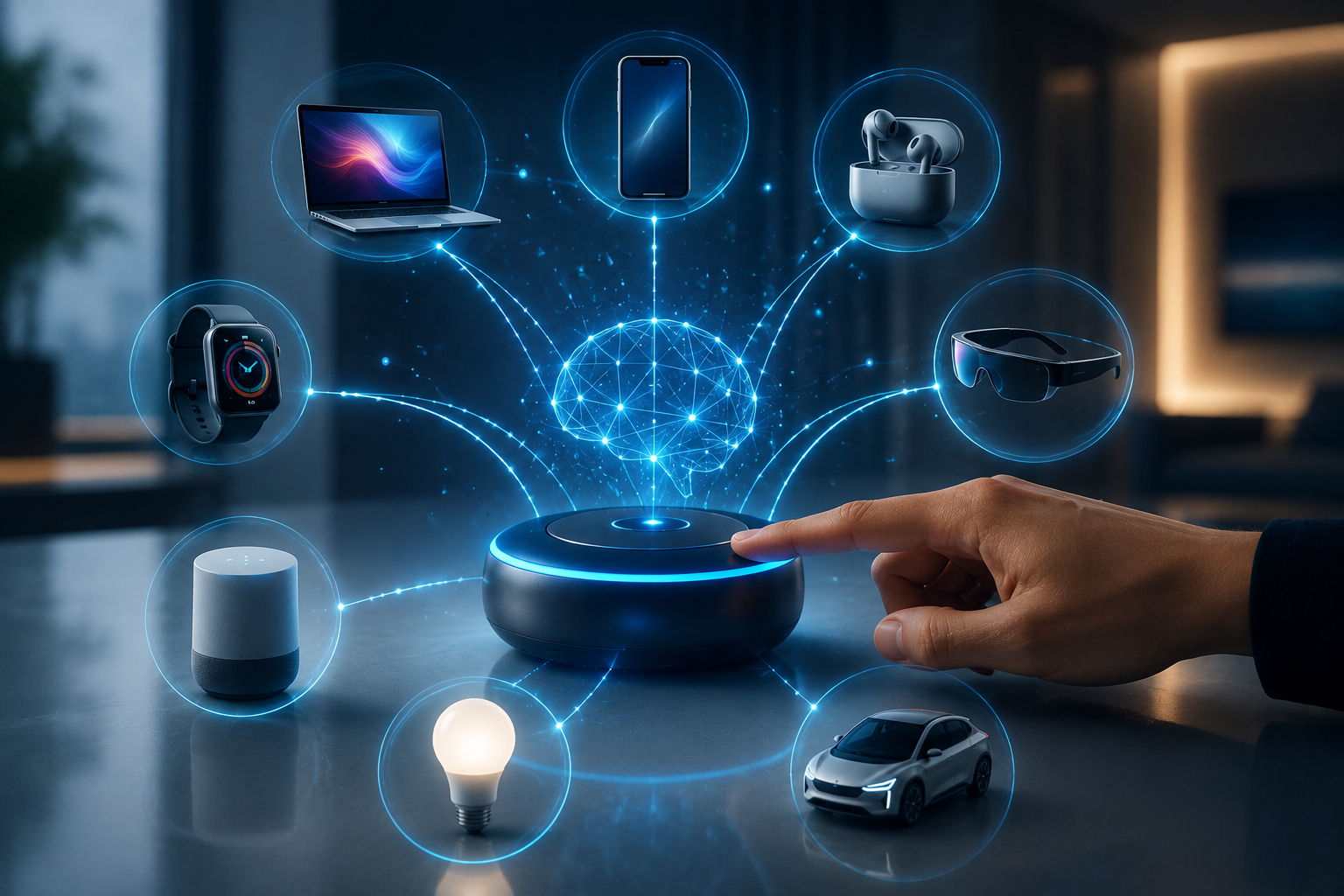
For the last decade, “wearable tech” has meant one thing: a screen on your wrist that counts steps, tracks sleep, and buzzes when you get a text. But as AI shifts from something you chat with to something that actually does things on your behalf—writing code, managing tasks, running errands through connected apps—a new category of hardware is quietly emerging. Call it the AI agent controller: a physical device built not to show you information, but to let you direct a fleet of autonomous AI agents working for you in real time.
This isn’t a hypothetical trend. It just became very real.
The Proof of Concept Just Shipped
On July 15, 2026, OpenAI released its first piece of branded hardware. Notably, it wasn’t the long-rumored screenless smart speaker being designed with former Apple design chief Jony Ive. It was something much smaller, much stranger, and arguably more telling about where AI hardware is actually headed: a $230 desktop macro pad called Codex Micro, built in partnership with boutique keyboard maker Work Louder.
Codex Micro isn’t a keyboard for typing. It’s a command surface for managing Codex, OpenAI’s AI coding agent. The device packs 13 mechanical switches, a rotary dial, a joystick, and six illuminated keys that display live status for running coding agents—whether a task is in progress, complete, waiting on feedback, or has hit an error. The rotary dial adjusts how much “reasoning” an agent applies to a task. The joystick navigates between agent workflows like reviewing a pull request or debugging code. A dedicated shortcut triggers push-to-talk voice prompts.
In other words: instead of tabbing between browser windows and typing instructions to an AI, you glance at a blinking light and tap a button. That’s the entire premise of an agent controller.
Why This Category Makes Sense
A smartwatch exists because you’re the one doing things—walking, sleeping, receiving calls—and the device reports on you. An AI agent controller exists for the opposite reason: the agent is doing things, often several agents at once, and you need a fast, low-friction way to monitor, direct, and course-correct them without breaking your flow to open an app.
That distinction matters more than it sounds. As AI systems move from single-turn chat to multi-agent, multi-hour autonomous work, a few real problems emerge that a screen-based interface doesn’t solve well:
- Status at a glance. When you’re running several agents simultaneously, constantly checking a dashboard is its own form of friction. A blinking light does the job faster than a browser tab.
- Low-friction intervention. Approving, rejecting, or redirecting an agent mid-task benefits from a single tactile action rather than navigating menus.
- Reduced context-switching. Developers using Codex Micro can stay inside their code editor and still track agent progress, rather than alt-tabbing to a chat window.
- Adjustable autonomy. The reasoning dial on Codex Micro hints at a new kind of control: not just “on or off,” but a live throttle on how independently an agent operates.
None of this maps neatly onto the smartwatch model, which was built to report data about a human. Agent controllers are built to manage delegated work.
This Is Part of a Bigger Pattern
Codex Micro is a niche, developer-focused device—by OpenAI’s own framing, closer to a “command palette you can touch” than a mainstream gadget. But it’s arriving in the middle of a much broader hardware scramble, and its existence tells you something about where the industry believes this is heading.
It comes just weeks after OpenAI acquired Jony Ive’s hardware startup, io, and began developing what’s reportedly a screenless, camera-equipped AI companion device for the home—a project now tangled in an Apple lawsuit alleging trade secret misappropriation. Analyst reporting has also pointed to a further-out concept: an “AI agent phone,” designed less around a grid of apps and more around a system-level agent capable of completing tasks on the user’s behalf, rather than requiring the user to tap through individual apps. Microsoft has reportedly teased its own AI hardware platform. And a wave of AI wearables—pendants, pins, wristbands—have already tried and, in several high-profile cases, failed to find their footing as standalone AI companions.
What ties all of these together isn’t form factor. It’s function. Each is an attempt to answer the same question: once AI can act autonomously, what’s the fastest, lowest-friction way for a human to stay in the loop?
The Skeptic’s Case
It’s worth being honest about the pushback here too. Some coverage of Codex Micro has framed it less as a breakthrough and more as niche merchandise—a “power-user accessory” for people who already live inside multi-agent coding sessions, not a mainstream necessity. There’s a real tension worth naming: AI coding tools are largely designed to reduce the number of manual actions between an idea and working software. Adding a physical board of buttons arguably pulls in the opposite direction, reintroducing friction that voice and natural language were supposed to eliminate.
That tension might be the honest state of this category right now. Agent controllers may end up being less a mass-market replacement for the smartwatch and more a specialized tool for a specific kind of “orchestrator” user—the person managing a small team of AI agents the way a manager oversees direct reports, not the person casually asking an assistant for the weather.
Why It’s Still Worth Watching
Even a niche launch can be a leading indicator. A dedicated Copilot key showed up on Windows keyboards back in early 2024 as a single button to summon an AI chat. Two years later, that single button has evolved into an entire physical control surface for directing autonomous agents. That trajectory—from a shortcut to a control panel—is exactly the kind of shift worth paying attention to, because it suggests the interface challenge of the agent era isn’t “how do I talk to AI,” which voice and chat already solved. It’s “how do I supervise several AI agents at once without losing my mind.”
If that framing holds, the smartwatch’s successor as the defining AI gadget of this decade might not look like a smartwatch at all. It might look more like a mixing board: dials, lights, and tactile controls built for orchestration rather than observation.
Conclusion
The smartwatch made sense in an era when AI was something you consulted. The agent controller makes sense in an era when AI is something you delegate to—and delegation, unlike observation, demands a different kind of interface. OpenAI’s Codex Micro is small, niche, and aimed squarely at developers for now. But as autonomous agents spread beyond coding into scheduling, shopping, research, and more, don’t be surprised if the next wave of “must-have” AI hardware looks less like a screen on your wrist and more like a control panel on your desk.






Leave a Reply