


Anyone who has switched between AI models — or between languages while talking to the same one — has probably noticed the tone shifts a little. A new research report from Anthropic, published this week, puts real data behind that impression. After analyzing more than 300,000 real conversations, the company’s researchers found that Claude consistently expresses different values depending on both the specific model being used and the language the conversation happens in.
This isn’t a claim that Claude “has” a personality in any human sense — Anthropic is explicit that the research doesn’t imply Claude holds values the way a person does. What it does show is that Claude’s behavior, measured systematically across hundreds of thousands of conversations, leans differently toward warmth or rigor, brevity or depth, depending on factors most users never think about. Here’s what the study actually measured, what it found, and why it matters.
Table of Contents
- How Anthropic Measured Claude’s “Values”
- The Four Axes That Define Claude’s Behavior
- How Value Profiles Differ Across Claude Models
- How Claude’s Behavior Shifts by Language
- Why This Happens — and Why Anthropic Doesn’t Fully Know Yet
- What This Means for Anyone Using Claude
- Conclusion
- Sources
How Anthropic Measured Claude’s “Values”
The study builds on earlier Anthropic research that identified more than 3,000 distinct values expressed across Claude conversations — everything from honesty to encouragement to risk-aversion. A list that large is difficult to draw conclusions from, so researchers first condensed those thousands of values down into 339 higher-level categories, then used a privacy-preserving analysis tool to examine 309,815 anonymized conversations sampled evenly across three models — Sonnet 4.6, Opus 4.6, and Opus 4.7 — and the 20 most common languages used on Claude.ai.
Crucially, the researchers only looked at subjective tasks: conversations where someone asked for advice, feedback, or an opinion rather than a simple factual answer. They also controlled for the topic and content of each conversation and for values the user themselves expressed, specifically to isolate differences coming from Claude’s own responses rather than from what people happened to be asking about in different languages.
The Four Axes That Define Claude’s Behavior {#the-four-axes-that-define-claudes-behavior}
Rather than tracking thousands of individual values separately, the researchers used a statistical technique to compress them into four broad axes — number lines running between two opposing groups of related values. Each conversation lands somewhere along each axis based on which values Claude expressed more of:
- Deference vs. Caution — whether Claude leans toward accommodating what the user wants, or toward guarding against possible risk and flagging concerns unprompted.
- Warmth vs. Rigor — whether Claude emphasizes positivity, encouragement, and emotional support, or accuracy, precision, and pushing back on assumptions.
- Depth vs. Brevity — whether Claude tends to explain its reasoning in detail, or sticks tightly to answering exactly what was asked.
- Candor vs. Execution — whether Claude foregrounds its own uncertainty and limitations, or produces a more polished, confident, results-focused answer.
Together, these four axes account for about 15% of the total variation in the values Claude expresses across conversations, after controlling for topic and task — a modest but statistically meaningful and structured pattern, not noise.
How Value Profiles Differ Across Claude AI Models
The clearest finding in the model comparison is that each Claude AI model’s measured value profile lines up closely with how people already describe that model’s character. Sonnet 4.6 — often described by users as warm — measurably leans toward deference, warmth, and brevity in the data. Opus 4.7 — known for rigor — leans measurably toward caution and depth, more often pushing back on false assumptions, flagging risks the user didn’t ask about, and explaining its reasoning in detail. Opus 4.6 sits in between, leaning toward rigor, deference, and brevity, and tends to stay tightly within the scope of whatever was actually asked.
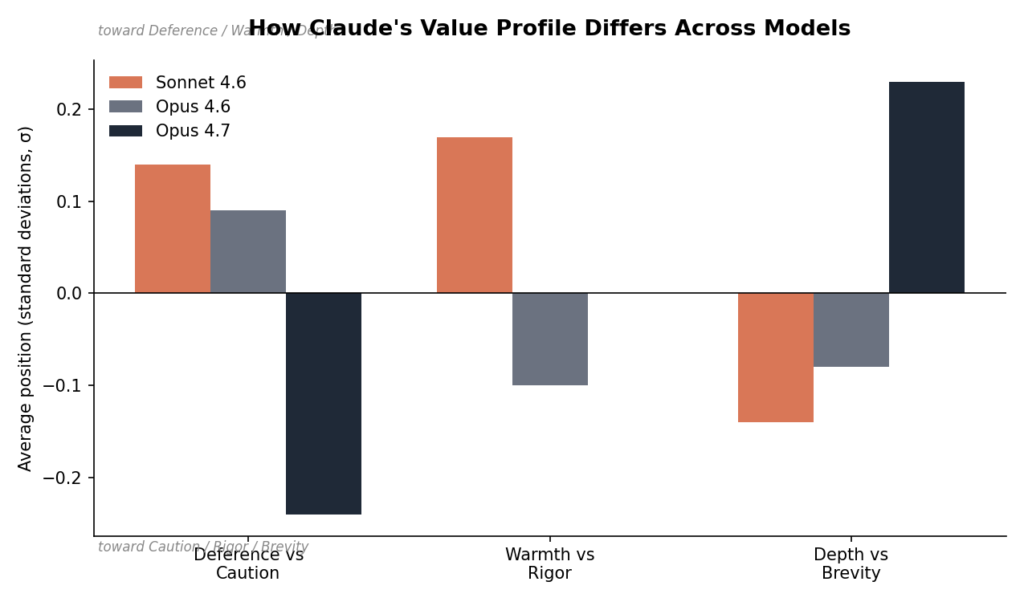
In concrete terms, the researchers describe Sonnet 4.6 as more likely to affirm a user’s ideas, use humor, and offer comfort without judgment, while Opus 4.7 is more likely to give candid critiques of a user’s work, acknowledge its own errors and limitations, and suggest next steps unprompted. The researchers note this convergence between the measured data and how people already perceive these models is itself a signal that the method is capturing something real, rather than just statistical noise.
How Claude’s Behavior Shifts by Language {#how-claudes-behavior-shifts-by-language}
The language findings are arguably the more surprising part of the report. Even when the model and the type of request stay the same, Claude’s expressed values shift meaningfully depending on what language the conversation happens in — and the size of that shift varies by axis.
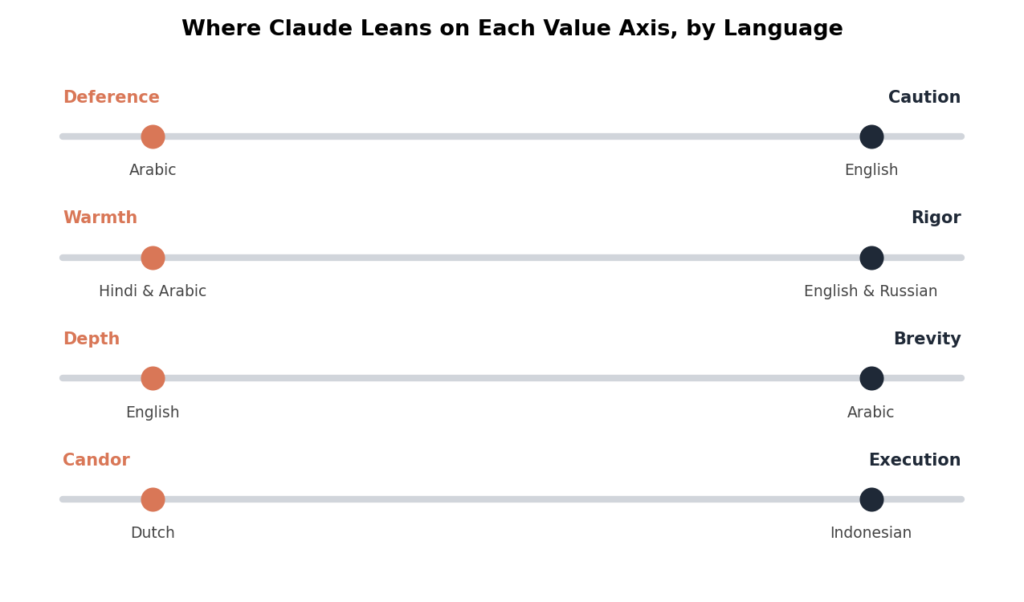
The clearest patterns:
- Deference vs. Caution: Claude expresses the most deference in Arabic and the most caution in English.
- Warmth vs. Rigor — the axis with the single largest language-driven swing: Claude expresses the most warmth in Hindi and Arabic, described as more polite, playful, and encouraging, while leaning most toward rigor in English and Russian, more often challenging assumptions, correcting details, and asking for supporting evidence.
- Depth vs. Brevity: Claude leans toward depth in English, giving more detailed explanations, while leaning toward brevity in Arabic.
- Candor vs. Execution: Claude leans toward candor in Dutch, more readily acknowledging its own uncertainty and mistakes, while leaning toward execution in Indonesian, focusing more on simply completing the request as asked.
The researchers offer a concrete example of why this matters: two people asking Claude for feedback on the same business plan — one in Hindi, one in Russian — could reasonably come away with different impressions of how good that plan actually is, purely because Claude expressed different values in how it framed the assessment, not because the underlying analysis differed.
Why This Happens — and Why Anthropic Doesn’t Fully Know Yet
Anthropic is notably candid in the report about what it doesn’t yet understand. The leading hypothesis is that training data isn’t evenly distributed across languages — some languages have far more available text than others, and the composition of that text likely differs too, with some languages potentially overrepresented in formal or professional writing that carries different values than casual writing. Both the amount and the makeup of the training data could be quietly shaping how Claude behaves once it’s actually deployed and talking to real people.
Importantly, the researchers stop short of saying this variation is a problem that needs fixing. They explicitly note that different languages carry different conversational norms to begin with, and some of what they’re measuring may simply reflect Claude appropriately adapting to those norms rather than behaving inconsistently. Untangling which portion of the variation is desirable cultural adaptation, and which portion represents a genuine gap in how well Claude serves different language communities, is described as open, ongoing work rather than a settled conclusion.
What This Means for Anyone Using Claude AI {#what-this-means-for-anyone-using-claude}
None of this means Claude AI is unreliable or inconsistent in a way that undermines its usefulness — the underlying axes were found to represent a relatively modest share of the total variation between conversations, and the differences are described as small but structured and detectable rather than dramatic. But it’s a useful thing to know if you regularly switch between models for different tasks, or use Claude in more than one language.
A few practical takeaways worth keeping in mind:
- Model choice shapes tone, not just capability. If you want more candid pushback and detailed reasoning, a model leaning toward caution and depth (like Opus 4.7 in this research) is likely to deliver that more consistently than one leaning toward warmth and brevity.
- Feedback in different languages may read differently — not because the underlying assessment changed, but because of how it’s framed. Worth keeping in mind if you’re getting a second opinion in a different language expecting a genuinely independent read.
- This is measured behavior, not a claim about consciousness. Anthropic is explicit that none of this implies Claude has intrinsic values or preferences — it’s a description of patterns in output, not an internal mental state.
Conclusion
Anthropic’s research doesn’t just confirm the vague sense that different AI models and languages produce different-feeling conversations — it puts a real, structured measurement behind exactly which values shift, by how much, and in which direction. For now, the company is treating this as the beginning of a longer investigation rather than a finished finding: they don’t yet know exactly why the training data produces these specific patterns, or how much of the variation is actually good for the people experiencing it. But the fact that it can now be measured at all — reliably, across hundreds of thousands of real conversations — is itself a meaningful step toward being able to answer that question.






Leave a Reply