

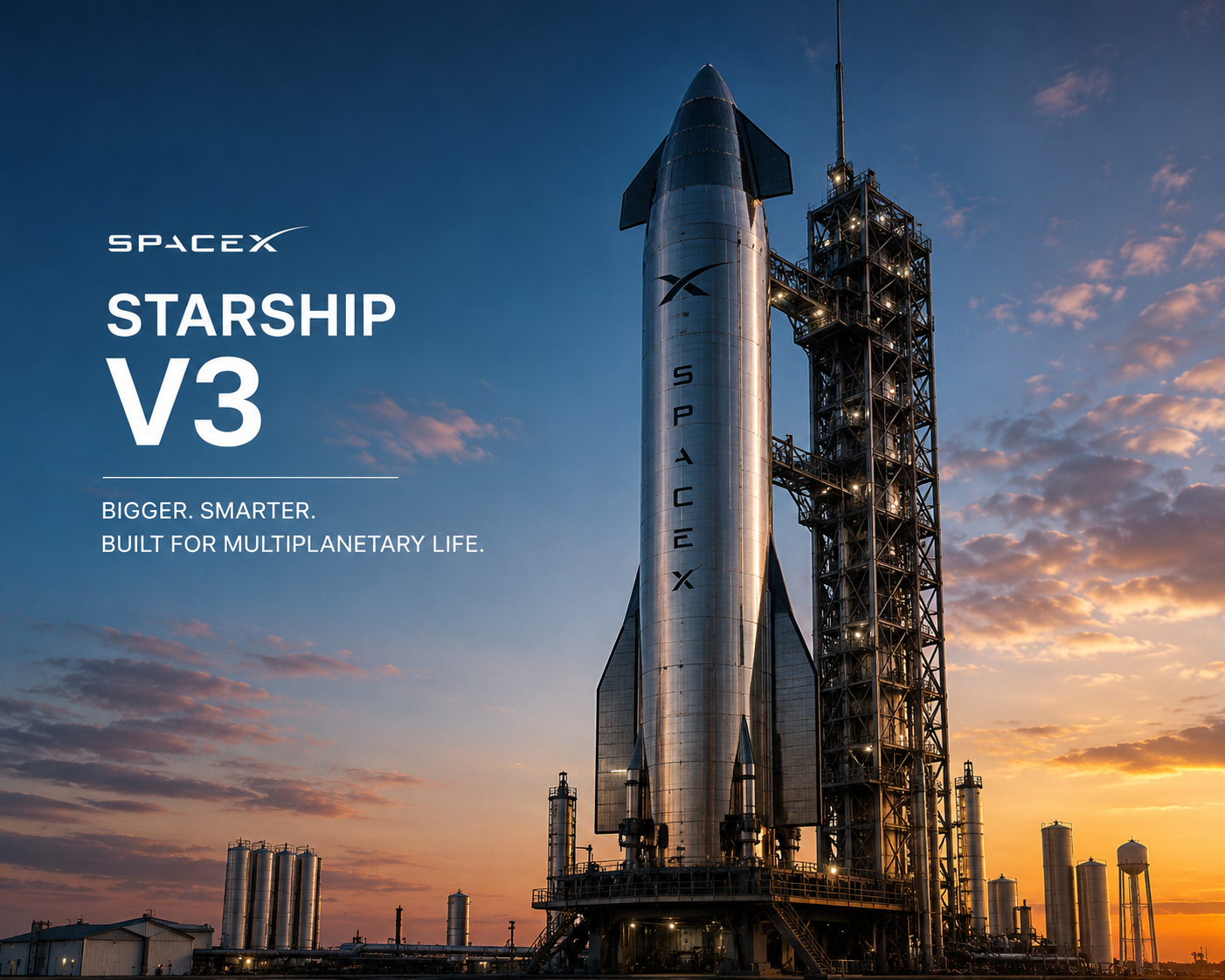
SpaceX’s second attempt to fly its upgraded Starship V3 rocket ended almost as soon as it began. On Thursday evening at Starbase in Boca Chica, Texas, the Super Heavy booster’s Raptor engines ignited on schedule — and then, within moments, the entire launch sequence shut down. Four of the booster’s engines apparently failed to fire, triggering an automatic abort just before the vehicle would have committed to flight.
The timing makes this more than just a routine scrub. It’s the first Starship test flight since SpaceX went public on June 12 in the largest IPO in history, and the company’s stock dipped in the aftermath. Here’s exactly what happened during Thursday’s countdown, what SpaceX says comes next, and why this particular mission carries more weight than a typical Starship test.
What Happened During Thursday’s Countdown
The countdown for Starship Flight 13 appeared to be proceeding normally, with only a brief hold at the T-minus one-minute mark that cleared quickly. As the countdown reached zero, the launchpad’s water deluge system activated as expected, and the Super Heavy booster’s Raptor engines began to fire. Then, abruptly, everything shut down. Broadcast telemetry graphics indicated that roughly four of the booster’s 33 Raptor engines failed to ignite as anticipated, triggering an automatic launch abort before the vehicle could lift off the pad.
Ignition was reached at approximately 5:45 p.m. CDT (6:45 p.m. EDT) at Starbase’s Pad 2. The abort happened during the ignition phase itself — after engine start had begun, but before Starship would have actually left the ground.
What Musk Has Said So Far
SpaceX founder and CEO Elon Musk confirmed the cause in a social media post roughly ten minutes after the abort: some of the engines failed to start, which triggered the automatic abort. He said the company would replace two of the affected Raptor engines before attempting to fly again, with the next launch attempt expected “hopefully in a few days” — later specified as most likely early the following week. Musk did not specify which two engines were being swapped or offer a technical explanation for why roughly four engines appear to have been affected during ignition.
Why This Flight Matters More Than a Typical Test
Starship test flights happen regularly, but Flight 13 carries unusual significance for a few overlapping reasons. It’s the first Starship launch attempt since SpaceX completed its June 12 initial public offering — the largest IPO in history, raising more than $85 billion and briefly pushing the company’s valuation into the same range as Amazon and Microsoft. SpaceX’s stock has trended downward in the month since that debut, and a high-profile launch abort is exactly the kind of visible setback that draws attention to a newly public company’s operational execution.
It’s also the second flight of the upgraded Starship V3 configuration, designed to bring the vehicle to full operational status after years of iterative testing. And it was meant to carry SpaceX’s first production-model Starlink V3 satellites into space for the first time — a mission tied directly to Starlink, which remains SpaceX’s largest revenue source and its only currently profitable business line.
What Flight 13 Was Actually Trying to Accomplish
Flight 13 was set to fly using Booster 20 and an upper stage designated Ship 40, both flying for the first time; SpaceX did not plan to attempt recovery of either stage on this mission. The flight’s core objectives mirrored those of the previous test: guide the Super Heavy booster to a controlled splashdown in the Gulf, and send the Ship stage most of the way around the world for its own controlled splashdown off the coast of Western Australia.
The mission’s headline payload was 20 of SpaceX’s next-generation Starlink V3 satellites — the first time this satellite generation would fly to space at all. These upgraded satellites are considerably more capable than the current constellation, engineered to provide roughly 1 terabit per second of downlink capacity (about 10 times the current generation) and 160 gigabits per second of uplink capacity (about 22 times current levels). The satellites weren’t headed to orbit on this flight; they were to be deployed along Ship’s suborbital trajectory, briefly link into the broader Starlink network, and then burn up on reentry roughly 20 minutes after deployment, since Starship has not yet demonstrated the ability to reach a stable Earth orbit. Six of the 20 satellites were also equipped with cameras specifically to image Ship’s heat shield during its return.
Why SpaceX Can’t Just Try Again Tomorrow
An aborted launch at the ignition stage isn’t something SpaceX can simply reset overnight. Before any engine replacement work can begin, the company has to safely drain propellant from both the Super Heavy booster and the Starship upper stage — a process involving hundreds of tonnes of liquid oxygen and liquid methane that can’t be rushed or handled carelessly. Only once that depressurization and draining process is complete can technicians actually access the affected hardware to swap out the two Raptor engines Musk said would be replaced.
That timeline lines up with Musk’s own estimate of a launch attempt early the following week rather than within a day or two.
How This Compares to Flight 12
This wasn’t Starship V3’s first outing. Flight 12, which launched on May 22, was largely successful but not without its own issues: the Super Heavy booster failed to steer itself back for its planned controlled splashdown in the Gulf of Mexico, and the Ship upper stage was unable to relight one of its Raptor engines while in space. Ship did, notably, complete its own controlled splashdown as planned on that flight.
Flight 13 was designed to build directly on those results — attempting the same booster and Ship splashdown targets, while adding the Starlink V3 deployment as a new test objective. SpaceX has described this kind of layered, incremental testing as central to its broader engineering approach, allowing the company to validate satellite deployment and communications capability even on a suborbital flight rather than waiting for a fully orbital-capable Starship.
Stock Reaction and What’s Next
SpaceX’s stock (ticker SPCX) fell more than 4% below its $135 IPO price in the aftermath of Thursday’s aborted launch — a reminder that as a newly public company, SpaceX’s operational milestones now carry direct, visible market consequences in a way they didn’t during its many years as a private company.
For now, the company’s stated plan is straightforward: replace the two affected Raptor engines, complete the propellant draining and inspection process, and attempt Flight 13 again, most likely in the early part of next week. Musk has not indicated any change to the flight’s objectives or payload as a result of the abort.
Conclusion
Thursday’s abort is a setback, but a fairly contained one by Starship’s own historical standards — an automatic safety system did exactly what it was designed to do, stopping the vehicle before a flight with known engine issues could get off the pad. The bigger story is the context around it: this is SpaceX’s first major public test of its execution since becoming a public company, tied to a satellite generation central to its most profitable business line. Whether Flight 13 launches cleanly next week will say less about Starship’s long-term prospects than it will about how much scrutiny SpaceX’s newest investors are going to apply to every step from here on out.


Leave a Reply