

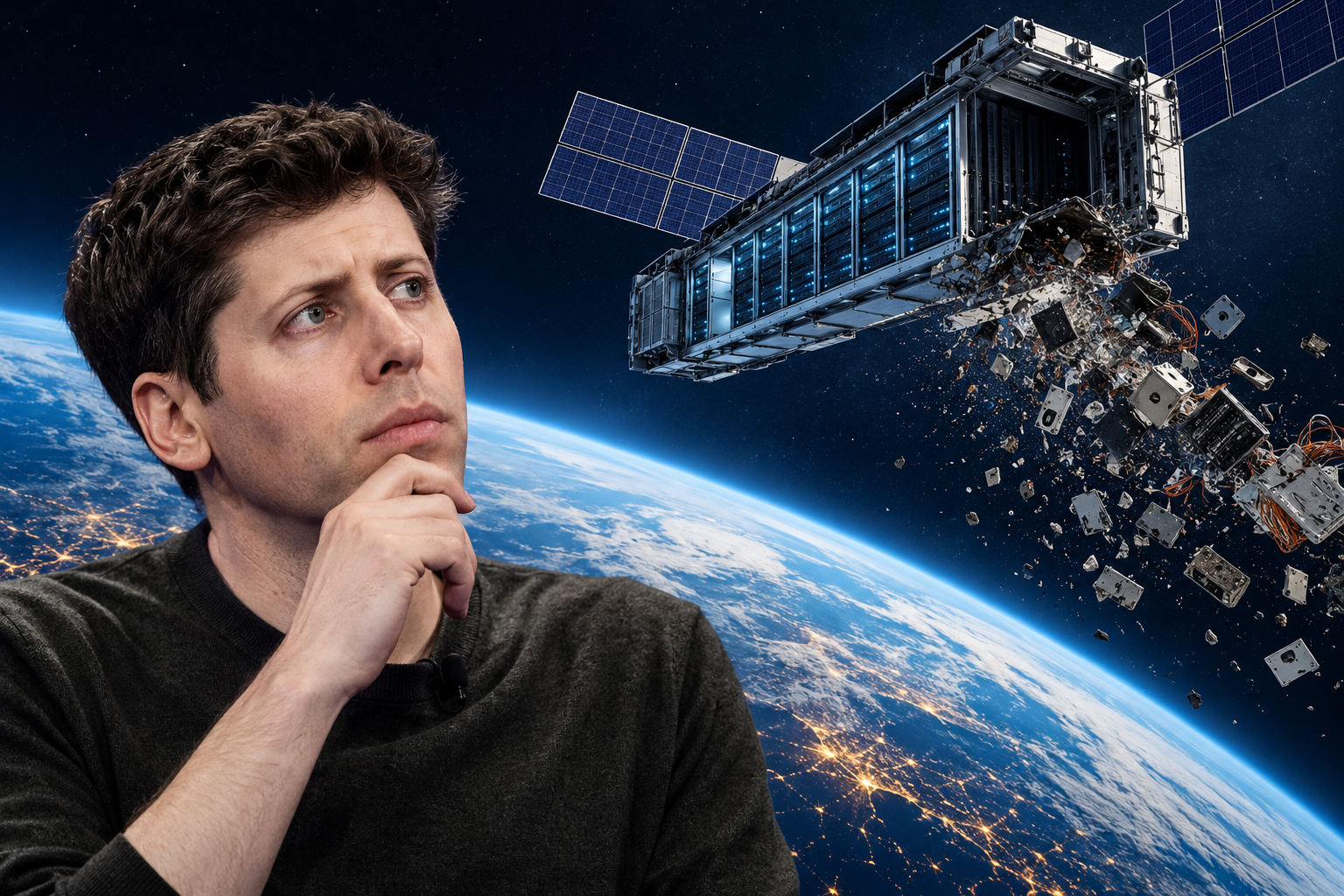
Sam Altman and Elon Musk are, once again, airing their rivalry in public — and this time, the flashpoint is space-based data centers. Over the weekend of July 11-12, 2026, the two exchanged pointed jabs on X, reigniting a long-running feud that stretches back to their falling out over OpenAI’s direction. But beneath the insults, Altman raised a question that a growing number of experts have already quietly answered: are orbital data centers actually close to becoming a real business?
How the Latest Round Started
The exchange followed news that Apple had sued OpenAI, alleging that the company and two former Apple employees stole trade secrets to help build up OpenAI’s hardware business — a claim OpenAI has denied, telling reporters it has no interest in competitors’ confidential information. Musk seized on the moment, calling Altman a “scammer” in a post on X.
Altman fired back by turning the conversation toward Musk’s own business ambitions, telling Musk he was the one “selling public market investors on short-term space datacenters.” Setting aside the colorful language, Altman’s underlying point lines up with what a large number of subject-matter experts — including entrepreneurs at rival space-compute startups and researchers inside Google’s own orbital computing efforts — have concluded: space data centers are not going to be a serious business anytime soon.
Why This Matters for SpaceX’s Valuation
This isn’t just an online spat between two billionaires — there’s real money riding on the answer. SpaceX’s plans to launch a fleet of orbital data centers to handle AI inference tasks have become a central pillar behind the company’s roughly $2 trillion valuation. Bullish analysts argue that the compute power could eventually fuel SpaceX’s own AI models or function as an “orbital neocloud,” offering advantages that don’t exist anywhere else in the current AI boom.
Musk has pushed an aggressive timeline for that vision, responding to Altman’s criticism by saying SpaceX would “start flying them next year.” But that claim runs into a complication SpaceX itself has acknowledged: during its IPO roadshow, the company conceded that Starship may not achieve full reusability in the near term, meaning it will likely need to discard each rocket’s second stage on every launch. That’s a significant problem for the economics of space data centers, since throwing away hardware on every flight makes the cost math far harder to close.
There’s little doubt SpaceX could launch a single satellite equipped for high-speed data processing next year. The much tougher question is when the company could manufacture and launch that hardware at the kind of scale needed to make orbital compute commercially meaningful — and most estimates put that milestone well into the 2030s.
Altman Has Been Saying This for Months
This weekend’s exchange wasn’t the first time Altman has dismissed the near-term viability of space data centers. In a February 2026 press conference hosted by The Indian Express, Altman called the idea “ridiculous” under current technology and economics, pointing to the cost of launching mass into orbit relative to the cost of generating power on Earth — before even factoring in the challenge of repairing a broken GPU in space. He noted that GPUs still fail at meaningful rates even in controlled data centers on the ground, let alone in orbit.
Altman has also said publicly that he doesn’t expect orbital compute to provide meaningful capacity for OpenAI within the next two, five, or even ten years. His skepticism doesn’t rule out the idea entirely — he’s acknowledged that space-based infrastructure will likely make sense “someday” — but he’s been consistent in saying that “someday” isn’t this decade.
The Physics Problem Nobody’s Solved Yet
Beyond launch costs, experts point to a more fundamental engineering issue: heat. AI GPUs generate enormous amounts of heat, and on Earth that heat can be managed through radiation, conduction, and convection. In the vacuum of space, only radiation is available as a cooling mechanism. The International Space Station already relies on a complex liquid ammonia cooling system just to manage heat from its solar panels and equipment — and a high-power orbital data center running dense AI workloads would need an even more elaborate setup to avoid literally cooking its own hardware.
Radiation exposure adds another layer of difficulty. Modern AI chips aren’t built to withstand the radiation levels found in orbit, and radiation-hardened semiconductor designs lag well behind the advanced fabrication processes that current AI workloads require. That combination — heat, radiation, and the near-impossibility of physically repairing hardware once it’s in orbit — is a big part of why so many experts remain skeptical, regardless of how promising the concept sounds on a slide deck.
Not Everyone Agrees on the Timeline
Not every major tech leader shares Altman’s pessimism. Google CEO Sundar Pichai has predicted that orbital data centers could be viable within roughly a decade, and both Musk and Amazon’s Jeff Bezos have talked up the long-term potential of orbital facilities that could tap abundant solar power without the physical and regulatory constraints they face on Earth.
Still, critics argue that even the more optimistic timelines understate the challenge. In an essay for the Financial Times, former NASA associate director Rebekah Reed argued that treating orbital data centers as a near-term workaround for AI’s energy demands is exactly the kind of “ridiculous” framing Altman has pushed back on, adding that the environmental questions around launching and operating hardware in space compound the existing cost and engineering problems.
The Bigger Picture: A Feud With High Stakes
The space data center jab is just the latest chapter in an increasingly public rivalry. The same weekend also saw SpaceX roll out its Grok 4.5 model and OpenAI push out GPT-5.6, with Altman citing benchmark results to argue his company’s model was currently the best in the world. That back-and-forth unfolded alongside major corporate milestones for both companies: SpaceX recently completed a record-setting $75 billion IPO and agreed to acquire AI coding startup Cursor for $60 billion in stock, while OpenAI has confidentially filed for its own IPO.
In other words, the space data center jab isn’t just personal — it’s playing out against a backdrop of two companies racing each other on valuation, model performance, and now, competing claims about the future of AI infrastructure itself.
Final Thoughts
Strip away the insults, and Altman’s weekend jab lands on a genuinely important point that a lot of experts have been making quietly for a while: space data centers make for a compelling narrative and a useful driver of investor enthusiasm, but the physics and economics haven’t caught up to the pitch. Between unresolved cooling challenges, radiation-hardening gaps, and Starship’s own reusability limitations, most specialists agree that commercially meaningful orbital compute is a 2030s story at the earliest — no matter how confidently anyone predicts flying units “next year.”






Leave a Reply