


Everyone’s been watching the AI economy through the lens of venture capital and chip stocks — Nvidia’s earnings, the next mega funding round, the S&P’s tech-heavy rally. But the trend actually doing the heaviest lifting right now isn’t equity at all. It’s debt. Specifically, it’s private credit, and it has quietly become the financing engine behind the biggest infrastructure buildout in a generation.
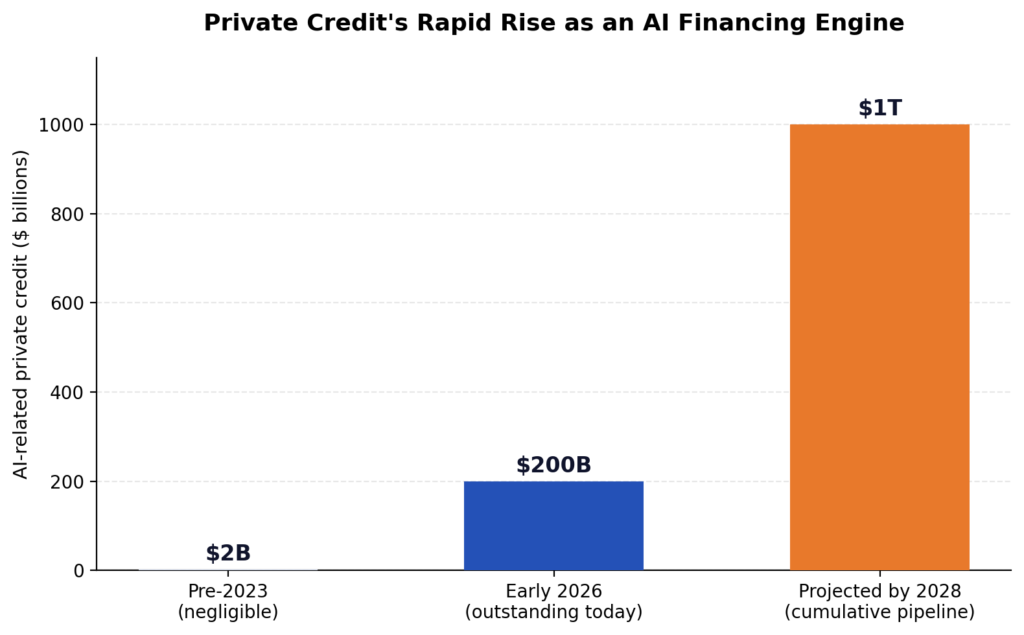
Outstanding AI-related private credit loans have already surged past $200 billion in early 2026, up from something close to zero just a few years ago. Another $800 billion is projected to flow into these deals over the next two years, creating close to a trillion-dollar pipeline of debt built specifically to fund the AI boom.
Why Equity Alone Couldn’t Keep Up
Even the world’s richest companies can’t self-fund the AI buildout forever. The top hyperscalers spent more than $800 billion in capital expenditure over the last five years, and that number is expected to exceed $3 trillion between 2026 and 2030 alone. Goldman Sachs puts the total hyperscaler bill for AI and data centers at roughly $5.3 trillion through the end of the decade.
That kind of spending, sustained at that pace, would strain even the strongest balance sheet and credit rating. So instead of paying cash or issuing more public debt directly, tech giants have started doing something new: outsourcing the financing to private lenders.
How the Trend Actually Works
The mechanism is what makes this trend genuinely new, not just bigger. Private credit funds are setting up structured special purpose vehicles, or SPVs, that own and finance data center projects on a hyperscaler’s behalf. The hyperscaler gets the compute capacity it needs; the debt used to build it sits with the private fund, off the tech company’s own balance sheet.
Meta’s arrangement with Blue Owl Capital is the clearest example so far. The two formed a roughly $27 billion joint venture called Hyperion to build data center capacity, with Blue Owl-managed funds owning 80% and Meta holding the remaining 20%. Blue Owl, in turn, funded part of its stake by selling debt to other institutional investors, including PIMCO. The capital ultimately comes from many different pockets, but the data center gets built, and Meta’s own credit rating stays largely untouched.
The firms leading this shift: Blue Owl Capital, Blackstone, Apollo, PIMCO and BlackRock have emerged as the dominant lenders behind the AI data center buildout, originating the bulk of this new private debt through both SPV structures and direct lending to data center developers.
The Numbers Behind the Shift
| Metric | Figure |
|---|---|
| AI-related private credit outstanding (early 2026) | Over $200 billion |
| Projected additional private credit financing (next 2 years) | $800 billion |
| Data center spending moved off hyperscaler balance sheets (under 18 months) | Over $120 billion |
| Global AI-related debt issuance projected for 2026 | $570 billion |
| Infrastructure funds raised in the prior year | A record $221 billion |
| Hyperscaler capital expenditure forecast, 2026–2030 | More than $3 trillion |
Traditional public bond markets are feeling the strain too. Hyperscalers issued roughly $121 billion in corporate bonds in 2025 alone, more than four times the five-year average, with AI-related investment accounting for close to 30% of net investment-grade issuance in the U.S. that year. Total data center debt issuance nearly doubled to $182 billion. As those numbers climb, some analysts warn that liquid credit markets are approaching saturation and issuer concentration limits — which is exactly why private markets are being asked to absorb more of the load.
Why This Trend Is Reaching Ordinary Investors
What makes this shift especially worth watching is where the money is coming from. Private credit used to be the province of institutional investors and pension funds. That’s changing. Firms are increasingly packaging AI infrastructure debt into products that flow into mutual funds and retirement accounts, meaning exposure to the AI buildout is showing up in ordinary portfolios — often without investors realizing it.
Life insurers, too, are becoming major buyers of this debt, using long-dated AI infrastructure bonds to match their annuity liabilities — turning the AI buildout into an insurance balance-sheet story as much as a stock-market one.
The Risk Side of the Ledger
This trend isn’t without warning signs. Nearly half of fund managers surveyed by Bank of America now name AI data center debt the top systemic credit risk for 2026. Bond investors have started pushing back too, with softening demand and declining coverage ratios on hyperscaler debt suggesting the market may soon require higher yields to keep lending at this pace.
The structural concern is transparency. Much of this financing now sits in off-balance-sheet vehicles that don’t show up cleanly on any single company’s public filings, making it harder for outside investors to see who actually bears the risk if AI returns disappoint or a newer generation of chips makes today’s hardware obsolete faster than expected. Add in shorter technology cycles, regional power bottlenecks, and heavy tenant concentration among a handful of hyperscalers, and the risk profile looks meaningfully different from the traditional infrastructure debt — utilities, railroads, toll roads — that private credit investors are used to underwriting.
What to Watch Next
- Whether infrastructure funds keep growing at this pace. Assets in this space could reach $3 trillion by 2030 if current fundraising momentum holds, but a slowdown would tighten the financing pipeline fast.
- How much of this debt reaches retail portfolios. The more AI infrastructure debt gets packaged into mutual funds and insurance products, the more ordinary investors are exposed to a sector most have never directly evaluated.
- Whether hyperscaler credit quality holds up. Investors are increasingly demanding firmly committed, transparent hyperscaler credit backing these deals rather than taking newer, less-established data center operators at face value.






Leave a Reply