

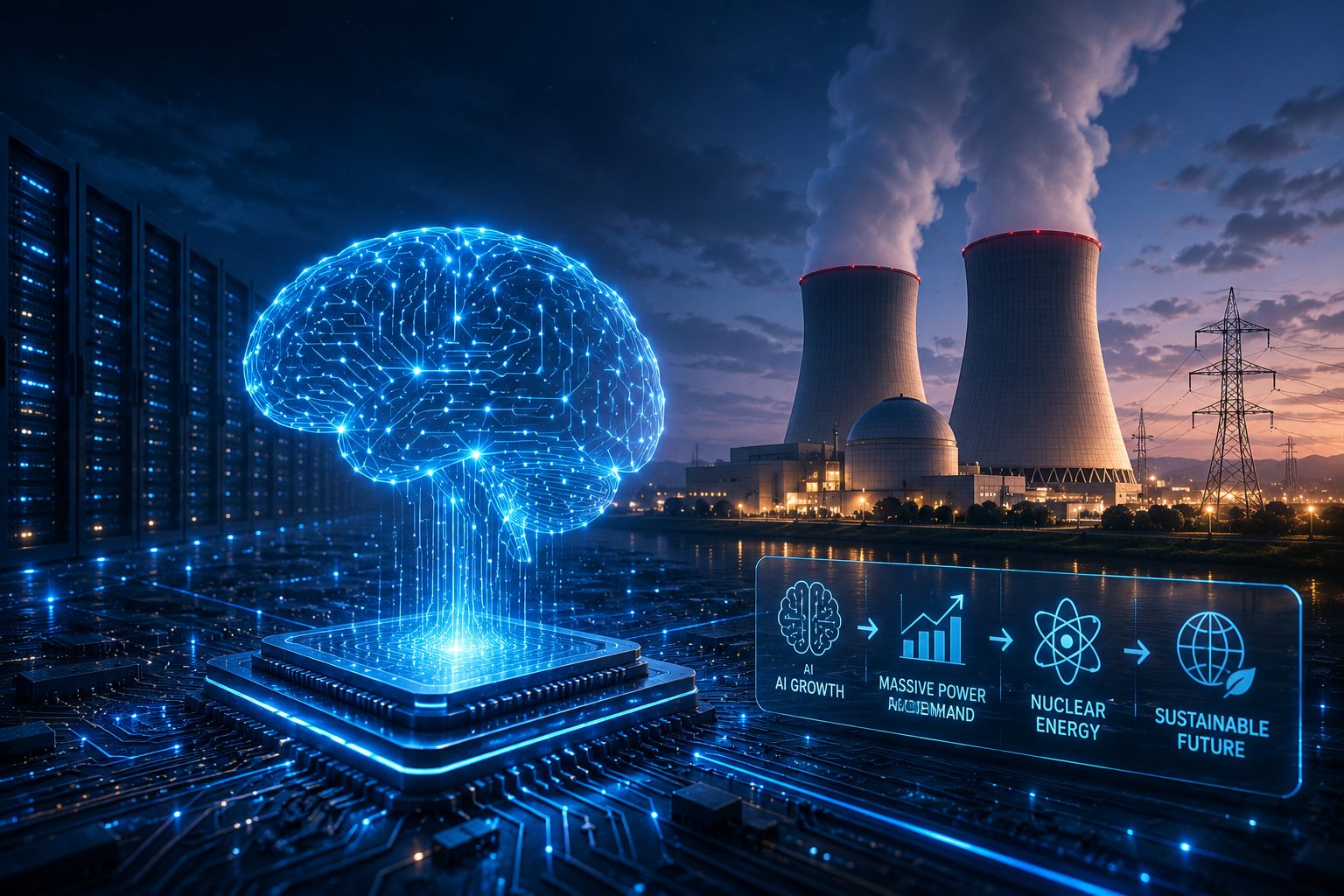
For most of the current AI boom, the conversation about bottlenecks centered on chips — who has enough GPUs, and who’s waiting for more. That conversation has shifted. Nvidia CEO Jensen Huang told podcast host Joe Rogan late last year that energy, not chips, is now the primary limit on AI growth, and that the power grid simply cannot keep pace with rising data center demand. Huang went further, predicting tech companies will be running their own small nuclear reactors near data centers within six to seven years.
That’s not a fringe prediction anymore — it’s already happening. Meta, Microsoft, Amazon, and Google have collectively committed more than $50 billion to nuclear power projects specifically to fuel AI infrastructure, and the first direct power purchase agreements between Big Tech and reactor operators are now closing. Here’s the actual scale of the numbers behind this shift, and why nuclear specifically has become the preferred answer.
The Demand Numbers Driving This
The scale of projected AI power demand is difficult to overstate. BloombergNEF forecasts that global data center power demand will roughly quadruple over the next decade, climbing from approximately 400 terawatt-hours in 2024 to more than 1,600 terawatt-hours by 2034, driven primarily by AI training and inference workloads that run continuously, around the clock. The International Energy Agency separately projects global data center energy demand could reach 945 terawatt-hours by 2030, while Goldman Sachs projects data center energy use will rise 175% by 2030 compared to 2023 levels.
Inference — the process of actually running a trained AI model to answer real user requests, as opposed to training it in the first place — is expected to be a particularly significant driver of that growth, with power demand for inference tasks projected to increase at a 122% compound annual growth rate through 2028 as providers work to serve billions of daily requests.
Why Nuclear Specifically, Not Just More Renewables
The core problem AI data centers present isn’t just total electricity volume — it’s the type of power required. Data centers running AI workloads need constant, “always-on” baseload electricity, not the variable output that solar and wind provide depending on weather and time of day. As Devon Swezey, a senior manager in global energy and climate at Google, has put it: wind, solar, and batteries remain critical for decarbonizing electricity consumption, but tech companies also need firm, dispatchable, carbon-free power to do that cost-effectively — and nuclear is one of the few sources that checks both the “carbon-free” and “always-on” boxes simultaneously.
Goldman Sachs Research has noted that thermal power sources — nuclear reactors and combined-cycle natural gas plants among them — can run continuously without the hourly intermittency challenges that renewable sources face, which is precisely why big tech companies are pursuing a mix of power sources rather than betting entirely on any single one, with nuclear playing an increasingly central role in that mix.
What Big Tech Has Actually Signed
The dollar figures and gigawatt commitments involved are already substantial. In the US alone, big tech companies signed new contracts for more than 10 gigawatts of possible new nuclear capacity in a single recent year, according to Goldman Sachs Research, which sees potential for three new plants to come online by 2030.
Individual company commitments illustrate the scale:
- Meta announced agreements in January 2026 with Vistra, TerraPower, Oklo, and Constellation Energy to secure up to 6.6 gigawatts of nuclear power capacity — enough, by some estimates, to power roughly 5 million homes, making Meta one of the largest corporate purchasers of nuclear energy in American history. The deal includes funding for two TerraPower units capable of providing 690 megawatts and a 1.2-gigawatt nuclear technology campus with Oklo in Pike County, Ohio.
- Alphabet/Google has ordered 500 megawatts of capacity from Kairos Power, with the first unit planned to come online in 2030, and has also been examining advanced nuclear technologies including small modular reactors as part of its broader clean-energy strategy.
- Meta, Microsoft, Amazon, and Google combined had committed over $50 billion collectively to nuclear power projects for AI data centers as of early 2026.
The Reactor Restart Nobody Expected
Perhaps the most symbolically striking development in this shift is Constellation Energy’s plan to restart the Three Mile Island nuclear plant specifically to power Microsoft’s data centers, expected to come back online in 2027. Three Mile Island remains one of the most recognizable names in American nuclear power history, and its planned restart specifically to serve AI infrastructure demand is a clear signal of how seriously utilities are now treating this demand shock.
Constellation itself — already the largest nuclear operator in the US, running 21 reactors across 12 sites — posted $25.5 billion in 2025 revenue, up 8.3% year-over-year, with $2.32 billion in net income. The company has issued 2026 adjusted operating earnings guidance of $11.00 to $12.00 per share and raised its share-buyback authorization to $5 billion while earmarking $3.9 billion specifically for growth capital expenditures — a sign that established nuclear operators, not just newer reactor startups, are positioning to benefit directly from this demand.
Small Modular Reactors: The Real Bet
While large-scale traditional reactors and restarts like Three Mile Island address near-term demand, much of the longer-term optimism in this space centers on small modular reactors (SMRs) and microreactors — smaller, factory-buildable nuclear units that can be sited closer to where power is actually needed. SMR development attracted $1.3 billion in equity funding in a recent year, alongside Department of Energy-backed deployment programs, and the first North American SMR has already received final regulatory approval.
Companies including X-energy, Kairos Power, Oklo, and TerraPower are leading this race, with big tech providing both capital and guaranteed offtake agreements — essentially pre-committing to buy the power before the reactors are even built, which gives these companies the financial certainty needed to actually build them. Some industry analysts project that as much as one-third of data centers could be fully off-grid by 2030, relying on direct colocation with nuclear plants and dedicated transmission lines rather than the shared public grid.
Government Policy Is Now a Tailwind
US policy has moved to actively support this shift rather than simply allowing it. The Trump administration signed four executive orders targeting accelerated nuclear deployment, setting a goal of quadrupling US nuclear output by 2050. The orders call for expanded uranium mining and enrichment capacity to strengthen the domestic supply chain, faster testing of advanced reactor designs including SMRs, and streamlined regulatory approval processes.
The Department of Energy has separately announced a program specifically designed to streamline approvals and unlock private funding for advanced reactors and SMRs, with a stated goal of getting at least three reactors to achieve criticality by July 4, 2026.
The Honest Timeline Problem
Despite the scale of investment and policy support, there’s a real gap between the demand curve and the construction timeline that’s worth being direct about. AI data centers are projected to quadruple power demand to roughly 1,600 terawatt-hours by 2034, but construction timelines for genuinely new nuclear facilities — as opposed to restarts of existing plants — generally won’t deliver meaningful new supply until the late 2020s or early 2030s at the earliest. That mismatch is part of why investor enthusiasm for newer, pure-play nuclear companies cooled somewhat compared to its peak, even as interest in established operators like Constellation — already generating power today rather than promising to in the future — has remained comparatively strong.
Energy experts covering the SMR sector specifically describe the technology as having moved from a long-range aspiration to a near-term candidate for firm, carbon-free power, but caution that reaching real scale requires an unusually clean execution track record: on-time and on-budget first deployments, rigorous and timely licensing, and reliable performance once reactors actually come online — none of which is guaranteed just because the demand and the capital are both clearly there.
Conclusion
The numbers behind AI‘s power problem are large enough that they’re reshaping how some of the world’s biggest technology companies think about infrastructure altogether — treating energy supply, not just chip supply, as a defining constraint on how fast AI can actually scale. Nuclear has emerged as the leading answer specifically because it offers the one thing renewables alone can’t: constant, carbon-free baseload power precisely when AI workloads need it. Whether the reactor construction and SMR deployment timelines can actually keep pace with the demand curve remains the open question — and likely the one that determines how much of this current enthusiasm translates into actual megawatts on the grid by the early 2030s.






Leave a Reply