


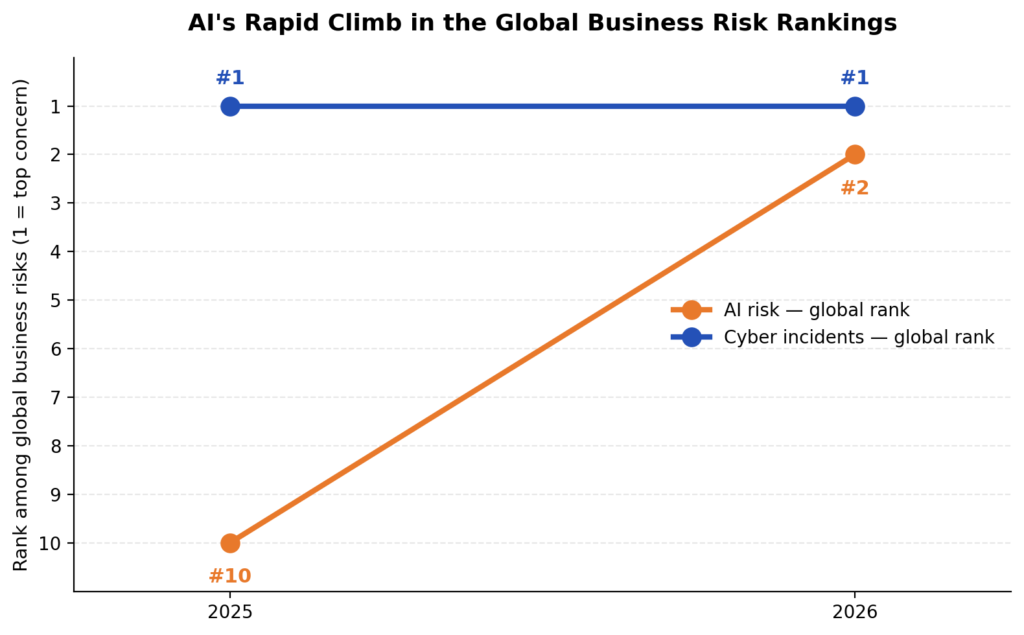
AI has climbed from the #10 concern on the global business risk radar to #2 in a single year — a faster rise than almost any other risk category has ever made. That jump isn’t hype. It reflects a real, uncomfortable truth: businesses are adopting AI faster than they’re securing it, and the gap between the two is quietly becoming one of the biggest liabilities on the balance sheet.
Most of the conversation around AI and cybersecurity focuses on the obvious stuff — smarter phishing emails, deepfake scams, faster malware. Those are real. But the risks that do the most damage are usually the ones nobody’s watching: the AI tool an employee signed up for without telling IT, the customer data pasted into a chatbot to save ten minutes, the AI agent connected to a system it was never meant to touch.
Why This Boom Is Different From Past Tech Shifts
Every major wave of enterprise technology has created new security headaches — cloud, mobile, remote work. AI is different for one simple reason: it lowers the cost and skill required to attack, at the same time it lowers the cost and skill required to adopt. That combination means both sides of the fight are accelerating together, and most organizations’ security processes were never built to move that fast.
Security researchers have already flagged that AI-driven attacks are evolving faster than traditional defenses can respond, and some analysts expect AI-powered techniques to be involved in more than half of all cyberattacks in the near future. Ransomware, meanwhile, remains the single largest cyber risk businesses face for a fifth consecutive year — except now it’s frequently AI-assisted, making it faster to execute and harder to detect.
The Hidden Risks Businesses Keep Underestimating
1. Shadow AI and Unmanaged Tool Sprawl
Employees are signing up for AI tools — writing assistants, coding copilots, meeting summarizers — without security review, often on the same devices used to access sensitive systems. Every unreviewed tool is effectively a new, unmonitored door into the business.
2. Data Leakage Through Everyday AI Use
Employees regularly paste customer records, financial data, source code, and internal documents into public AI platforms to save time on summarizing or drafting. Because many of these tools process data on external, cloud-based infrastructure, that information can leave the organization’s control the moment it’s typed in — often with no record that it ever happened.
3. Prompt Injection Attacks
As businesses connect AI systems to internal tools and data, attackers have started hiding malicious instructions inside content the AI is asked to process — a document, an email, a webpage — to manipulate how the system behaves. It’s a new class of attack that most traditional security tools were never designed to catch.
4. AI-Powered Social Engineering at Scale
Generative AI has made it possible to industrialize phishing and deepfake scams — personalized, well-written, and voice- or video-based attacks that used to require real skill can now be produced in bulk by attackers with little technical background.
5. Faster, Cheaper Multistep Attacks
AI and automation have sharply reduced the cost of running sophisticated, multistep intrusions — the kind that involve lateral movement across a network and multiple exploits chained together. That’s pulling smaller organizations, once considered too low-value to target, into attackers’ crosshairs.
6. Third-Party and Supply Chain Exposure
AI risk doesn’t stop at your own organization’s walls. Businesses are increasingly dependent on third-party AI vendors and connected systems, meaning a single compromised node in a supply chain, logistics network, or communication platform can cascade across an entire ecosystem.
Who’s Most Exposed Right Now
| Sector | Where the exposure comes from |
|---|---|
| Financial services | AI-driven fraud, phishing and transaction manipulation that’s increasingly hard to detect in real time |
| Energy and utilities | High-value operational technology targets with cascading disruption risk |
| Small and mid-sized businesses | Limited security resources combined with falling attack costs make them newly attractive targets |
| Any business using generative AI tools | Data leakage and shadow AI risk from everyday employee use, regardless of industry |
The Cost of Getting This Wrong
The damage from an AI-driven attack rarely stops at the initial breach. Ransom demands have climbed, but the harder-to-see costs — downtime, legal exposure, and the work of rebuilding compromised systems — often end up costing more than the ransom itself. Reputational damage compounds it: customer trust that took years to build can disappear after a single incident, and it rarely comes all the way back.
Close to half of businesses still believe AI brings more benefit to their industry than risk — which is exactly why the risk side of that equation needs deliberate attention, not an assumption that it will sort itself out.
What Businesses Should Do About It
- Get visibility into shadow AI first. You can’t govern what you can’t see — start with an honest inventory of which AI tools employees are actually using.
- Set clear data-handling rules for AI tools. Employees need explicit guidance on what can and can’t be shared with external AI platforms, not just a policy buried in the handbook.
- Treat AI agents like new identities, not features. Any AI agent with access to internal systems should be governed with the same rigor as a human user account — least-privilege access, monitoring, and revocation included.
- Update incident response for AI-speed attacks. Playbooks built around human-speed threats won’t hold up against automated, multistep attacks that move in minutes.
- Extend scrutiny to vendors and partners. Ask what AI tools your suppliers and partners are running, and how exposure there could flow back into your own systems.





Leave a Reply