

Two years ago, “AI PC” was mostly a marketing label stuck on laptops that didn’t do much differently than the ones before them. That’s no longer a fair description. AI PCs have gone from a niche category to more than half of everything shipping worldwide, and the trajectory suggests they’ll simply be called “PCs” again within a few years — because there won’t be much of a non-AI alternative left to compare them to.
The Numbers Tell a Fast Story
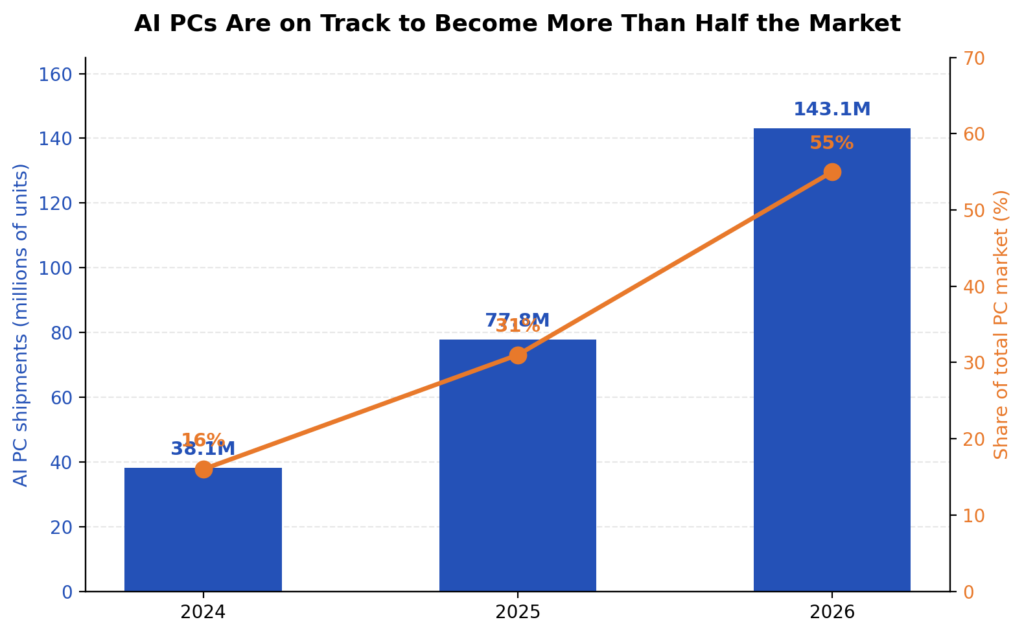
Worldwide AI PC shipments grew from 38.1 million units in 2024 to 77.8 million in 2025, and are projected to reach 143 million units in 2026. As a share of the total PC market, that’s a jump from roughly 16% to 31% to 55% in just two years. Gartner expects AI PCs to become the market standard by 2029, at which point the category label itself will likely stop being meaningful.
The market’s dollar value is scaling right alongside unit shipments. The global AI PC market was valued at roughly $109.7 billion in 2025 and is projected to reach $131.8 billion in 2026, on its way to more than $574 billion by 2034.
What Actually Makes a PC an “AI PC”
The defining hardware difference is the neural processing unit, or NPU — a dedicated chip built specifically to handle AI workloads locally, alongside the traditional CPU and GPU. That local processing lets a laptop run generative AI features, real-time transcription, image generation and machine learning tasks directly on the device, without routing every request through a cloud server. It’s the same architectural shift powering the on-device AI trend showing up across smartphones and wearables — just applied to the traditional laptop and desktop form factor.
Businesses and Consumers Are Choosing Different Paths
Not everyone is buying the same kind of AI PC, and the split matters for how the category evolves. In the business segment, x86 processors running Windows are expected to represent 71% of AI business laptops in 2025, with Arm-based chips at around 24%. Consumers are moving differently: Gartner expects Arm-based laptops to capture a larger share of the consumer market as application compatibility issues get resolved, since Arm chips tend to offer stronger battery efficiency for everyday use.
Who gets AI PCs first inside a company: Survey data shows IT departments are the clear priority for early AI PC rollout (86% of organizations), followed by marketing and operations (51% each), sales and finance (44% each), and customer service (41%). HR trails the list at 26%.
Software is catching up to the hardware shift too. Gartner expects 40% of software vendors to prioritize investment in AI capabilities built directly into PCs by the end of 2026, up from just 2% in 2024 — a sign that the applications running on these machines are starting to actually use the local AI hardware rather than treating it as unused silicon.
The Bottleneck: Memory Is Becoming the Real Constraint
The one thing standing between “AI PC adoption is surging” and “everyone gets one” is a supply problem that has nothing to do with software. Global memory chip supply is under structural pressure, driven largely by AI data centers pulling manufacturing capacity away from consumer devices. Nvidia’s AI processor imports alone recently crossed $165 billion, eclipsing the combined import value of all consumer PCs and phones. Dell, HP and Apple have all confirmed supply constraints tied to memory availability on recent earnings calls, and some analysts now expect budget-tier PCs to effectively disappear from the market as manufacturers prioritize memory allocation toward higher-margin AI-capable models.
This is not a temporary supply hiccup. AI data centers are consuming an unprecedented share of the world’s semiconductor manufacturing capacity, physically redirecting the chips that used to go into consumer devices toward hyperscale data center racks instead.
Where AI PC Adoption Is Growing Fastest
| Market | Projected AI PC CAGR, 2025–2035 |
|---|---|
| China | 57.8% |
| India | 53.5% |
| Germany | 49.2% |
| France | 44.9% |
| United Kingdom | 40.7% |
| United States | 36.4% |
What to Watch Next
- Whether memory supply keeps pace with adoption. A widening gap between demand and available memory could slow the shift toward “standard by 2029” even as consumer appetite grows.
- Whether software finally catches up to the hardware. The jump from 2% to a projected 40% of vendors investing in on-device AI capabilities is the piece that turns an NPU from unused silicon into something buyers actually notice day to day.
- How the price of entry-level PCs moves. If budget-tier models genuinely disappear as some analysts expect, “AI PC” may stop being a choice and simply become the only option left on the shelf.






Leave a Reply