

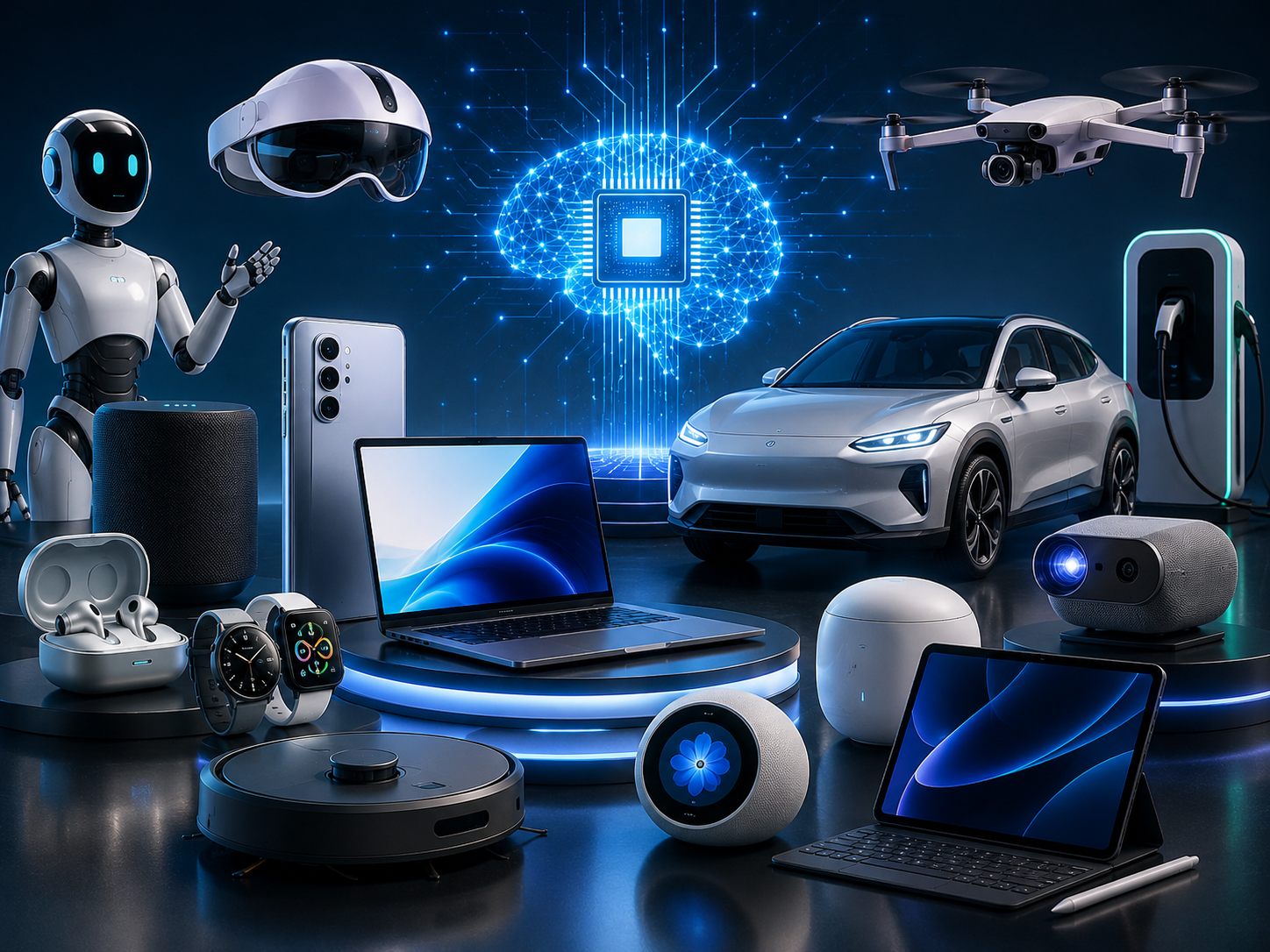
Samsung‘s crease-free OLED breakthrough has been the headline photo of every “future of phones” story this year. It’s an impressive engineering feat. It’s also not the thing actually reshaping consumer electronics in 2026. The bigger shift is happening off the screen entirely — in what’s powering the device, and increasingly, in whether there’s a screen at all.
The real story of this year’s gadget cycle is the move from devices you look at to devices that think for themselves, on your body, without needing to phone home to the cloud to do it.
From “Smart” to “Intelligent”: A Different Kind of Upgrade
At Mobile World Congress 2026, the framing that stuck was simple: devices moved from smart to intelligent. AI stopped being a feature layered onto a phone, PC or wearable and started being the foundation those devices are built around. Vendors across the show floor described a shift from standalone endpoints to orchestrators — devices designed to coordinate with each other inside a wider ecosystem rather than function as isolated products.
That shift shows up most clearly in one hardware change: neural processing units, or NPUs, doing serious AI reasoning directly on the device. Complex language processing and contextual reasoning that used to require a cloud round-trip now happen locally, with near-zero latency and no dependence on an internet connection. That’s the unglamorous engineering breakthrough making everything else in this shift possible.
The Category Actually Growing Fastest: Ambient, Screenless AI
Smart glasses are the clearest evidence of where the industry is actually placing its bets. Global AI smart glasses shipments are projected to roughly triple this year, jumping from 6 million units in 2025 to 20 million units in 2026, while revenue is expected to more than quadruple.
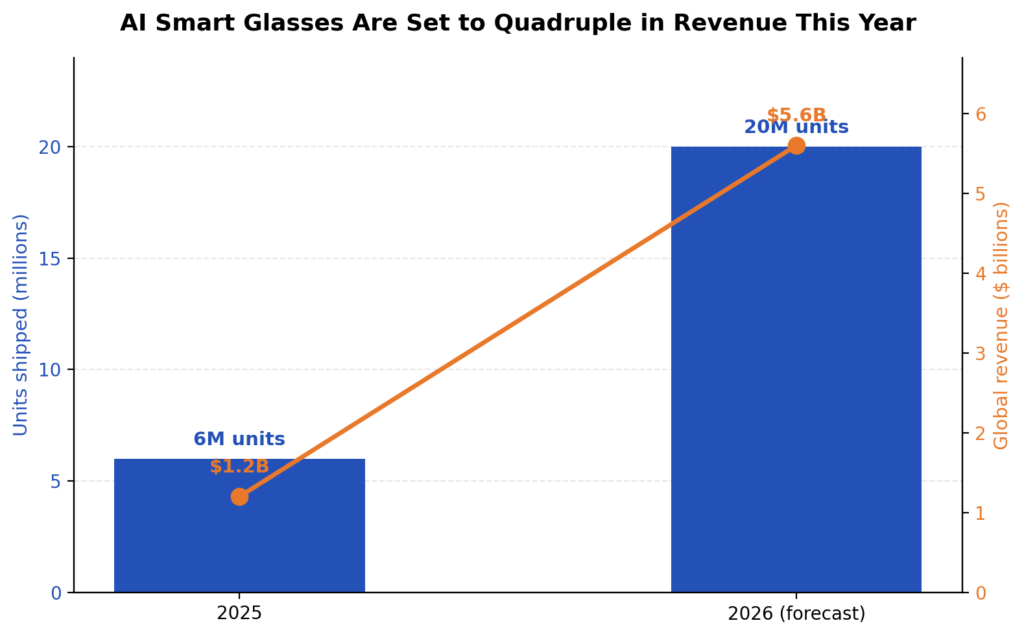
Counterpoint Research puts the broader intelligent eyewear category — VR headsets, AR glasses and display-less smart glasses combined — up 83% year-over-year in the first quarter of 2026 alone, even as VR shipments fell 17% amid an aging product cycle. Display-less smart glasses were the standout, with shipments up 210% year-over-year, followed by AR glasses at 136% growth. The audio-first, screen-free approach is winning early, not the flashier AR display version most people picture when they hear “smart glasses.”
Why this matters more than another foldable: A foldable phone is still fundamentally a phone with a different hinge. Screenless AI wearables represent an actual change in how people access information — glancing, speaking and listening instead of pulling out a device and scrolling.
It’s Not Just Glasses
The same ambient, always-available design philosophy is showing up across a wider set of devices this year:
- AI pins and rings that passively record, transcribe and summarize meetings and conversations without the user having to open an app.
- AI companion devices, including emotional-support robots and pets, designed for ongoing interaction rather than single-task utility.
- AI PCs and modular laptops, where AI capability is being built into the hardware layer itself rather than added through software updates.
- A parallel counter-trend of deliberately minimalist gadgets — e-paper readers and tactile keyboards — aimed at consumers actively trying to reduce screen time, even as the AI-powered side of the market accelerates.
Devices Are Becoming Entry Points, Not Products
Perhaps the most consequential shift isn’t a device at all — it’s a strategic one. Across major vendors, the device itself is increasingly treated as the entry point into a broader connected ecosystem rather than the product being sold. Samsung is extending AI across its entire portfolio rather than one flagship phone. Lenovo is aligning PCs and peripherals into a unified AI system. Xiaomi is emphasizing scale and integration across its whole device lineup. Competition is shifting away from individual spec sheets and toward how well a company connects devices, data and services into one seamless experience.
Competition is no longer defined solely by device specifications. It is increasingly about how effectively companies connect devices, data, and services into a seamless experience.
The Supply-Side Risk Nobody’s Foldable Headline Mentions
None of this growth is guaranteed a smooth runway. Industry executives flagged an emerging memory chip shortage as a structural risk heading into this cycle — not a minor supply hiccup, but a genuine constraint as demand for AI-capable devices accelerates faster than chip supply can keep pace. That bottleneck could shape which companies can actually ship AI hardware at scale over the next year, regardless of how compelling their product roadmaps look on paper.
What to Watch Next
- Whether display-less AI wearables keep outgrowing display-equipped ones. The early data suggests audio-first, screen-free design is winning the category, which would be a genuine surprise given how AR displays have dominated the marketing narrative.
- How the major platform players position their glasses. With Apple and Samsung both preparing entries alongside Meta and Google, 2026-2027 looks like the period when smart glasses stop being a niche category and start being a mainstream one.
- Whether the memory shortage becomes a genuine bottleneck. A supply constraint here could slow the entire AI hardware cycle regardless of consumer demand.






Leave a Reply